
Population
≈280,000 in the city; the 41-municipality Górnośląsko-Zagłębiowska Metropolia around it is roughly 2.2 million, and the wider conurbation over 2.5 million
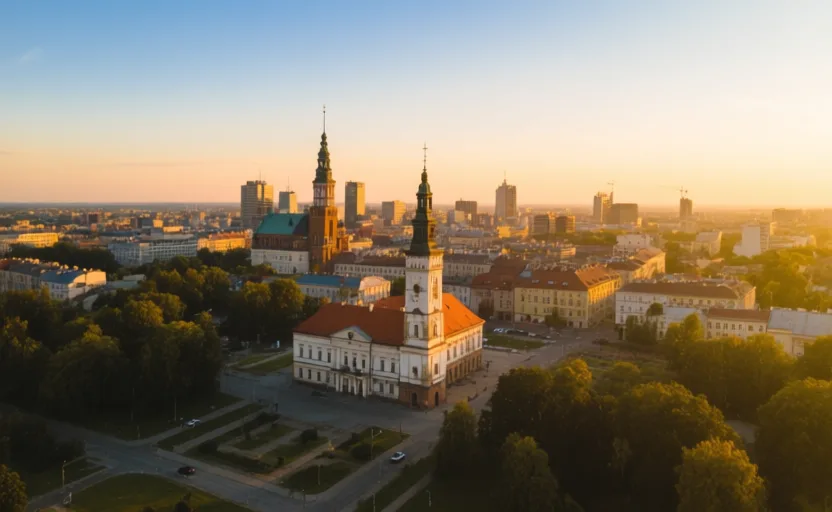 AI city illustration · Artistic impression
What people learn after moving
≈280,000 in the city; the 41-municipality Górnośląsko-Zagłębiowska Metropolia around it is roughly 2.2 million, and the wider conurbation over 2.5 million
Śląskie — residence cases are decided by the Śląski Urząd Wojewódzki in Katowice, with the foreigner information point at the Centrum Integracji Cudzoziemców, ul. Jordana 18 since January 2026
Polish, plus Silesian (ślōnskŏ gŏdka), whose recognition as a regional language was vetoed again in February 2026. English is standard in the business-services towers
Polish złoty (PLN)
AI city illustration · Artistic impressionCost of living in Katowice
Check your eligibility
Pick your passport to see entry rules and the long-stay routes we have researched.
Pick your passport to see whether you can enter Poland — and what it takes to stay.
One combined permit covers residence and work for a named employer. Since 27 April 2026 the MOS portal is the only accepted filing channel, so a login.gov.pl trusted profile is a prerequisite rather than a convenience. Śląskie is one of Poland's most populous voivodeships and its foreigners department carries a matching caseload; the ministry's own 2019–2022 figures put the average decision here at 348 days. Plan around months, not weeks.
EU and EEA licences remain valid indefinitely. A non-EU licence expires for Polish purposes six months after you establish residence and must be exchanged, with a sworn translation and — for countries outside the Vienna and Geneva road traffic conventions — a Polish theory exam. Katowice has no clean transport zone, so an older car is still legal here; the real argument against one is that the Metropolia's rail and tram network reaches 41 municipalities on a single ticket and the A4 through the conurbation does not move at 8am.
Opening an account is straightforward and Polish retail banking is genuinely excellent. Two things are worth doing deliberately: issue your profil zaufany inside the bank app, because it now gates the MOS residence filing, and open a proper business account before your first invoice if you go B2B, because only business accounts can be listed on the Ministry of Finance whitelist.
An employment contract enrols you in NFZ automatically through employer ZUS contributions. A B2B contract does not: you pay the health contribution yourself, at a rate that depends on which tax regime you elected. Public primary and emergency care works and Silesia's hospital network is unusually strong for a region this size. The local variable nobody warns you about is air: this is the worst winter air quality of any Polish metropolis, and it is a real clinical consideration for asthma, COPD and small children.
Four networks and a healthy reseller market at some of the lowest prices in the EU. Every SIM, prepaid included, must be registered against an identity document. Home fibre is widely available in the district-heated blocks and the new developments; in a familok or an unrenovated tenement, ask the building administrator what is physically in the stairwell rather than trusting a street-level coverage map.
Employment income is taxed at 12% and 32%, with a PLN 30,000 tax-free allowance and a near-total exemption for workers under 26. Much of the senior technical workforce instead invoices through a sole trader registration on the ryczałt lump-sum regime at 12% of revenue, with IP Box available at 5% on qualifying software income if the ledger is kept from day one. The local layer is municipal property tax: Katowice, like every big Polish city, adopted the 2026 statutory maximum, and the gap between the residential and business rates is where home-office registrations go wrong.
Each guide has verified costs, timelines, required documents, and the non-obvious gotchas — sourced from official government pages. Last verified August 2026.
Reading a list isn’t learning it. Globe Quest turns these into a trainer — hear each phrase spoken, drill them with spaced repetition, and get scored as you say them out loud.
Katowice proper had about 280,000 residents in 2025. The Górnośląsko-Zagłębiowska Metropolia around it groups 41 municipalities — Gliwice, Zabrze, Sosnowiec, Bytom, Tychy, Chorzów and the rest — into one transport authority, and the wider conurbation is counted at over 2.5 million people. Nothing else in Poland is shaped like this. Practically it means: pick your flat on the tram and train map rather than the city boundary, and check whose city hall issues your meldunek, because it may not be Katowice's.
Transport GZM runs the trams, buses and trolleybuses across the whole metropolis on a single tariff, and the 30-day network ticket costs PLN 158. That is more than a city-only pass in Łódź or Szczecin, and it buys something they cannot: living in Gliwice and working in Katowice on one ticket, or the reverse. If your job is in the Metropolia rather than in Katowice specifically, the network pass is what makes the whole labour market reachable.
Ministry of the Interior figures covering 2019–2022 put the average wait for a temporary residence decision in Śląskie at 348 days, against a statutory 60. The office has since digitised — since 27 April 2026 applications go through the MOS portal only — and moved its foreigner information point to the Centrum Integracji Cudzoziemców at ul. Jordana 18 in January 2026. Neither of those is a promise about the queue. Do not book a flight home on the assumption your card will arrive.
Silesian winter air is the worst in Poland, and the cause is not the mines or the steelworks — it is tens of thousands of household coal and wood stoves in older single-family houses, burning at street level on windless January days. The voivodeship's anti-smog resolution has been retiring old solid-fuel boilers in stages since 2017. A flat on district heating in a postwar block is a different product from a room in an unmodernised familok with a coal stove, and in January the difference is visible from the window.
A 2021 agreement between the government and the mining unions set out a phased closure of Poland's hard-coal mines by 2049, with retraining and a one-off severance for miners who leave the industry. That is not an abstraction in Silesia: it is the single biggest fact about the regional economy, it is why EU Just Transition money flows here, and it is why the city has spent twenty years building an office and culture sector on top of the pits. Expect the subject to come up, and expect strong feelings.
Parliament has now twice passed a law recognising Silesian as a regional language alongside Kashubian — in 2024 and again on 9 January 2026 — and the President vetoed it both times, most recently on 12 February 2026. Many people here describe themselves as Silesian first. Treating the godka as a quaint dialect, or assuming the region is simply Polish in the way Mazovia is, will land badly in a way that is easy to avoid.
ING Hubs Poland, PwC Service Delivery Center, Capgemini, Fujitsu, Accenture
The sector that rebuilt central Katowice. Fujitsu runs its Polish global delivery centre across Katowice and Łódź, and the office towers around the station exist because of this layer — it is also the most reliably English-speaking way into the city.
Rockwell Automation, ABB, Famur, Kopex, Siemens
A hundred and fifty years of heavy industry left a deep mechanical and electrical engineering base, and the automation firms recruit straight out of the Silesian University of Technology in Gliwice.
JSW, Polska Grupa Górnicza, Tauron, Węglokoks
Still the largest hard-coal complex in the EU, and on a legislated wind-down to 2049. The interesting jobs now are on the other side of it — grid, heat networks, methane capture and land remediation funded partly by the EU Just Transition Fund.
Opel/Stellantis Gliwice, Fiat Tychy, Nexteer, Eaton
The Katowice Special Economic Zone is one of the largest in Europe and put car plants in Gliwice and Tychy. Both are inside the metropolis and both are reachable on the ZTM network.
Silesian Medical University, Śląskie Centrum Chorób Serca (Zabrze), American Heart of Poland
Zabrze's cardiac centre performed Poland's first heart transplant and remains a national reference hospital. The regional cluster around it is one of the few Polish medtech ecosystems outside Warsaw.
NOSPR, Spodek, MCK, Silesian Museum, Tauron Nowa Muzyka
Katowice has been a UNESCO City of Music since 2015. The Culture Zone — the national radio symphony's concert hall, the congress centre and the museum, all built on the site of the old Katowice colliery — is the clearest single statement of what the city decided to become.
Neighborhood · Janów-Nikiszowiec, east
A complete red-brick miners' town of 1908–1918, built around interlocking courtyards by the same architects as Giszowiec, and still lived in.
Local tip: Go on a weekday and walk the inner courtyards rather than the perimeter — that is where the estate makes sense. The Sunday market on Plac Wyzwolenia is the real thing, and the Wilson Shaft Gallery a few minutes away is a contemporary art space inside a 1918 mine building.
Culture · On the site of the old Katowice colliery
The NOSPR concert hall, the International Congress Centre with the green valley cut through its roof, and the Silesian Museum sunk underground beneath the surviving pithead.
Local tip: The Silesian Museum put its galleries below ground so the mine buildings could stay standing; you descend into it. NOSPR's acoustics are among the best in Europe and last-minute tickets are cheap by any Western standard.
Landmark · Centre, by Roździeńskiego
The 1971 'flying saucer' arena, an engineering stunt built on unstable post-mining ground and still the city's emblem.
Local tip: It hosted COP24 in 2018 and hosts the Intel Extreme Masters every winter, when the whole centre fills with esports crowds. Worth checking the calendar before booking a hotel in February for anything else.
Nightlife · Śródmieście
A pedestrianised street of bars under a neo-Gothic church, and the compact heart of a night-out in a city with no old town.
Local tip: Katowice has no medieval core to charge tourist prices in, which is exactly why the drinking is cheap and local. Start on Mariacka, then walk to Gliwicka or the Załęże side for the places that have not been discovered.
Nature · Chorzów, between Katowice and Bytom
Six hundred hectares of park built in the 1950s on reclaimed industrial wasteland, with a zoo, a planetarium, an open-air ethnographic museum and a cable car.
Local tip: It is bigger than Hyde Park and Central Park and it is not in Katowice at all — it sits in Chorzów, on the ZTM network. The Elka cable car across it costs a few złoty and is the best way to grasp how completely the region rebuilt its own landscape.
Neighborhood · South-east
A 1907 garden city for miners, laid out as detached cottages with gardens on an English model — half of it demolished in the 1970s for tower blocks.
Local tip: Walk it after Nikiszowiec and the contrast tells the whole twentieth century in one afternoon: paternalist garden suburb, socialist slab blocks, and the surviving cottages now protected. Almost no visitor makes it here.
Side-by-side cost of living, language, climate and careers — to help you choose.