Population
About 1.6 million (2016 estimate) — no census since 1984, so every figure is a projection
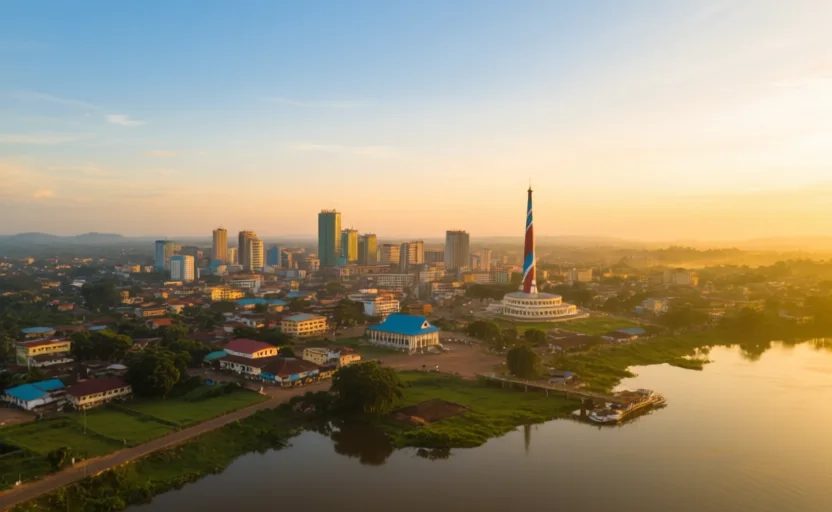 AI city illustration · Artistic impression
What people learn after moving
About 1.6 million (2016 estimate) — no census since 1984, so every figure is a projection
French (official); Swahili and Lingala both in everyday use — this is the frontier between them
Congolese franc (CDF, written FC) — rent and larger payments quoted in US dollars
GMT+2 (the DRC's eastern zone) — an hour ahead of Kinshasa
AI city illustration · Artistic impressionCost of living in Kisangani
Check your eligibility
Pick your passport to see entry rules and the long-stay routes we have researched.
Pick your passport to see whether you can enter Congo (DRC) — and what it takes to stay.
There is no residence permit separate from the visa: the visa d'établissement IS the residence status, granted on the DGM Director-General's decision under a 1987 ordinance. Before it comes the biometric carte de travail from the Commission Nationale de l'Emploi des Étrangers — a precondition of the work establishment visa, not a consequence of it. Provincial applicants lodge with the Division provinciale de l'Emploi et du Travail rather than the CNEE secretariat in Kinshasa. And before you accept a posting that involves travel east, read Loi 86-007.
Only the biometric chip licence issued by CONADEP is recognised: the rollout relaunched in November 2024, roadside enforcement began 30 June 2025 and the Ministry of Transport confirmed in September 2025 that controls were continuing. Beyond that, the defining fact is that Tshopo's road network largely does not function. Kisangani is 2,912 km from Kinshasa and the realistic connections are the river and the aeroplane, not the road.
Open a bank account and a mobile-money wallet in your first weeks. Since 9 April 2026 commercial banks may not physically import foreign banknotes; from 9 April 2027 no person or company may settle any transaction in foreign-currency cash at any amount. Dollars are not banned — dollar cash is. In a provincial city where cash has been the default and card acceptance is limited, mobile money is the practical answer rather than a convenience.
There is no national emergency medical number in the DRC — you call a clinic directly. Serious cases are evacuated, and from Kisangani that means an internal flight to Kinshasa before any international leg, which is the single most important thing to understand about your insurance. Malaria is year-round and intense, the national cholera epidemic is the worst in twenty-five years, and Ituri next door is under a WHO-declared Public Health Emergency of International Concern for Ebola.
The main networks — Vodacom Congo, Airtel DRC, Orange RDC and Africell — cover the city, with mobile money on all of them. Anonymous SIMs are finished: the government adopted mandatory, systematic subscriber identification for every new subscription, implemented by ARPTC with the operators. Bring your passport. Ignore anything about the RAM levy, abolished on 1 March 2022. And do not assume a signal exists once you leave the city.
Your employer withholds IPR on annual bands of 3%, 15%, 30% and 40%, capped so IPR can never exceed 30% of taxable salary. CNSS takes 5% from you for pensions and 13% from your employer across three branches. The employer separately pays the IERE at 25% of your gross simply because you are an expatriate. Foreign-source income is not taxed in the DRC. And if you are on a UN or diplomatic contract, most of this describes your colleagues rather than you — find out which you are.
Each guide has verified costs, timelines, required documents, and the non-obvious gotchas — sourced from official government pages. Last verified August 2026.
Reading a list isn’t learning it. Globe Quest turns these into a trainer — hear each phrase spoken, drill them with spaced repetition, and get scored as you say them out loud.
Tshopo is in the DRC's eastern time zone, an hour ahead of Kinshasa. The DRC is the only country in Africa running two zones and roughly 59% of the population lives in the eastern one. Every guide that quotes a single national time is describing the capital, and every head-office calendar invite that assumes it will be an hour wrong.
This is the farthest navigable point up the Congo, roughly 2,100 km from the sea and 2,912 km from Kinshasa, and the road network out of the city is not a serious alternative. Bangoka is called an international airport but currently carries scheduled service only to Kinshasa, Kindu and Goma. Bring specialist medication, spare parts and anything you genuinely cannot substitute, and expect intermittent gaps in things you assumed were always available.
The 1986 mining-zones law forbids foreigners from staying or circulating in a schedule of designated areas, with six months to two years' imprisonment for breach. Kisangani is not on the list. Bafwasende territory, in this same province, is — as are all of Ituri and Haut-Uélé immediately east. If your work takes you toward the gold areas, that is a legal question to settle with the Ministry of the Interior before it is a logistics one.
Kisangani sits essentially on the equator with a tropical monsoon climate: about 1,620 mm of rain a year and humidity averaging around 86%. There is no dry season worth planning around, only wetter and less wet. Mould, corrosion and anything with a lens or a circuit board are the practical consequences — buy the dehumidifier before you need it.
Ituri, where the DRC's 17th Ebola outbreak was declared in May 2026 and where France formally advises against all travel, begins east of this province. Kisangani is a natural referral and logistics hub for that region, so screening, health messaging and NGO traffic are all visible here — none of which makes this an outbreak city. Know the difference precisely, because your insurer and your family will both ask.
Founded as a falls station in 1883, renamed Stanleyville, renamed Kisangani in 1966, and the site of serious fighting during the 1960s crises and again between foreign armies in 2000. People here have long memories and firm views. Ask, listen, and do not arrive with a summary.
MONUSCO, WFP, UNICEF, WHO, OCHA, MSF, ICRC and the implementing NGOs
Kisangani is the natural forward base for operations across the north-east, which makes the aid sector the largest employer of foreigners here by a wide margin — and makes the city's job market unusually sensitive to humanitarian funding cycles and to the MONUSCO drawdown.
Concession holders across Tshopo, sawmills, the river freight operators that move the logs
Tshopo is one of the DRC's major timber provinces and the river is the export route. It is also the sector under the most international scrutiny, with certification, legality-of-origin and community-rights questions attached to almost every transaction.
Barge and baleinière operators, the beach's freight agents, ONATRA successors
Everything that is not flown in comes up or down the river, and the port is the city's real industrial asset. If you want to understand the local economy, spend a morning at the beach rather than reading a report.
Bralima, SOTEXKI, local food processors and pharmaceutical packagers
A surprisingly real industrial base for a city this isolated — precisely because it is isolated. Producing locally beats freighting from Kinshasa, and that logic has sustained a brewery and a textile mill here for decades.
Université de Kisangani, INERA Yangambi, CIFOR, the biosphere and forest-monitoring programmes
UNIKIS and the Yangambi station downstream give Kisangani a genuine scientific community working on tropical forest, biodiversity and carbon — one of the few parts of the local economy where an international specialist is hired for expertise rather than for management.
Provincial government of Tshopo, DGM provincial direction, DGI, DGRAD, SNEL, Regideso
As a provincial capital Kisangani carries the full set of state services, which matters practically: your residence, tax and licensing business can be done here rather than in Kinshasa, which is not true of smaller Congolese cities.
Nature · Eastern edge of the city
Seven cataracts on the Lualaba, and on the rocks the timber scaffolds of the Wagenia fishermen — wedged into the current, holding conical basket traps that are hauled up by hand. It is one of the genuinely singular sights in central Africa and it is a working fishery, not a display.
Local tip: Go with a guide arranged locally and agree what you are paying before you set out; access runs through the fishing community and that is as it should be. Morning light is better and the water is at its most dramatic in the wetter months.
Culture · About 100 km downstream on the Congo
A colonial-era agronomic research station turned UNESCO biosphere reserve, holding one of the largest herbaria in Africa and decades of tropical-forest data, now at the centre of international forest-carbon and biodiversity research.
Local tip: Getting there is by river and it is a day's commitment each way — arrange it through UNIKIS or one of the research programmes rather than turning up. For anyone with a scientific interest it is the reason to be posted here.
Neighborhood · Right bank, central
The administrative and residential heart — the provincial offices, the university's town presence, the better housing stock, and the long avenues laid out when this was Stanleyville. It is where almost every foreign resident ends up living.
Local tip: Walk it in the early morning before the heat and the humidity settle. It is also the only part of the city where you can realistically do bank, immigration and provincial-government business on foot in a day.
Landmark · Riverfront
Where two thousand kilometres of river logistics arrives and departs: barges lashed into floating villages, cargo of every description, and the traders who live aboard for the weeks a journey to Kinshasa takes.
Local tip: Go and look, ask before photographing anything or anyone, and treat it as the place to understand this city rather than a place to visit. If prices in the market moved this week, the reason is tied up at the beach.
Food · Central Kisangani
Fish from the river, cassava, plantain, forest produce and the imported goods that came up by barge at a price that reflects the journey. The clearest single illustration of what isolation costs a household.
Local tip: Buy fish early and buy it whole. And use the market to calibrate: if a familiar imported item costs three times what it does in Kinshasa, that is the freight, not a foreigner's price.
Nightlife · Along the Congo, Makiso and beyond
Grilled capitaine, cold Primus, plastic chairs facing the water and rumba at volume. The evening here is slower and more river-facing than Kinshasa's, and considerably better for it.
Local tip: Sunset over the Congo from a nganda terrace is the single best hour in Kisangani. Go with someone local, carry small clean notes, and arrange your ride home before you settle in.
Side-by-side cost of living, language, climate and careers — to help you choose.