
Population
256,885 in the City of Kitchener at the 2021 census; 575,847 across the Kitchener–Cambridge–Waterloo census metropolitan area, and about 587,000 in the Region of Waterloo including the townships
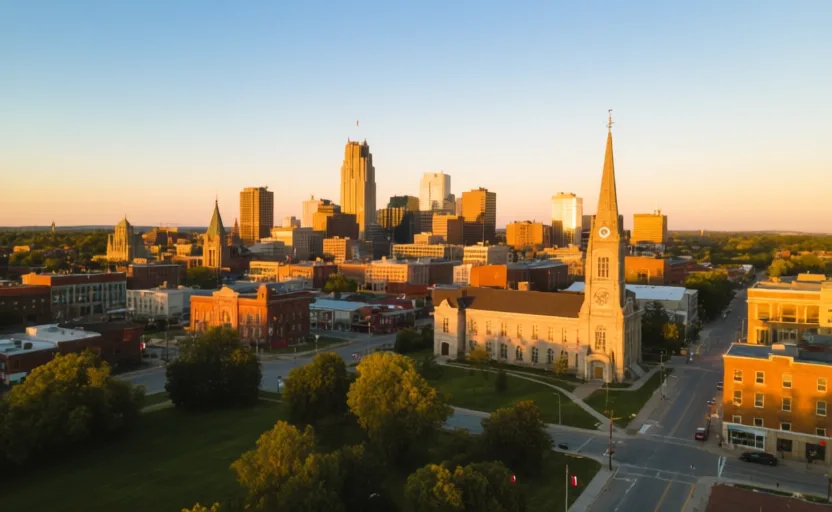 AI city illustration · Artistic impression
What people learn after moving
256,885 in the City of Kitchener at the 2021 census; 575,847 across the Kitchener–Cambridge–Waterloo census metropolitan area, and about 587,000 in the Region of Waterloo including the townships
English. A deep Pennsylvania German and German heritage that survives in place names and Old Order Mennonite communities in the townships, plus large Punjabi-, Arabic-, Mandarin-, Spanish- and Tagalog-speaking populations
Canadian dollar (CAD)
EST/EDT (GMT−5/−4) — the same clock as Toronto, Ottawa and New York
AI city illustration · Artistic impressionCost of living in Kitchener
Check your eligibility
Pick your passport to see entry rules and the long-stay routes we have researched.
Pick your passport to see whether you can enter Canada — and what it takes to stay.
Two doors, and one of them was replaced this year. Express Entry ranks you on points, needs no employer, and carries a six-month service standard after an invitation. The Ontario Immigrant Nominee Program is the second door and it changed completely in 2026: Ontario closed all of its previous streams on 30 May and launched a single Ontario Workforce Priority stream in late June, so guidance describing the old Human Capital Priorities, Employer Job Offer and graduate streams now describes routes that no longer exist. The surviving stream is employer-driven, and a nomination is worth 600 points federally only on a TEER 0–3 occupation that separately meets a federal stream's criteria. The third thing to understand here is that this region runs on study permits — three post-secondary institutions, a huge co-op programme — and the federal rules around study permits and post-graduation work permits have moved more than any other part of the system since 2024.
Ontario exchanges licences directly with every Canadian province and with a defined list of countries; everyone else enters graduated licensing and tests — but since 1 July 2026 they can claim up to twelve months of foreign driving experience on presentation of an original licence, which lets them sit the G2 road test immediately instead of waiting. Insurance is private and territory-rated, and Waterloo Region prices well below the Greater Toronto Area. Two local skills nobody warns you about: the ION runs on the street through downtown Kitchener and Uptown Waterloo with left turns restricted and its own signals, and the townships around the region carry horse-drawn buggies at about twelve km/h on roads posted at eighty.
Opening a chequing account takes under an hour and every major bank runs a newcomer package with waived fees and no requirement for Canadian credit history. The part that catches people is that your credit record does not cross the border. The local twist is timing: this region's leases turn over three times a year on the university and college calendar, so the competitive weeks are the fortnight before January, May and September, and the packet you bring to a viewing matters most then. Get the account and the credit card in the same appointment.
OHIP is Ontario's public health insurance and it has no waiting period: the three-month wait was removed from the regulations in March 2020, so an eligible resident is covered from enrolment. You apply in person at a ServiceOntario centre with one document from each of three categories. The local landscape changed on 1 April 2025, when Grand River Hospital and St. Mary's General Hospital merged into the Waterloo Regional Health Network and every site was renamed — searching for the old names now sends you to redirects and stale directions. Public health, immunisation records and paramedics sit with the Region, which catches people who go looking on the City's website.
Every phone sold in Canada has been unlocked since 2017, so bring your handset. Without a Canadian credit file a postpaid plan means a credit check and often a deposit — unless you ask for a newcomer plan and present a work permit, study permit or PR card, which waives it. The cheapest sensible route is a flanker brand riding the same network as its parent. Home internet across the Kitchener–Waterloo built-up area is genuinely competitive, with cable, fibre and a healthy set of independent resellers on the CRTC's wholesale framework; step out into Woolwich, Wilmot or Wellesley townships and the honest answer may be fixed wireless or satellite.
One return to the CRA, due 30 April, covering both federal and Ontario tax. The combined top marginal rate approaches 53% and HST is 13%. All of that is identical to Toronto, Mississauga, Hamilton and London; there is no Ontario city with an income tax advantage. What is specifically Kitchener is the property tax bill: because this is a two-tier municipality, the bill carries a City of Kitchener levy, a Region of Waterloo levy and the provincial education portion, and the regional share is the larger of the two municipal ones because the Region runs the police, the paramedics, transit and public health. Gas and water are billed separately by the City rather than by a private utility. There is no municipal land transfer tax and no vacant unit tax here.
Each guide has verified costs, timelines, required documents, and the non-obvious gotchas — sourced from official government pages. Last verified August 2026.
Reading a list isn’t learning it. Globe Quest turns these into a trainer — hear each phrase spoken, drill them with spaced repetition, and get scored as you say them out loud.
Kitchener is a lower-tier city inside the Regional Municipality of Waterloo, which also covers Waterloo, Cambridge and the townships of Woolwich, Wilmot, Wellesley and North Dumfries. The Region runs water and wastewater, waste collection, public health, paramedics, Grand River Transit and the ION, social services, long-term care, regional roads and the Waterloo Regional Police Service. The City of Kitchener runs local roads, parks, planning, building permits, fire — and, unusually, its own natural gas, water, sewer and stormwater billing through Kitchener Utilities. Both appear on one property tax bill. This is the exact opposite of Hamilton and London, where a single City does all of it, and it is the single most common source of newcomer frustration here.
Kitchener Utilities is a municipally owned natural gas distributor, along with water, sewer, stormwater and rental water heaters. Almost every other Ontario household buys gas from Enbridge; here it is the City. Practically: you open one account with the City for gas and water rather than two with separate companies, the bill arrives on municipal letterhead, and the customer service line is the City's. New arrivals who cannot find their gas supplier are usually looking for a company that does not serve this address.
Metrolinx is building the Kitchener line towards two-way, all-day service, adding trips incrementally as corridor segments finish — a second weekday morning train from Toronto and a new afternoon eastbound trip were added in April 2026. It is not there yet. The constraint is physical: much of the line between Bramalea and Kitchener is single track shared with CN freight, and the fix is building dedicated track, with an agreement in principle reached with CN in late 2025. Until it is done, an eastbound morning commute works and a westbound one is awkward. If your plan depends on being in a Toronto office, read the current timetable rather than the project page.
Grand River Hospital and St. Mary's General Hospital merged on 1 April 2025 to form the Waterloo Regional Health Network. The former Grand River K-W campus is now WRHN at Midtown, St. Mary's is WRHN at Queen's Blvd, and the Freeport campus is WRHN at Chicopee. Both Midtown and Queen's Blvd have emergency departments, which is worth knowing because the equivalent split in some Ontario cities does not. A new joint hospital is planned near the David Johnston Research and Technology Park in Waterloo, and is not expected to be operating until around 2034 — so the current sites are what you are dealing with for a decade.
The light rail runs 19 km from Conestoga Mall in Waterloo through Uptown, downtown Kitchener and out to Fairway, and essentially every new apartment tower in the region has been built within a few hundred metres of it. That makes the ION corridor the expensive, walkable, car-optional part of the region and everywhere else genuinely car-dependent. A cheap listing 'in Kitchener' that is a twenty-minute bus ride from the nearest ION stop is a different city from a flat above the line. Check the stop, not the postcode.
One half is software: Communitech in the Tannery, Google's Kitchener engineering office, OpenText, D2L, Vidyard, ApplyBoard and a long tail of startups fed by the University of Waterloo's co-op programme and its unusual policy of letting creators keep the intellectual property they generate. The other half is manufacturing, heavily weighted to motor vehicles and parts — which CMHC has flagged as one of the most tariff-exposed local economies in Ontario. A software job here is comparatively insulated; a manufacturing one is not, and the difference is invisible in the average wage figures.
The University of Waterloo's co-op programme cycles students through January, May and September start dates, Wilfrid Laurier adds its own intake and Conestoga College is the largest of the three by headcount. The result is three lease turnover points a year rather than one, three waves of sublets, and a service labour market that empties and refills constantly. Conestoga's international enrolment fell sharply after the federal cap on study permits, which loosened the student end of the rental market and hit local hospitality employment at the same time. Time your search for the fortnight before a term boundary.
Google Kitchener, OpenText, D2L, Vidyard, ApplyBoard, Miovision, Descartes Systems, Communitech, Shopify
The densest startup ecosystem in Canada outside Toronto and Vancouver, anchored by Communitech in the Lang Tannery and fed by the University of Waterloo, whose policy of letting creators own the intellectual property they generate is the structural reason so many companies spun out here rather than elsewhere. Expect real depth in engineering, product and data roles — and a network small enough that reputations travel.
University of Waterloo, Wilfrid Laurier University, Conestoga College, Perimeter Institute, Institute for Quantum Computing
Three institutions inside one region, with the world's largest co-operative education programme at Waterloo cycling students through employers on four-month terms. The Perimeter Institute and the Institute for Quantum Computing give the region a theoretical physics and quantum research base that has no equivalent in a Canadian city this size.
Toyota Motor Manufacturing Canada (Cambridge and Woodstock), ATS Corporation, Linamar (Guelph), Babcock & Wilcox, COM DEV / Honeywell Aerospace
The half of the economy the tech coverage ignores, and the larger employer of the two by headcount across the region. It is also the exposed half: CMHC identified Kitchener–Cambridge–Waterloo as one of Ontario's most tariff-exposed local economies, largely because of motor vehicles and parts. Judge a manufacturing offer here against that, not against the software salaries.
Sun Life, Manulife (Waterloo), Definity, Economical Insurance, Equitable Life of Canada
Waterloo has been an insurance town since the nineteenth century and the industry is still one of the largest white-collar employers in the region, concentrated in Uptown Waterloo rather than Kitchener. It is the steadiest part of the local labour market and the one most likely to hire an experienced newcomer without a Canadian network.
Waterloo Regional Health Network (Midtown, Queen's Blvd and Chicopee sites), Region of Waterloo Public Health and Paramedic Services, Grand River Hospital Foundation, community health centres
Grand River Hospital and St. Mary's General merged into the Waterloo Regional Health Network on 1 April 2025, and a new joint hospital near the David Johnston Research and Technology Park is planned for around 2034. Paramedics and public health sit with the Region rather than the hospitals, which is where a substantial number of the health-sector jobs actually are.
Sofina Foods, Piller's, Waterloo Brewing, Home Hardware (St. Jacobs), regional dairy and produce operations
The townships around the cities are some of Ontario's most productive farmland, worked in part by Old Order Mennonite communities, and the region has an old and continuing meat-processing and brewing trade — Piller's and the sausage counters at the markets are direct descendants of the city's German founding.
Food · Woolwich Township, ten minutes north of Waterloo
Canada's largest year-round farmers' market — hundreds of vendors across an indoor building and outdoor stalls, with Old Order Mennonite growers, bakers and butchers selling alongside everyone else.
Local tip: Go early on a Thursday rather than a Saturday if you actually want to shop rather than shuffle. The apple fritters and the summer sausage are the things to buy, and the drive out takes you through buggy country — slow down and pass wide. There is a seasonal market bus from the ION's northern end, which saves the car park entirely.
Nature · Downtown Kitchener, west of King Street
The city's Victorian centrepiece — a lake with an island, a boathouse, mature trees and a bandstand, ringed by some of Kitchener's best housing stock and hosting most of the year's festivals.
Local tip: It is the venue for the Kitchener Blues Festival and a large share of Oktoberfest, and it is the best free evidence of how the city has changed: the park is a hundred and thirty years old and the towers now going up around it are two years old. Walk the perimeter streets — Roland, Park, David — for the housing rather than only the lake.
Culture · Charles Street West, downtown Kitchener
A converted 1900s leather works holding Communitech and a few hundred startups, at the centre of the redeveloped rail-side district that also holds Google's Kitchener engineering office in the nearby Breithaupt Block.
Local tip: The ground floor is open and there are public events most weeks — this is the fastest way into the local tech network if you are arriving without one, and considerably more effective than applying online. The whole district is a five-minute walk from Kitchener GO and the Central Station ION stop, which is not an accident.
Nature · From downtown Kitchener to Uptown Waterloo
A rail trail on an abandoned Grand Trunk right-of-way running five kilometres through the back of both city centres — asphalt, lit, and the main commuting route for anyone here on a bike.
Local tip: It is the answer to 'can I live in Kitchener and work in Waterloo without a car', and most newcomers do not discover it for months because it runs behind things rather than along a road. Join it at Victoria Park and ride north; it connects onward to the Spurline Trail and the Laurel Trail network.
Neighborhood · King Street North, Waterloo — four ION stops from downtown Kitchener
The other city centre: a compact strip of restaurants, bars, the Waterloo public square and the farmers' market, with Waterloo Park, the university and the insurance towers immediately around it.
Local tip: The distinction between Uptown and Downtown is the first thing to get straight here — they are separate municipalities with separate councils and separate characters, joined by the light rail. Uptown is smaller, denser and more expensive; Downtown Kitchener is larger, rougher and changing faster. Spend an evening in each before deciding where to live.
Landmark · Huron Road, south Kitchener near the 401
The regional museum with a reconstructed 1914 Waterloo County village behind it — sixty acres of working farm, houses, a sawmill and a railway station staffed in period.
Local tip: The value here is understanding why the region looks and sounds the way it does: Pennsylvania German settlement, the wartime renaming of Berlin, and the industrial trades that became the modern manufacturing base. Go in summer when the village is fully staffed, and pair it with the Homer Watson House gallery a few minutes away.
Side-by-side cost of living, language, climate and careers — to help you choose.