
Population
2,343,409 in the province (Göç İdaresi, 30 July 2026); the city is Selçuklu, Meram and Karatay
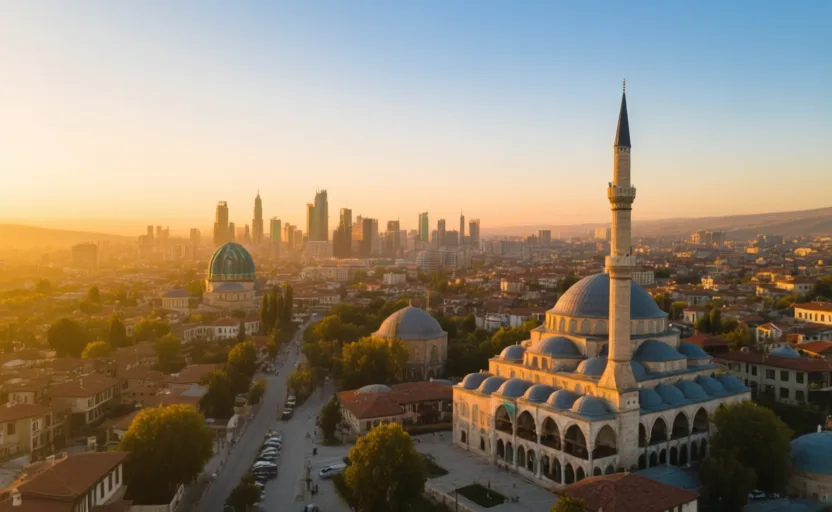 AI city illustration · Artistic impression
What people learn after moving
2,343,409 in the province (Göç İdaresi, 30 July 2026); the city is Selçuklu, Meram and Karatay
Turkish — very little English outside the universities and the Mevlâna complex
Turkish Lira (TRY, ₺) — high inflation; savings usually held in USD/EUR
TRT (GMT+3), no daylight saving
AI city illustration · Artistic impressionCost of living in Konya
Check your eligibility
Pick your passport to see entry rules and the long-stay routes we have researched.
Pick your passport to see whether you can enter Turkey — and what it takes to stay.
Most Western nationals enter Türkiye visa-free for 90 days in any 180; anything longer needs a residence permit (ikamet izni), applied for online through e-İkamet and completed in person at the Konya İl Göç İdaresi Müdürlüğü. The national rules apply unchanged. Konya's closed-mahalle position is one of the lightest in the country and worth stating precisely, because the raw number misleads in both directions: the official list carries 18 Konya mahalles — five each in Karatay, Meram and Selçuklu plus one each in Ereğli, Kadınhanı and Karapınar — but two of the Selçuklu five are organised industrial estates (Büyükkayacık OSB and Horozluhan OSB) where nobody lives. Thirteen residential closures across three very large districts is a mild constraint, comparable to Ankara's, and nothing like Adana's 75. The province holds 16,384 residence-permit holders, which is enough that the directorate handles foreigner files routinely, and a large share of them are students — so the student route is well-trodden here in a way it is not in Adana. On approval you receive a Yabancı Kimlik Numarası (YKN), an 11-digit ID starting 99, which is the master key to a bank account, tax number, SIM, healthcare and e-Devlet.
KonyaKart runs the city: a tram line threading the centre and the university campuses, plus a large bus network across three very large districts. Konya is dead flat and laid out generously, which makes it one of the easiest Turkish cities to cycle in and one where distances are longer than they look. The genuinely distinctive part is intercity: Konya sits on Türkiye's second high-speed line, which puts Ankara within well under two hours and Istanbul within an afternoon, from a city with a third of their rents. That single fact does more to shape how people live here than anything about the local network. On the road, the plain gives you long straight highways and two specific winter hazards — black ice and freezing fog — that catch drivers used to milder places. On licences, your home permit is valid for 6 months from entry with a notarised Turkish translation or an IDP, after which you exchange it, and most nationalities do so with no test.
The order matters more than the bank. First get a free Turkish tax number (vergi kimlik numarası) — online in minutes with just a passport, before you have any residency. Then open the account in person with your passport, that tax number, proof of a Turkish address and a Turkish mobile number; since 2025-26 banks tightened KYC/AML and many branches now also want a residence permit or YKN. Konya's distinctive feature is the shape of its banking market rather than the process: this is one of the strongholds of Türkiye's participation-banking (katılım bankacılığı) sector, the interest-free model, and the participation banks have a branch density and a customer base here that they do not have in İzmir or Antalya. If avoiding interest matters to you, this is the easiest large Turkish city in which to bank entirely that way; if it does not, the conventional banks are all here too and nothing about the process changes. Once you are in, the real skill is not holding idle lira.
If a Turkish employer hires you on a work permit, SGK enrolment starts on your first working day with no waiting period. If you are not employed you must buy compliant private insurance for the first permit, and can only opt into SGK voluntarily after one full year of legal residence — with one important exception that matters a great deal here: international students can apply to join SGK within their first three months of registration, which is a far better deal than private cover for anyone staying several years. Konya's public provision is genuinely strong for a city this size. Konya Şehir Hastanesi is a large multi-hospital campus — separate general, maternity and children's, cardiovascular and oncology hospitals on one site — backed by two university medical faculties at Selçuk and Necmettin Erbakan (Meram). The local seasonal profile is a plateau one: dry cold and heating-season air quality in winter, and dryness rather than humidity in summer.
Local SIMs are cheap and city coverage is good, but the thing that actually costs people money is national: a foreign phone's IMEI works on Turkish networks for only about 120 days from your entry, then is permanently blocked unless you pay a steep government registration fee — over 54,000 TL, about US$1,260, for 2026. In a city where a furnished central one-bed runs US$180-350 a month, that fee is worth several months' rent, and the calculation almost every long-term resident here eventually makes is to buy a cheap Turkish handset instead. Land connected with a data-only eSIM bought and installed BEFORE you fly, because BTK has blocked most foreign eSIM apps inside Türkiye since mid-2025. The Konya coverage question is about the province rather than the city: this is the largest province in Türkiye by area, and the emptier stretches of the plain and the Taurus foothills to the south are a long way from anywhere.
Your vergi kimlik numarası is free, passport-only and obtainable online in minutes, and once you hold a permit your YKN doubles as it. Konya is overwhelmingly a payroll and stipend city, which simplifies things considerably: employees have income tax withheld at source through payroll (stopaj) across the progressive brackets and usually never file a return, and students on scholarships generally have no Turkish filing obligation at all. The line to watch is residency: spend more than about 183 days in a calendar year, or establish a legal residence here, and Türkiye taxes your WORLDWIDE income, where non-residents are taxed only on Turkish-source income. That catches academics who keep consulting income or investments at home far more often than it catches anyone else. Freelancers must open a sole proprietorship (şahıs şirketi), keep books through an accountant, charge and file VAT and pay quarterly provisional tax. R&D, design and software staff working inside Konya Teknokent carry an income-tax exemption under Law No. 4691.
Each guide has verified costs, timelines, required documents, and the non-obvious gotchas — sourced from official government pages. Last verified August 2026.
Reading a list isn’t learning it. Globe Quest turns these into a trainer — hear each phrase spoken, drill them with spaced repetition, and get scored as you say them out loud.
The Göç İdaresi closed-neighbourhood spreadsheet lists 18 mahalles in Konya province: five each in Karatay, Meram and Selçuklu, plus one each in Ereğli, Kadınhanı and Karapınar. Two of the five Selçuklu entries — Büyükkayacık OSB and Horozluhan OSB — are organised industrial estates where essentially nobody lives, so the residential count across a city of three very large districts is thirteen. That is a genuinely light picture, comparable to Ankara's and far lighter than Adana's 75. But a lease inside a closed mahalle still cannot be registered as your residence-permit address, so check the exact mahalle against the current list before signing, because the file is republished as populations shift.
Lira inflation is high enough that a rent agreed in TRY is a different rent in real terms within months. Keep savings in USD or EUR in a döviz sub-account and convert only what you're about to spend. Central exchange offices (döviz) beat bank counters, and both beat anything at a transport terminal.
Not a warning, and not the whole story — but it does shape daily life in ways worth knowing before you arrive rather than after. Alcohol is legal and available, but from far fewer places and rarely in ordinary restaurants; Ramadan is observed widely enough that daytime eating in public feels conspicuous; dress is more modest than on the coast, particularly around the Mevlâna complex where it is a requirement rather than a convention; and mixed-gender socialising follows different defaults. People here are as a rule warm and extremely hospitable to foreigners, and the newcomers who struggle are almost always the ones who arrived expecting İzmir.
Konya sits at roughly 1,030 m on the Anatolian steppe, and MGM's 1927-2025 normals give it a January average low of −4.1°C, a record of −28.2°C, and only 327 mm of precipitation across the entire year — drier than almost any other large Turkish city. Practically: heating is a serious winter budget line, black ice and freezing fog are the real driving hazards, the air is dry enough to matter for skin and sinuses, and summers at a 30°C average high are hot but far more bearable than Adana's because there is no humidity in them at all.
Konya was on Türkiye's second YHT line, which puts Ankara within well under two hours and Istanbul within an afternoon, from a city where a large flat costs a third of what it does in either. If your work needs occasional presence in the capital or in Istanbul but not daily presence, that combination is genuinely unusual — and it is the single fact that most changes the arithmetic of living here. Book ahead for Şeb-i Arûs week in December, when the whole country tries to reach Konya at once.
The Konya Closed Basin has been drawn down hard by irrigation, and the visible result is obruk — sinkholes opening across the plain, sometimes dramatically and sometimes near roads and fields. It is a live subject in local politics and agriculture rather than an abstraction, and it is worth understanding as context for the province's economy. For a city resident it changes nothing day to day, but it explains a lot of what you will read in the local news.
The Konya Ovası farms; Konya Şeker and the agricultural cooperatives
Konya is the largest province in Türkiye by area and one of the largest single contributors to the national grain harvest. Almost everything else in the city's economy grew out of feeding and equipping that plain.
The Konya OSB estates; farm-machinery makers and component suppliers
One of the country's biggest organised industrial zones, built around making what the plain needs — tractors, implements, irrigation kit — and now a substantial automotive-components supplier in its own right.
Kalyon Karapınar YEKA solar plant, ~100 km east on the plain
A 1,350 MW plant of roughly 3.5 million panels that reached full capacity in March 2023 — the largest single solar installation in Europe, sitting on the flat, cloudless steppe that makes Konya province the obvious place for it.
Flour milling, sugar, dairy, confectionery
The direct downstream of the harvest, and a large, non-seasonal employer across the industrial estates — flour and sugar in particular are processed here at national scale.
Selçuk Üniversitesi, Necmettin Erbakan Üniversitesi, KTO Karatay; Konya Teknokent
A very large student population across several universities, with Konya Teknokent carrying the Law No. 4691 income-tax exemption for R&D, design and software staff working inside it.
The Mevlâna complex, the Şeb-i Arûs season, Çatalhöyük
Distinct from coastal tourism in every way — domestic and pilgrimage-driven, concentrated around December, and it supports a hotel and hospitality sector far larger than the city's size would suggest.
Culture · Karatay (city centre)
Rumi's tomb beneath a fluted turquoise-tiled dome, inside the former lodge of the Mevlevi order — sarcophagi under embroidered cloths, illuminated manuscripts, and a constant quiet stream of visitors who are there to pray rather than to look.
Local tip: Go early on a weekday and treat it as a working shrine, because that is what it is: modest dress, head covering for women, and no photographs of people at prayer. The rose garden outside is where to sit afterwards.
Landmark · Selçuklu / Karatay
The artificial mound at the centre of the city, topped by the twelfth-century Alâeddin Mosque with its forest of reused Roman columns, ringed by the Karatay and İnce Minareli medreses and their Seljuk stone carving.
Local tip: The İnce Minareli Medrese's carved portal is the single best piece of Seljuk stonework in Türkiye and takes ten minutes to see. Walk the hill in the evening when the city comes out; the tram circles the base of it.
Landmark · Çumra, ~50 km south-east
A nine-thousand-year-old Neolithic town of mudbrick houses entered through the roof, with no streets at all — one of the earliest urban settlements anywhere, excavated under shelters on the open plain.
Local tip: Read something about it before you go, because what survives is subtle and the site rewards knowing what you are looking at. Combine it with the drive across the ova, which is the fastest way to understand what this province actually is.
Neighborhood · Selçuklu, ~8 km north-west
A stone village in a small gorge on the city's edge, Greek-speaking until the 1924 population exchange, with the Byzantine church of Aya Elenia still standing and rock-cut chapels in the cliffs above.
Local tip: Come for breakfast rather than lunch and walk up the streambed past the rock chapels afterwards. It is fifteen minutes from the centre by bus and almost nobody from outside Konya knows it exists.
Food · Around Mevlâna Caddesi, Karatay
Long wood-fired ovens turning out metre-long flatbreads of minced lamb, sold by the length and cut across the counter, in places that have done nothing else for generations.
Local tip: Order by the metre for a group and ask for it 'kıtır' — crisp. Then go somewhere else for fırın kebabı at lunch, because the two are different meals and no single place does both properly.
Nature · Meram, west of the centre
The old vineyard and orchard quarter climbing toward the hills, with poplars, water channels, tea gardens under the trees and a genuine drop in temperature — the city's traditional escape.
Local tip: This is where Konya goes on a summer evening. Take the bus out to Meram and walk up through the gardens; the tea houses along the stream are the point, and they are open long after dark.
Side-by-side cost of living, language, climate and careers — to help you choose.