
Population
≈382,000 in the municipality (2025) — the largest city in the Canary Islands and the ninth largest in Spain
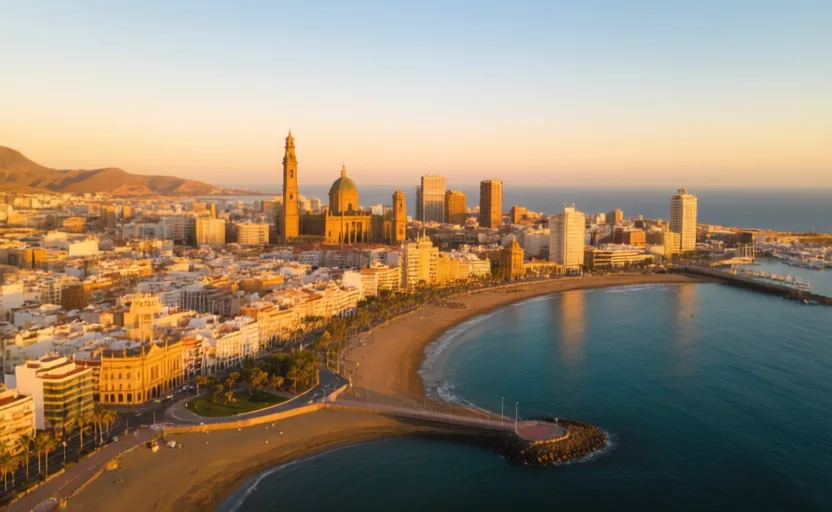 AI city illustration · Artistic impression
What people learn after moving
≈382,000 in the municipality (2025) — the largest city in the Canary Islands and the ninth largest in Spain
Castilian Spanish, the sole official language. Canarian Spanish uses seseo and 'ustedes' in place of 'vosotros', and shares much of its vocabulary with the Caribbean — 'guagua' for bus, 'papas' for potatoes
Euro (EUR)
WET (GMT+0); WEST (GMT+1) from late March to late October — one hour behind mainland Spain all year
AI city illustration · Artistic impressionCost of living in Las Palmas de Gran Canaria
Check your eligibility
Pick your passport to see entry rules and the long-stay routes we have researched.
Pick your passport to see whether you can enter Spain — and what it takes to stay.
Spanish residency is a sequence: a NIE number, then municipal registration on the padrón, then a TIE card, then social security, then a health card. Each is a prerequisite for the next and each needs a cita previa. In the Canary Islands the padrón does extra work, because island residence also carries a 75% state subsidy on flights to the rest of Spain — claimed with a separate, time-limited certificate from your ayuntamiento. Whether a newly arrived third-country national qualifies for that subsidy turns on residence status and should be confirmed rather than assumed.
EU and EEA licences are exchangeable straightforwardly. For everyone else it depends on whether Spain has a bilateral agreement with the issuing country — if it does you exchange without a test, if not you take the full Spanish exams in Spanish. The six-month clock starts when you become resident. In the city itself you do not need a car: Las Palmas is linear, walkable and well served by the Guaguas Municipales. The island beyond it is a different question, and fuel here is materially cheaper than on the mainland because the Canaries sit outside the EU excise territory.
Spanish banks distinguish sharply between resident and non-resident accounts, and the non-resident version carries higher fees and a certificate that must be periodically renewed. With a NIE and a padrón certificate you can open a resident account. The Canary-specific part is on the spending side: goods ordered from mainland Spain or elsewhere in the EU clear customs on arrival, so IGIC, sometimes AIEM and a customs agent's handling fee land after the purchase, often as separate charges you did not authorise at checkout.
Spanish public healthcare is good and, once you are in it, free at the point of use — but entry runs through social security rather than through residency alone. The sequence is padrón, then social security registration, then the Canarian health card. Las Palmas itself is well equipped: the Doctor Negrín and the Insular-Materno Infantil complexes cover most specialties for the eastern islands. What is genuinely different from the mainland is that anything the archipelago cannot treat means an organised transfer, and that Canarian waiting lists have historically compared poorly with the Spanish average.
Spain requires every SIM to be registered against an identity document, so there is no anonymous pay-as-you-go. A prepaid SIM can be activated on a passport, which is what to do on arrival. Contract tariffs — better value and usually bundled with fibre — need a NIE and a Spanish bank account. Fibre in Las Palmas is excellent and cheap. The island-specific trap is hardware: a handset ordered from a peninsular retailer is a customs import, and the tax and handling fee land on you afterwards.
The Canary Islands sit inside the EU customs union but outside the EU VAT and excise territory. Indirect tax is IGIC rather than IVA, at a general rate reported at 7% against the mainland's 21%, with reduced and increased bands either side, plus AIEM on certain imports. Corporate incentives under the Régimen Económico y Fiscal are substantial — the Zona Especial Canaria's 4% corporate rate, the Reserva para Inversiones en Canarias and the Deducción por Inversiones en Canarias. Personal income tax is not part of that: you pay Spanish IRPF on the state scale plus the Canarian regional one, and Canarias applies wealth tax broadly on the state model.
Each guide has verified costs, timelines, required documents, and the non-obvious gotchas — sourced from official government pages. Last verified August 2026.
Reading a list isn’t learning it. Globe Quest turns these into a trainer — hear each phrase spoken, drill them with spaced repetition, and get scored as you say them out loud.
The islands are inside the EU customs union but excluded from the EU VAT and excise territory. Locally that means IGIC instead of IVA at a much lower general rate, and cheaper fuel, alcohol and tobacco. Practically it means something more disruptive: anything shipped from mainland Spain is an export, clears customs, needs a DUA, and attracts IGIC, possibly AIEM, and a customs agent's handling fee on arrival. A large share of Spanish online retailers simply refuse to ship here, and the ones that do quote a delivery price that is not the final price. Budget differently, and check the shipping page before you assume a purchase is possible at all.
The Canary Islands run on WET and WEST, exactly one hour behind mainland Spain in every season. This is not a curiosity if you work with a peninsular or European team: a 9am Madrid meeting is 8am here, and the whole Spanish working day, including the late lunch and the late finish, lands an hour earlier on your clock. Combined with the mild climate it makes the islands unusually workable for UK and Portuguese hours and slightly awkward for central European ones. Set your calendar to Atlantic/Canary and stop doing the arithmetic.
Residents of the Canary Islands get a 75% state subsidy on flights between the islands and the rest of Spain, which turns an expensive geography into a manageable one. It is claimed with a certificado de residencia issued by your ayuntamiento — a different, time-limited document from the ordinary padrón certificate, issued under Real Decreto 1316/2001. The conditions attach to residence status as well as to registration, and airlines' own guidance for third-country nationals refers to long-term residence rather than any residence permit, so if you are arriving on a first TIE do not assume you qualify from day one. Confirm your position with the Ministerio de Transportes before you build a travel budget on it.
The trade winds hit Gran Canaria from the north-east, which makes the north green, breezy and frequently overcast — the panza de burro can sit over Las Palmas for weeks in summer while Maspalomas in the south is in unbroken sun forty minutes away. Neither is better; they are different climates on a 50 km island, and almost every guide to 'Canary weather' averages them into something that describes nowhere. Add the calima, which arrives from Africa a few times a year, spikes temperatures well above the normal range and can ground flights. Visit in summer, not in February, before deciding where to live.
The Canary Islands' Régimen Económico y Fiscal is a real and legally distinct advantage — low IGIC, the Reserva para Inversiones en Canarias, the Deducción por Inversiones en Canarias, and the Zona Especial Canaria's 4% corporate rate. Nearly all of it applies to companies that actually operate here and meet hard investment and employment tests. As an individual you still pay Spanish IRPF on the state scale plus the Canarian regional scale, and Canarias applies wealth tax broadly on the state model without a general regional rebate. Do not confuse a good regime for a business with a low personal tax bill.
Las Palmas has been a serious digital-nomad base since well before the phrase was common — the Nomad City event has run here annually since 2016, and the coworking and coliving stock around Las Canteras is deep and long-established rather than newly opportunistic. Fibre in the city is excellent, the cost of living is below mainland Spanish coastal cities, and there is an actual community with continuity rather than a rotating cast. The flip side is a small local professional job market outside tourism, the port and the public sector: this is a place to bring an income to, not to look for one in.
Autoridad Portuaria de Las Palmas, Astican, Zamakona Yards, Repsol, Boluda
The port is the main mid-Atlantic servicing hub between Europe, Africa and the Americas, handling bunkering, repair and transhipment as well as being the base for much of the West African fishing fleet.
Lopesan, Grupo Santana Cazorla, Barceló, Riu, Binter
Tourism is the Canarian economy's foundation, though Las Palmas city itself is far less tourist-dependent than the resorts in the south of the island — it is a working port capital first.
Gobierno de Canarias, Cabildo de Gran Canaria, Ayuntamiento, ULPGC
Las Palmas is co-capital of the autonomous community with Santa Cruz de Tenerife, and the regional and island administrations plus the university are among the largest employers in the city.
Nomad City, The Roof, Restation, Sky Coworking, Repeople
One of the longest-established remote-work ecosystems in Europe, with an annual conference running since 2016 and a dense cluster of coworking and coliving around Las Canteras.
PLOCAN, ULPGC marine sciences, Siemens Gamesa, Ecoener
The Plataforma Oceánica de Canarias offshore test platform, the university's marine sciences faculty and the islands' offshore-wind ambitions form a small but genuinely specialised cluster.
Canary Islands Film, Gran Canaria Film Commission, international production services firms
The Canaries offer an audiovisual production tax credit materially more generous than the mainland's, which combined with year-round light and varied landscapes brings a steady flow of international shoots.
Nature · Northern city, Guanarteme to La Cícer
A three-kilometre urban beach along the city's north-western face, sheltered for most of its length by La Barra reef.
Local tip: The beach is three different places. The Cícer end is a surf break with a young crowd, the middle is a flat lagoon behind the reef where families swim, and the Confital end is a rocky headland with a serious right-hand wave and no facilities. Walk to Confital at sunset — most residents never do.
Neighborhood · Southern old city
The original colonial town, laid out in 1478, with the Santa Ana cathedral, the Casa de Colón and the streets from which the Spanish conquest of the Americas was provisioned.
Local tip: Thursday evening is the ruta de tapas, when the bars around Plaza del Pilar Nuevo put out small plates for a couple of euros each and the whole city turns up. Go up the cathedral tower first — the lift is cheap and the roof view over the old town and the port is the best free thing in the city.
Food · Santa Catalina, near the port
A nineteenth-century iron market hall attributed to the Eiffel workshop tradition, now a dense cluster of food stalls and bars.
Local tip: Come for lunch on a weekday when it is full of port workers rather than at the weekend. The stalls that matter are the fish counters — order whatever came off the boat that morning with papas and mojo, and drink the local Tropical or Dorada rather than anything imported.
Nature · Tafira, 8 km inland and uphill
The largest botanical garden in Spain, built into a ravine, dedicated to the endemic flora of Macaronesia.
Local tip: It is free, it is enormous, and it is up in Tafira where the temperature is several degrees cooler than the coast — which is the real reason to go on a hot day. The dragon tree collection and the ravine paths at the bottom are where almost nobody walks.
Nature · Central Gran Canaria, about an hour by car
An eighty-metre volcanic monolith at 1,800 metres in the centre of the island, in a landscape UNESCO designated a biosphere reserve.
Local tip: Gran Canaria is often called a continent in miniature and the interior is the reason — pine forest, terraced villages and desert within an hour of the beach. Go early: cloud fills the caldera by mid-morning in summer, and the road up through Tejeda is slow, spectacular and not something to attempt tired.
Culture · Between Vegueta and the isthmus
The pedestrianised commercial spine of the historic city, with modernista shopfronts, the Pérez Galdós theatre and the writer's house museum.
Local tip: Walk Triana northwards and then cut east to the Parque San Telmo to see how abruptly the colonial city stops. The Casa-Museo Pérez Galdós is small, cheap and almost empty, and Galdós is the most important Spanish novelist after Cervantes — this is his house.
Side-by-side cost of living, language, climate and careers — to help you choose.