
Population
≈630,000 and still rising — Leipzig grew faster than any other large German city through the 2010s
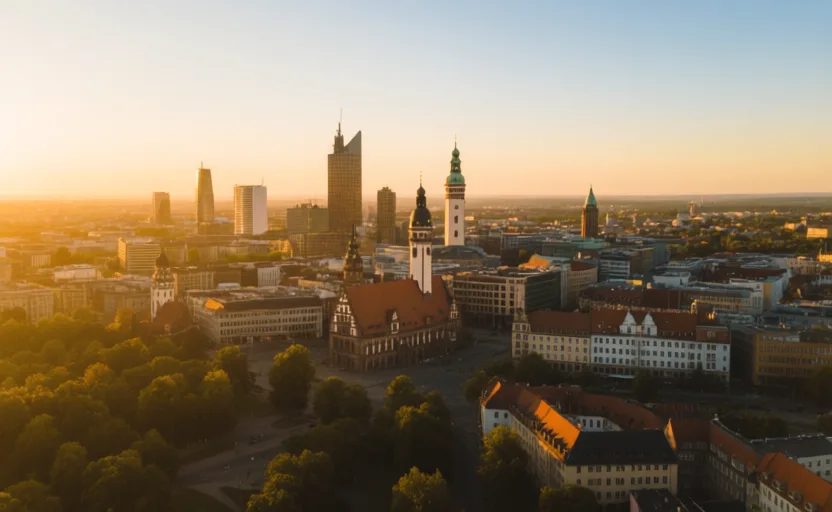 AI city illustration · Artistic impression
What people learn after moving
≈630,000 and still rising — Leipzig grew faster than any other large German city through the 2010s
German, in a Saxon dialect that other Germans enjoy imitating. English is common among students and in the startup and research sectors, less so at a counter
Euro (EUR)
CET (GMT+1); CEST (GMT+2) from late March to late October
AI city illustration · Artistic impressionCost of living in Leipzig
Check your eligibility
Pick your passport to see entry rules and the long-stay routes we have researched.
Pick your passport to see whether you can enter Germany — and what it takes to stay.
Register your address within two weeks of moving in and you get the Meldebescheinigung that the tax office, your bank, your insurer and the immigration office all demand. Leipzig's registration capacity has been chasing a decade of very fast population growth, so book earlier than the city's easygoing reputation implies. Two things are worth knowing beyond the standard route: Saxony charges 9% church tax on the basis of one line on the registration form, and the Chancenkarte gives qualified people a way to arrive and look for work.
An EU or EEA licence needs no action at all. A non-EU licence is valid for six months from taking up residence, after which you need a German one — and whether that is a form or a full driving course depends on the issuing country, or for the United States, Canada and Australia, the individual state or province. Leipzig is flat, compact and heavily cycled, has a low emission zone covering most of the built-up city and requiring a green badge, and is genuinely one of the easier German cities to live in without a car.
You need a German IBAN for salary, rent and the direct debits that run German life. Traditional banks want the registration certificate and the tax ID first; digital banks generally do not, which is why almost everyone starts there. Two Leipzig-specific notes: the Sparkasse still dominates ordinary banking here in a way it does not in Frankfurt or Berlin, and eastern Germany remains markedly more cash-oriented, so a card-only wallet will fail you regularly.
Employees below an annually reset threshold join the statutory system, where contributions are income-based, split with the employer and cover non-earning dependants free. Above it, and for the self-employed, private cover opens up — cheaper young, dearer old, priced per person and very hard to leave. The Leipzig-specific point is the Künstlersozialkasse: qualifying artists, writers, musicians, designers and photographers pay only the employee half of health and pension contributions, with the KSK paying the rest.
There is no anonymous SIM in Germany — every card is tied to an identified person, verified in store, by video call or at a post office. Prepaid needs no registration certificate, bank account or credit history and is the only sensible first move. The bigger issue is fixed-line: Leipzig's housing stock is overwhelmingly late-nineteenth-century, and what is physically wired into a Gründerzeit block varies enormously from one street to the next.
For an employee the system runs itself — Lohnsteuer comes off each month by tax class and many people never file. For the freelance half of Leipzig it is a different exercise entirely: quarterly prepayments, VAT decisions in the first weeks, and the distinction between a freelance profession and a trade, which determines whether you pay municipal trade tax at all. Both groups should file in their relocation year, because it usually refunds.
Each guide has verified costs, timelines, required documents, and the non-obvious gotchas — sourced from official government pages. Last verified August 2026.
Reading a list isn’t learning it. Globe Quest turns these into a trainer — hear each phrase spoken, drill them with spaced repetition, and get scored as you say them out loud.
The Anmeldung at a Bürgeramt is legally due within two weeks of moving in and gates the tax ID, the bank account, health insurance and the residence permit. Leipzig has absorbed well over a hundred thousand additional residents since 2010 and its registration capacity has not kept pace with that in the way people assume a mid-sized eastern city's would. Book the moment you know your move date, take any district office, and check early in the morning when cancellations are released.
Declaring membership of a recognised church at registration triggers automatic deduction of Kirchensteuer at 9% of your income tax in Saxony — the standard rate everywhere except Bavaria and Baden-Württemberg. Saxony also has some of the lowest church membership in Germany, which means the question is asked briskly and answered casually. Declaring no affiliation is lawful and costs nothing; leaving the church later requires a formal appointment, a fee, and only takes effect from the following month.
The Sächsische Mietpreisbegrenzungsverordnung covers Leipzig and Dresden and nowhere else in the state. Inside it, a new rent may exceed the local reference rent by at most 10%, and increases to a sitting tenancy are capped at 15% over three years instead of 20%. The current version took effect on 1 January 2026 and runs to 30 June 2027, continuing a cap first introduced in 2022. Move to Chemnitz, Halle or a Leipzig suburb and none of it applies.
Health insurance is compulsory for everyone. An employee's contribution is split with their employer; a freelancer pays the whole thing and must arrange cover themselves. In a city with as much freelance creative work as Leipzig this catches people repeatedly. The important exception is the Künstlersozialkasse: artists, writers, musicians, designers and photographers who qualify pay only the employee half, with the KSK covering the rest. Check whether your work qualifies before you assume it does not.
Leipzig genuinely was the bargain, when roughly a fifth of the housing stock stood empty in 2000. Vacancy has since collapsed into the low single digits, average asking rents now sit around nine euros per square metre and have risen every year, and the municipal landlord is putting through record numbers of increases. It remains far cheaper than Munich, Frankfurt or Stuttgart — but arriving with 2015 numbers in your head will cost you a flat.
Eastern German salaries still trail western ones for comparable work, and a package quoted in Leipzig is often below what the same role pays in Düsseldorf or Stuttgart — worth knowing before you negotiate, and partly offset by rent. Politically, Leipzig itself leans strongly left and green while Saxony as a whole returns very different results, and newcomers who are visibly foreign consistently report that the inner city and the regional trains out of it feel like different places. Both facts are worth hearing before you arrive rather than after.
BMW Group Plant Leipzig, Porsche Leipzig
Both plants were built from scratch after 2000 on greenfield sites north of the city. BMW's central building by Zaha Hadid runs the production line straight through the offices, and both plants anchor a supplier network across Saxony.
DHL Express European hub, Amazon, DB Schenker, Kühne+Nagel
Leipzig/Halle airport is DHL's European hub and one of the very few German airports permitted to operate through the night, which is why the freight sector here is disproportionately large — and why the northwestern districts hear it.
MDR, Leipziger Buchmesse, Kiepenheuer, Spiegel's regional operations
Leipzig was the centre of German publishing for three centuries and remains a media city — MDR, the eastern public broadcaster, is headquartered here and the March book fair is the trade's reader-facing counterpart to Frankfurt's.
VNG, TotalEnergies Leuna, Dow Olefinverbund, Verbundnetz
The chemical triangle at Leuna, Schkopau and Bitterfeld sits half an hour west and is one of Europe's larger chemical clusters, with a substantial hydrogen and refinery-conversion programme attached to it.
BioCity Leipzig, Max Planck Institute for Evolutionary Anthropology, Helmholtz UFZ, Fraunhofer IZI
The Max Planck institute here did the work that sequenced the Neanderthal genome. Combined with the university medical faculty and the BioCity incubator, life sciences are the city's strongest research pillar.
Spreadshirt, Amazon customer operations, and the Plagwitz and Westwerk startup scene
Spreadshirt was founded here in 2002 and remains the local reference point. The startup scene is smaller and considerably cheaper than Berlin's, clustered in converted industrial buildings in the west of the city.
Landmark · City centre
The church where the Monday prayers for peace grew into the demonstrations that ended the GDR in autumn 1989.
Local tip: The prayers still take place every Monday at five and are open to anyone. The interior — pale palm-tree columns added in the 1780s — is startling if you are expecting Lutheran austerity, and the single original column standing outside on the square is easy to walk past without knowing what it is.
Neighborhood · West of the centre
A nineteenth-century industrial quarter of brick factories and a canal, now the city's art and studio district.
Local tip: The Spinnerei was Europe's largest cotton mill and is now a complex of galleries and studios, home to the New Leipzig School painters. Galleries open together on set weekends several times a year — go then rather than on a random Tuesday when half the doors are locked.
Nature · 10–20 minutes south by tram or bike
Open-cast lignite pits flooded into a chain of lakes with beaches, sailing clubs and a marina, right at the edge of the city.
Local tip: Cospudener See is reachable by bicycle along the canal in half an hour and is where Leipzig swims all summer. Not every pit in the chain is finished — some are still filling and some banks are closed for stability reasons, so stick to the marked bathing areas rather than the interesting-looking shoreline.
Culture · City centre and Augustusplatz
The church where Bach was cantor for twenty-seven years and is buried, and one of the world's oldest civic orchestras.
Local tip: The Thomanerchor still sings motets on Friday evenings and Saturday afternoons, in the building the music was written for, for a very small entrance fee. It is the least touristic world-class thing in Germany and most residents never go.
Nightlife · Südvorstadt and Connewitz
'Karli' — two kilometres of bars, kebab shops, cinemas and beer gardens running south from the centre.
Local tip: The northern half is student and mainstream; keep going south into Connewitz for the alternative and left-wing scene the district is known for nationally. Cash still rules in a lot of these places, and several of the best ones do not take cards at all.
Food · Southeast of the centre
The oldest surviving terminus railway station building in the world, from 1842, now a brewpub making Gose on the premises.
Local tip: The portico is the actual 1842 structure, kept while the tracks beneath were rebuilt for the City Tunnel. Order the Gose with a shot of Allasch caraway liqueur, which is how it has been drunk here for two centuries, and sit in the beer garden under the arches.
Side-by-side cost of living, language, climate and careers — to help you choose.