
Population
≈658,000 and falling by roughly 6,000 a year — the fastest-shrinking large city in Poland, down over a fifth from its 1988 peak
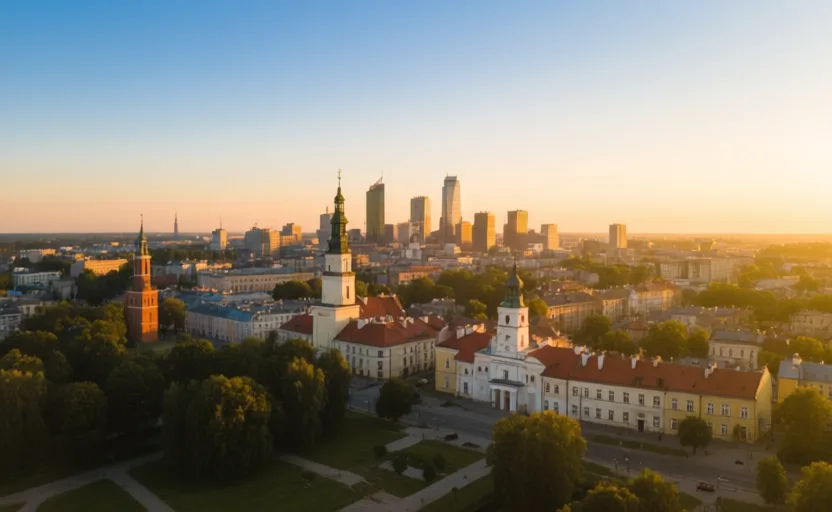 AI city illustration · Artistic impression
What people learn after moving
≈658,000 and falling by roughly 6,000 a year — the fastest-shrinking large city in Poland, down over a fifth from its 1988 peak
Łódzkie — residence cases are decided by the Łódzki Urząd Wojewódzki, Wydział Spraw Obywatelskich i Cudzoziemców, ul. Piotrkowska 103
Polish; English is standard across the outsourcing and IT sector, which is the main way foreigners enter the city
Polish złoty (PLN)
AI city illustration · Artistic impressionCost of living in Łódź
Check your eligibility
Pick your passport to see entry rules and the long-stay routes we have researched.
Pick your passport to see whether you can enter Poland — and what it takes to stay.
One combined permit covers residence and work for a named employer. Since 27 April 2026 the MOS portal is the only accepted filing channel, so a login.gov.pl trusted profile is a prerequisite rather than a convenience. The genuine local advantage is queue length: Łódzkie has consistently been reported among the faster half of Poland's voivodeships, materially clear of Wielkopolskie, Dolnośląskie and Zachodniopomorskie. That is worth months, and it is the single most underrated reason to choose Łódź over a larger Polish city.
EU and EEA licences remain valid indefinitely. A non-EU licence expires for Polish purposes six months after you establish residence and must be exchanged, with a sworn translation and — for countries outside the Vienna and Geneva road traffic conventions — a Polish theory exam. Łódź has no clean transport zone and, uniquely among Poland's big cities, an ex-industrial road grid built for far more people than now live here, so driving is genuinely easy. The tram network is the counter-argument, and the Karta Łodzianina makes it cheap.
Opening an account is straightforward and Polish retail banking is genuinely excellent. Do two things deliberately: issue your profil zaufany inside the bank app, because it now gates the MOS residence filing, and make sure the tax office your PIT names is a Łódź one — that is what unlocks the Karta Łodzianina and its municipal discounts, and it is decided by where you live rather than by where your employer is registered.
An employment contract enrols you in NFZ automatically through employer ZUS contributions. A B2B contract does not: you pay the health contribution yourself, at a rate that depends on which tax regime you elected. Łódź has a large medical university and its teaching hospitals, so specialist capacity is real — but it also has the oldest and fastest-shrinking population of Poland's big cities, which loads the system with exactly the demand that lengthens outpatient queues.
Four networks and a healthy reseller market at some of the lowest prices in the EU. Every SIM, prepaid included, must be registered against an identity document. Home fibre is standard in the postwar estates and new build; in the nineteenth-century centre it is a lottery decided by whether that specific kamienica has been modernised — and Łódź has more of those buildings than anywhere else in Poland.
Employment income is taxed at 12% and 32%, with a PLN 30,000 tax-free allowance and a near-total exemption for workers under 26 — which matters here, because eighty thousand students feed the local BPO sector. Contractors elect ryczałt at 12% of revenue for software development, with IP Box available at 5% on qualifying software income. The distinctly local layer is that Łódź ties municipal benefits to your tax address through the Karta Łodzianina, and that its property tax, like every big Polish city's, sits at the 2026 statutory maximum.
Each guide has verified costs, timelines, required documents, and the non-obvious gotchas — sourced from official government pages. Last verified August 2026.
Reading a list isn’t learning it. Globe Quest turns these into a trainer — hear each phrase spoken, drill them with spaced repetition, and get scored as you say them out loud.
Average asking rents ran around PLN 2,300 in early 2026 and a studio can still be found at PLN 1,400–1,700, against roughly PLN 3,000 in Poznań and more in Warsaw. That is not a temporary discount. Łódź has been losing population faster than any other large Polish city since the late 1980s — 658,444 residents in 2025, down about six thousand in a year and down more than a fifth from its peak. Salaries in the BPO and IT sectors are only modestly below Kraków's, so the arbitrage is real; the flip side is a city with visible vacancy and a shrinking tax base.
Residence permits are national law administered by the voivode, and the queue is where the cities genuinely differ. Ministry reporting has consistently placed Łódzkie among the faster half of Poland's sixteen voivodeships, well clear of Wielkopolskie, Dolnośląskie and Zachodniopomorskie. It is not fast in absolute terms — no voivodeship met the statutory 60-day deadline in the ministry's 2019–2022 review — but if you are choosing between Polish cities and you need a card, this is a point in Łódź's favour rather than against it. The foreigners department sits at ul. Piotrkowska 103.
The card is issued to people who settle their income tax in Łódź: you bring proof of residence and a PIT from the previous year to Piotrkowska 8, pay PLN 5 to activate the resident package, and your MPK season tickets are charged at the pre-increase rates. It is the clearest example of a Polish city buying loyalty with municipal discounts, and it is the reason locals care which tax office your PIT names.
Łódź has the largest stock of nineteenth-century tenements in Poland and has spent a decade and a great deal of EU money on area-based revitalisation of the centre. The result is uneven by design: a restored kamienica with a courtyard, a lift and fibre can stand next to one with a coal stove, a shared toilet on the landing and a structural survey. Photographs flatter both. Ask what year the building was modernised, what heats it, and whether the courtyard belongs to the same owners' community.
The main street runs about four kilometres dead straight from Plac Wolności to Plac Niepodległości, and Łódź was laid out around it as an industrial grid rather than growing out of a market square. There is no old town because there was almost no old city — the place went from a settlement of a few hundred people to the second-largest city in Poland inside seventy years. Orient yourself on Piotrkowska and the whole street plan makes sense.
Poles, Jews, Germans and Russians built industrial Łódź together, and the factory dynasties — Poznański, Scheibler, Grohman — were Jewish and German as often as Polish. The Litzmannstadt Ghetto was here; the Jewish cemetery on Bracka is the largest in Europe. Locals talk about the 'city of four cultures' constantly, and it is neither marketing nor a settled subject. Knowing what happened between 1939 and 1944 changes how you read every second building.
Infosys BPM, Fujitsu, Nordea Operations, Accenture, Sii
Łódź is one of Poland's largest outsourcing centres, and this is the sector that replaced textiles as the entry point for graduates. Infosys is among the largest foreign employers in the region and Fujitsu runs its Polish global delivery centre across Łódź and Katowice.
BSH, Indesit/Whirlpool, Ceramika Paradyż, Wielton
The Łódź Special Economic Zone pulled white-goods manufacturing into the region on the strength of central location and cheap industrial land. It is the quiet half of the local economy and the half that hires without English.
Panattoni parks, DHL, Raben, Rohlig Suus
Łódź sits at the crossing of the A1 and A2 motorways, roughly equidistant from Warsaw, Poznań, Wrocław and Gdańsk. That geography made it Poland's central warehousing hub, and the rail freight terminal has direct China connections.
National Film School (PWSFTviT), Se-ma-for heritage, Opus Film, Toya Studios
A UNESCO City of Film since 2017. Se-ma-for's stop-motion studio won Oscars from here, and Opus Film produced Ida. The school is the reason the labour pool exists at all.
Redan, Monnari, Próchnik heritage, a dense small-designer scene
The industry that built the city collapsed twice — first with the loss of Soviet export markets, then to Asian competition. What survived moved up-market into design, and the Textile Museum in Ludwik Geyer's White Factory is the place to understand what was lost.
University of Łódź, Łódź University of Technology, Medical University of Łódź
Around eighty thousand students. The Medical University runs the region's teaching hospitals, and the technical university supplies the engineering pipeline the appliance plants and the logistics operators recruit from.
Landmark · The spine of the city
A four-kilometre dead-straight commercial street laid out on an old trade route, lined with the tenements the textile barons built.
Local tip: Walk it north to south with your eyes up: the facades are the whole nineteenth century in sequence. Then duck into the courtyards — most of the interesting bars, studios and restaurants are through an archway rather than on the street.
Nightlife · Piotrkowska 138/140
A former cotton mill turned into a courtyard of bars, studios, record shops and small restaurants without being renovated into blandness.
Local tip: It is the single best answer to 'is there anything going on in Łódź'. Go on a Friday evening in summer when the courtyard fills up, and note that half the businesses inside are one-person operations that have been there for a decade.
Culture · Poznański's factory complex, west of Piotrkowska
Izrael Poznański's red-brick empire — mill, palace and workers' housing — converted into a vast retail, museum and hotel complex around a public square.
Local tip: Skip the shops and go to the Poznański Palace next door, which is the family's actual house and shows exactly how much money the textile boom made. The MS2 modern art museum inside the complex holds one of Poland's best twentieth-century collections.
Neighborhood · South-east of the centre
Karol Scheibler's self-contained factory town — mill, workers' terraces, school, hospital, fire station and villa — built as a single system in the 1870s.
Local tip: This is the best-preserved industrial settlement in Poland and people still live in the terraces. Walk the length of the workers' housing, then look at the Herbst villa at the end of it, and the whole logic of nineteenth-century paternalist capitalism is laid out in one street.
Culture · Around Łódź Fabryczna station
The city's first power station, rebuilt as a science centre and planetarium beside the underground station that anchors an entirely new district.
Local tip: Łódź Fabryczna is one of the largest underground railway stations in Europe and it was built for a cross-city tunnel that is still being finished. The planetarium in EC1 is genuinely good; the surrounding building site is the city betting its future on a piece of infrastructure.
Culture · Bałuty, north
The largest Jewish cemetery in Europe — over forty hectares, around two hundred thousand graves, and the Poznański mausoleum.
Local tip: Much of it is deliberately left half-wooded, which makes the scale hit harder than a tidied site would. The Ghetto Field at the edge holds the graves of those who died in the Litzmannstadt Ghetto. Almost no visitor to Łódź comes here and it is the most important place in the city.
Side-by-side cost of living, language, climate and careers — to help you choose.