Population
Around 2.6 million (2021 urban estimate) — no census since 1984, so treat every figure as a projection
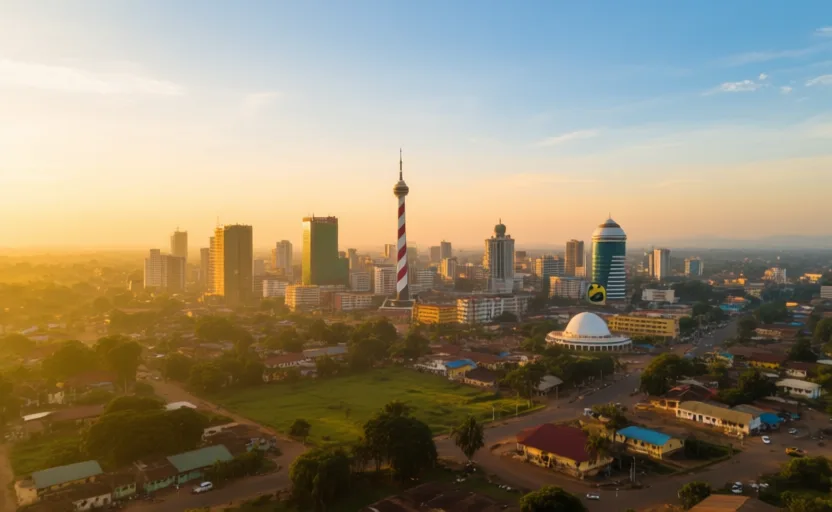 AI city illustration · Artistic impression
What people learn after moving
Around 2.6 million (2021 urban estimate) — no census since 1984, so treat every figure as a projection
French (official); Swahili in its Kingwana dialect is the lingua franca, with Kiluba, Bemba, Chokwe and Kisanga
Congolese franc (CDF, written FC) — rent, salaries and mining contracts in US dollars
GMT+2 (Africa/Lubumbashi) — an hour AHEAD of Kinshasa; the DRC is Africa's only two-zone country
AI city illustration · Artistic impressionCost of living in Lubumbashi
Check your eligibility
Pick your passport to see entry rules and the long-stay routes we have researched.
Pick your passport to see whether you can enter Congo (DRC) — and what it takes to stay.
There is no residence permit separate from the visa in the DRC: the visa d'établissement IS the residence status, granted on the decision of the DGM's Director-General under a 1987 ordinance. Before it, your employer needs the biometric carte de travail from the Commission Nationale de l'Emploi des Étrangers — the work card is a precondition of the work establishment visa, not a consequence of it. In Haut-Katanga the work-card file goes to the Division provinciale de l'Emploi et du Travail rather than to the CNEE secretariat in Kinshasa.
Only the biometric chip licence issued by CONADEP is recognised. The rollout relaunched in November 2024, roadside enforcement began on 30 June 2025, and the Ministry of Transport confirmed in September 2025 that the control campaign was continuing. Old paper and plastic licences are not the document any more, and an International Driving Permit is a visitor's document rather than a resident's.
Open a bank account and a mobile-money wallet early. Since 9 April 2026 commercial banks may no longer physically import foreign banknotes; from 9 April 2027 no person or company may settle any transaction in foreign-currency cash at any amount. Dollars are not banned — dollar CASH is, and everything moves to transfer, card and mobile money. Meanwhile Haut-Katanga's provincial government has formally instructed traders and changers to stop refusing damaged notes, which tells you both that the practice is rife and that somebody in authority is finally pushing back.
There is no national emergency medical number in the DRC — you call a clinic directly. Serious cases are evacuated, and Lubumbashi's advantage is that the destination is Johannesburg, reachable by direct flight rather than via Kinshasa. The additional risk is industrial: this is a century-old smelting city where mining and processing sit inside and around the urban area. Malaria is year-round, and the national cholera epidemic — the worst in twenty-five years — is a country-wide backdrop.
Four networks — Vodacom Congo, Airtel DRC, Orange RDC and Africell — with mobile money on all of them. Anonymous SIMs are finished: the government adopted mandatory, systematic subscriber identification for every new subscription, implemented by the regulator ARPTC with the operators. Bring your passport. Ignore anything about the RAM levy, abolished on 1 March 2022. And turn data roaming off before you drive south.
Your employer withholds IPR on annual bands of 3%, 15%, 30% and 40%, capped so IPR can never exceed 30% of taxable salary. CNSS takes 5% from you for the pension branch and 13% from the employer across three branches. The employer also pays the IERE on your gross salary — 25% generally, but 12.5% for mining companies in their first ten years of activity. And the DRC does not tax individuals' foreign-source income at all.
Each guide has verified costs, timelines, required documents, and the non-obvious gotchas — sourced from official government pages. Last verified August 2026.
Reading a list isn’t learning it. Globe Quest turns these into a trainer — hear each phrase spoken, drill them with spaced repetition, and get scored as you say them out loud.
The DRC is the only country in Africa that runs two time zones, and Haut-Katanga is in the eastern one, an hour ahead of the capital. Roughly 59% of Congolese live in that eastern zone. Every guide that says 'the DRC is GMT+1' is describing Kinshasa; every calendar invite from a head office that assumes one national time will be an hour wrong. Set your phone to Africa/Lubumbashi and check it after every flight west.
At 1,208 metres, Lubumbashi has a real dry winter: June and July average a minimum of about 8°C and single-digit nights are normal, in houses built with no heating whatsoever. Newcomers who packed for 'the Congo' spend their first July buying blankets. The dry season runs roughly May to September and is the best half of the year; the rains bring about 1,238 mm between October and April.
Katanga's lingua franca is the Kingwana dialect of Swahili, alongside Kiluba, Bemba, Chokwe and Kisanga. Lingala is the army's language and the music's language and it will get you understood, but it is not the street language here. This is also the clearest signal that Katanga's orientation runs south toward Zambia and Southern Africa rather than west toward Kinshasa.
This is a city built around a century of copper smelting — the Gécamines terril is the skyline — and industrial land, tailings and active plant sit inside the urban area. Ask what is upwind of a house before you sign, ask what the dust looks like in the dry season, and take local advice on the neighbourhoods immediately adjacent to industrial sites. Nobody will volunteer this; everybody will answer it.
Loi 86-007 du 27 décembre 1986 forbids foreigners from staying or circulating in a schedule of designated mining zones, with imprisonment of six months to two years for breach. Read Article 1 carefully: it lists the Kasaïs in full, parts of Kivu, Maniema, Bas-Congo, Ituri, Haut-Uélé and Bandundu — and it does not list Shaba/Katanga. The copper belt is outside the schedule. If you are travelling on from here to the Kasaïs, that stops being true.
Lubumbashi's practical hinterland is Zambia and South Africa, not Kinshasa. Johannesburg is the medical-evacuation destination and the direct-flight relationship that makes it workable; Kasumbalesa is the border that most of the province's goods cross; and a surprising share of what is on the supermarket shelf came up the road from Lusaka. Build your logistics around that rather than around the capital.
Gécamines, Glencore (KCC and Mutanda), CMOC (Tenke Fungurume, Kisanfu), Ivanhoe/Zijin (Kamoa-Kakula), Chemaf, Ruashi Mining, Somika
The reason the city exists. The DRC supplies around two-thirds to three-quarters of the world's mined cobalt and is now among the largest copper producers on earth, and Lubumbashi is where the mining industry's offices, laboratories, logistics and lawyers sit — the pits themselves are spread across Haut-Katanga and Lualaba.
SGS, Bureau Veritas, Alex Stewart, Bolloré/AGL successors, Amanzi, freight forwarders on the Kasumbalesa corridor
For every engineer underground there is a laboratory technician, an assayer, a customs broker and a fleet manager in Lubumbashi. This is the part of the economy that most reliably hires foreigners on ordinary commercial terms rather than through a mining major.
SNEL, ZESCO cross-border supply, mining-company independent power projects
Katanga's grid is physically remote from Inga and chronically short, which is why mines import power from Zambia and Southern Africa and why the province is a live market for independent generation. Load-shedding is not a nuisance here, it is an industrial input constraint.
Brasimba (Simba beer), Bralima, Sodeico-served manufacturers, Katanga agri-processors
Simba is brewed here and is a Katanga identity object as much as a drink. The consumer-goods sector is unusually exposed to the Zambian border: when Kasumbalesa slows, shelves in Lubumbashi notice before shelves in Kinshasa do.
Rawbank, Equity BCDC, Trust Merchant Bank, Ecobank, Access, plus the mining sector's treasury operations
A commodity-export economy means trade finance, letters of credit and foreign-exchange work rather than retail branch banking. The BCC's April 2026 de-dollarisation package lands hardest exactly here, on a province that settles large sums in cash.
Université de Lubumbashi (1955), Université protestante de Lubumbashi, Musée national de Lubumbashi, the Picha biennale
UNILU is one of the DRC's oldest and best universities, with a strong geology and mining-engineering tradition that feeds the industry directly. The city also runs a genuinely internationally-regarded contemporary art biennale, which surprises people who expected a company town.
Landmark · Central Lubumbashi
A black mountain of smelter slag rising straight out of the city — the accumulated waste of a century of copper refining, and by a distance Lubumbashi's most recognisable object. It is the thing you orient by, the thing in every photograph, and a fairly direct statement of what this city has been doing since 1910.
Local tip: It is industrial property and it has been actively reprocessed for residual metal, so this is a look-at rather than a climb-up. The view of it from the western approaches at the end of the dry season, with the light low and the dust up, is the picture.
Culture · City centre
The regional national museum, holding Katanga's archaeology and ethnography — Luba and Chokwe material, the copper-cross currency the region traded in for centuries, and the industrial history of the Union Minière years that made the city.
Local tip: Small and uneven, and worth an hour rather than an afternoon — but the copper-cross collection reframes the entire province. Ask about the Picha biennale while you are there; the contemporary art scene here punches far above the city's profile.
Neighborhood · West of the centre
The low-rise residential grid laid out when this was Élisabethville — wide avenues, deep verandas, walled gardens and jacarandas that go purple around September. It is where most of the mining and diplomatic households live and where the city looks least like the rest of the country.
Local tip: Walk it in the late dry season for the jacarandas. And note what it tells you about the housing market: this quarter is priced by mining-company allowances, so its rents are not the city's rents.
Nature · Kundelungu National Park, north-east of the city
A single unbroken drop off the Kundelungu escarpment, reckoned the tallest waterfall in the DRC, on a high grassland plateau that looks nothing like anyone's mental image of the Congo — closer to Zambia's Nyika than to rainforest.
Local tip: Dry-season only in practice, and a serious 4x4 expedition rather than an outing: go with people who have done it, check the current park access position before setting out, and treat fuel and recovery gear as non-optional.
Food · Kenya, Katuba and the central markets
Katanga eats like Southern Africa: bukari — stiff maize meal — with sombe, beans, dried fish or chicken, rather than the cassava chikwangue of the west. The markets in the townships are where that food economy actually happens, and where the Zambian import trade is most visible.
Local tip: Go early, go with someone, and eat the bukari at the market rather than in a restaurant. If you want to understand why prices moved this month, ask a market trader about Kasumbalesa before you ask an economist.
Nightlife · City centre
Lubumbashi's evening runs on ngandas — open-air bars with grilled meat, plastic chairs and a sound system — and the central avenues are where they cluster. The music is rumba and ndombolo like everywhere in the DRC, but the crowd is talking Swahili and drinking Simba.
Local tip: Nothing starts before nine and the good nights are Thursday to Saturday. Take a driver you know rather than flagging a taxi at 2 a.m., and carry small notes and clean ones.
Side-by-side cost of living, language, climate and careers — to help you choose.