Population
~690,000 in about 33 km²
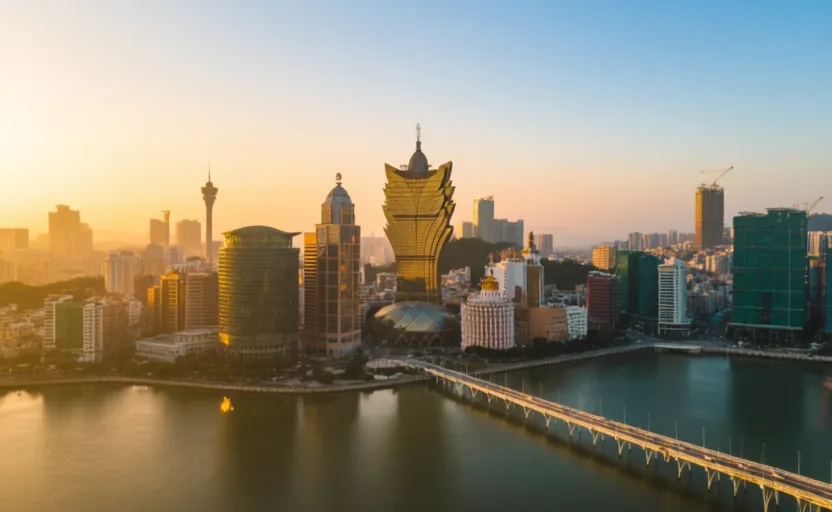 AI city illustration · Artistic impression
What people learn after moving
~690,000 in about 33 km²
Among the highest on earth — roughly 21,000 people per km²
Chinese (Cantonese in practice) and Portuguese
Macanese pataca (MOP), pegged to the HK dollar
AI city illustration · Artistic impressionCost of living in Macau
Check your eligibility
Pick your passport to see entry rules and the long-stay routes we have researched.
Pick your passport to see whether you can enter Macau — and what it takes to stay.
Macau separates the right to work from the right to reside, and most foreign hires get only the first. A blue card ties you to one employer, gives you no Macao Resident Identity Card, and earns you nothing toward permanent residence no matter how many years you renew it. Residence — which does start the seven-year clock — comes from a different set of routes entirely. Getting this distinction right at offer stage is the single highest-value thing you can do.
Macau will issue you a local licence without any test if you hold a Macao Resident Identity Card and a valid licence from a Convention on Road Traffic country. The fee is MOP 2,000 plus stamp duty and it is a single counter visit. The catch — and it is a big one — is the resident ID card requirement, which puts this route out of reach of blue-card holders. Most residents solve the problem by not driving at all.
Opening a Macau account is straightforward if you have an employer and a local address, and awkward if you have neither. The useful thing to understand is currency: your salary may be paid in patacas, your rent quoted in Hong Kong dollars, and the two are pegged but not equal. Open an account that holds both, and pay in the right one.
Macau has one public hospital, Centro Hospitalar Conde de São Januário, plus a network of government health centres, and two significant private hospitals in Kiang Wu and MUST Hospital. Residents get the public system essentially free. Non-residents pay published non-resident rates. Which side of that line you are on is decided by your immigration status, not by how long you have lived here.
Getting connected in Macau takes fifteen minutes with a passport. The thing worth thinking about is not the SIM itself but the borders: Macau, Hong Kong and mainland China are three separate mobile markets within an hour of each other, and if you cross regularly a tri-area plan will save you a lot of roaming.
Macau's personal tax burden is genuinely light and, unusually, does not depend on residence. Professional tax applies to income from employment services performed in Macau or from a Macau employment, whoever you are and wherever you were paid. In 2026 the first MOP 144,000 is exempt, the top marginal rate is 12%, there is a 25% standard deduction and a 30% reduction in the liability on top. There is no separate tax on investment income, no capital-gains tax, no VAT and no inheritance tax.
Each guide has verified costs, timelines, required documents, and the non-obvious gotchas — sourced from official government pages. Last verified August 2026.
Reading a list isn’t learning it. Globe Quest turns these into a trainer — hear each phrase spoken, drill them with spaced repetition, and get scored as you say them out loud.
Most foreign workers in Macau hold a non-resident worker's permit, the blue card, under Law 21/2009. It lets you work for one named employer and nothing else. It does not make you a resident, does not get you a Macao Resident Identity Card, and time on it does not count toward the seven years needed for permanent residence. The residence routes are the talent regime under Law 7/2023, IPIM investment residency, and family reunion. At offer stage, ask the employer which one this is.
The pataca is pegged to the Hong Kong dollar at about MOP 1.03 to HKD 1, and HKD is accepted almost everywhere — but shops take it at 1:1. Paying in Hong Kong dollars quietly costs you roughly 3% on every transaction, and change comes back in patacas you can't easily spend in Hong Kong. Change money once and pay in MOP.
Like Hong Kong and unlike mainland China ten minutes away across the bridge. Crossings, roundabouts and the direction traffic comes from all flip at the border. Look right first when stepping off a kerb — this is the most common way visitors get hurt here.
Macau packs its population into about 33 square kilometres, which puts it among the most densely populated places on earth. Almost nowhere on the peninsula is more than a half-hour walk from anywhere else, buses are cheap and frequent, and owning a car is largely a parking problem. Most residents never bother.
Gaming and the integrated resorts dominate employment, wages, rents and even traffic patterns. Frontline gaming roles are legally reserved for Macau residents, which shapes where foreign hires land — hospitality, back-of-house, construction, finance and specialist functions. Understand which side of that line your job sits on before you accept it.
Cantonese is what you'll hear, but Portuguese is a co-official language: street names, official forms, court judgments and much of the Civil Code exist in Portuguese. You do not need to speak it, but knowing that a lawyer or notary may work primarily in Portuguese explains a lot about how paperwork feels here.
Sands China, Galaxy Entertainment, SJM, Wynn Macau, MGM China, Melco
The overwhelming gravitational centre of the economy; frontline gaming jobs are reserved for Macau residents.
The Venetian, Galaxy, Grand Lisboa, Londoner
Tens of thousands of hotel rooms and a major conference and events sector attached to the resorts.
Resort retail malls, Senado Square high street
Driven by mainland visitor flows; sensitive to border policy and consumer sentiment in Guangdong.
BNU, ICBC Macau, Bank of China Macau, Luso International Bank
A deliberate diversification push — bond listings, wealth management and leasing are named priority sectors.
Cotai resort developers, Hengqin cross-border projects
Sustained public and private building, plus the Hengqin cooperation zone across the border.
University of Macau, MUST, Kiang Wu Hospital
'Big health', traditional Chinese medicine and cultural tourism are the government's stated diversification targets.
Landmark · Macau Peninsula (Santo António / Sé)
The stone façade of a burned-out 17th-century Jesuit church above a wave-patterned Portuguese square — the postcard, and deservedly so.
Local tip: Go before 9am or after 8pm. Between those hours it is one of the most crowded few hundred metres in Asia.
Food · Taipa
A narrow lane of almond-cookie bakeries, pork-chop buns and Macanese restaurants at the heart of the old Taipa village.
Local tip: Eat the pork-chop bun standing up, then walk five minutes to the Taipa Houses museum for the colonial-era waterfront that used to be there.
Nightlife · Cotai
Reclaimed land between Taipa and Coloane, now a canyon of integrated resorts, arenas, shows and 24-hour everything.
Local tip: The free inter-resort shuttle buses are the cheapest transport network in Macau, and nobody checks whether you are a hotel guest.
Nature · Coloane
The green, hilly southern island that development never reached — a fishing village, a black-sand beach and proper hiking trails.
Local tip: Take the 15 or 21A bus, eat at Lord Stow's in the village, and walk the Coloane Trail. It is the antidote to the Cotai Strip and it is twenty minutes away.
Culture · Barra, Macau Peninsula
The oldest temple in Macau, dedicated to the sea goddess Mazu, and the origin of the name 'Macau' itself.
Local tip: Climb the terraces at the back — most visitors stop at the first courtyard and miss the quieter shrines above.
Neighborhood · Macau Peninsula (São Lázaro)
A few blocks of pastel Portuguese townhouses and calçada pavements, now a small creative quarter of studios and independent cafés.
Local tip: Sunday afternoons bring a low-key market and the light on Calçada da Igreja de São Lázaro is the best photography in Macau. Almost nobody who comes for the casinos ever finds it.
Side-by-side cost of living, language, climate and careers — to help you choose.