
Population
≈12.5 million in the city; ≈21 million across the metropolitan region
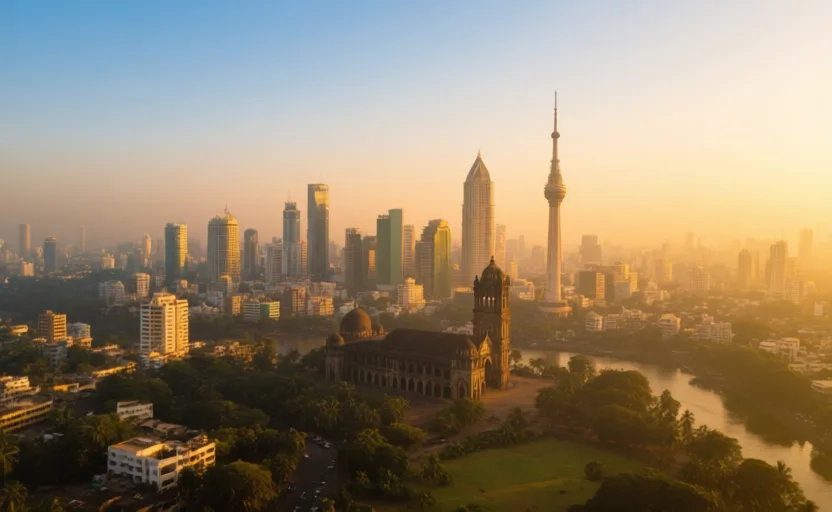 AI city illustration · Artistic impression
What people learn after moving
≈12.5 million in the city; ≈21 million across the metropolitan region
Marathi is the state language; Hindi and English are used everywhere, and Mumbai Hindi has its own distinct flavour
Indian rupee (INR)
IST (GMT+5:30) — India has a single time zone and no daylight saving
AI city illustration · Artistic impressionCost of living in Mumbai
Check your eligibility
Pick your passport to see entry rules and the long-stay routes we have researched.
Pick your passport to see whether you can enter India — and what it takes to stay.
India's employment visa is employer-sponsored and carries a minimum annual salary threshold. The step people miss is registration: if your visa is valid for more than 180 days you must register with the FRRO within 14 days of arrival, now done online through e-FRRO. Missing it compounds — exit permissions, visa extensions and address changes all flow through the same system, and an unregistered foreigner has a problem at every subsequent step.
You may drive on a valid foreign licence accompanied by an International Driving Permit for a limited period after arrival — generally up to a year — after which you need an Indian licence issued by the Regional Transport Office covering your address. The more useful advice is that very few foreign residents in Mumbai drive themselves. Traffic is dense and improvisational, parking is scarce and expensive, and a hired driver or app-based cabs cost a fraction of what they would elsewhere.
Which account you can open depends on your residential status under FEMA, not on your visa. A foreign national resident in India for employment can generally open an ordinary resident savings account; those not resident use NRO or NRE accounts. Everything requires a PAN card and full KYC, and the process is document-heavy by international standards. Start it in week one, because your salary depends on it.
Your employer's group medical cover is the normal route, and Mumbai has some of the best private hospitals in Asia at a fraction of Western prices. What newcomers underestimate is the seasonal disease pattern: dengue, malaria, leptospirosis and gastrointestinal illness all spike around and after the monsoon, and the precautions are specific and effective. Air quality in the winter months is also a genuine health factor.
India requires full identity verification for every SIM, and for foreign nationals the requirements go further: passport, visa, photographs, proof of local address and sometimes a local reference. SIMs issued to foreigners are typically given a validity tied to the visa and may start with a short initial period. Plan for this to take a day or two rather than minutes — it is one of the few places where India is more bureaucratic than most countries in this app.
You are tax-resident in India if you spend 182 days or more in a financial year, or 60 days or more in the year plus 365 days across the preceding four. The new regime has been the default since AY 2024-25 — lower rates, very few deductions — with the old regime available by election. Note the section number changed: it was section 115BAC of the Income-tax Act 1961, and since the Income-tax Act 2025 replaced that Act on 1 April 2026 the new regime sits in section 202. India's financial year runs April to March, which catches almost every newcomer from a calendar-year country.
Each guide has verified costs, timelines, required documents, and the non-obvious gotchas — sourced from official government pages. Last verified August 2026.
Reading a list isn’t learning it. Globe Quest turns these into a trainer — hear each phrase spoken, drill them with spaced repetition, and get scored as you say them out loud.
Foreign nationals on an employment visa valid for more than 180 days must register with the jurisdictional FRRO within 14 days of arrival. The process is now online through e-FRRO — no agent is required and usually no office visit. You need your passport, a registered lease or accommodation proof, your appointment letter and employment contract, and proof of annual income. Missing the window creates a compounding problem that is far harder to fix than to avoid.
The Permanent Account Number is India's tax identifier and it gates almost everything: opening a bank account, receiving a salary, buying property, large transactions. Foreign nationals can apply, and it is worth starting in your first week because the downstream dependencies are extensive. Without it your employer may be required to deduct tax at a much higher rate.
Maharashtra's rent control legislation gives long-term tenants strong protections, so landlords universally use an 11-month leave-and-licence agreement instead, renewed annually. The agreement must be registered with the state, and stamp duty and registration charges apply. This is completely normal — but understand that you have a licence, not a tenancy, and that renewal is at the landlord's discretion.
Most Mumbai flats sit in co-operative housing societies which approve incoming tenants, charge their own fees, set rules on everything from pets to parking, and in practice sometimes discriminate on grounds of nationality, religion or diet. It is unlawful but it happens. Budget time for society approval on top of agreeing terms with the landlord, and get the landlord to confirm approval before you pay anything.
From June to September the rain is not a weather event but a season. Suburban trains stop, low-lying areas flood, commutes double, and the July 2005 and 2017 floods are within living memory. Check whether a prospective flat is in a flooding area, keep a few days of supplies, and expect to lose working days. Locals plan around it rather than being surprised by it.
Mumbai is a narrow peninsula and the suburban rail runs north-south on three lines — Western, Central and Harbour. A flat ten kilometres away on your line is closer in practice than one four kilometres away requiring a change. The commute is the single largest determinant of quality of life here, and people organise their entire lives around it.
Reserve Bank of India, HDFC Bank, ICICI, Kotak, State Bank of India
Mumbai is India's financial capital without qualification — the central bank, both stock exchanges and the headquarters of nearly every major bank and insurer are here.
BSE, NSE, SEBI, Motilal Oswal, HDFC AMC
The Bombay Stock Exchange is Asia's oldest, and the regulator sits in the same city, which concentrates the entire securities industry within a few square kilometres.
Yash Raj Films, Dharma Productions, Netflix India, Amazon Prime Video
Hindi cinema is headquartered here and the streaming platforms have built substantial production operations around it. It is a genuinely large employer, not just a cultural export.
Jio, Tata Consultancy Services, Razorpay, CRED, Zerodha (Bengaluru-linked)
Mumbai's tech sector skews to fintech and consumer platforms — proximity to banks and regulators matters more here than engineering density, which is Bengaluru's advantage.
Reliance Industries, Tata Group, Aditya Birla, Mahindra, Godrej
An unusual concentration of India's largest business houses, most of them family-controlled, and most with headquarters within a few kilometres of each other.
JNPT, Sun Pharma, Cipla, Lupin
Jawaharlal Nehru Port handles a large share of India's container traffic, and the western pharmaceutical corridor runs north from the city.
Landmark · South Mumbai
A three-kilometre art deco crescent along the Arabian Sea, its streetlights known as the Queen's Necklace after dark.
Local tip: Go at sunset and walk north to Chowpatty for bhelpuri from the stalls. Mumbai has the world's second-largest collection of art deco buildings after Miami — look up at the facades along the promenade.
Nature · Borivali, northern suburbs
A 104-square-kilometre national park inside the city limits, with 2,000-year-old Buddhist caves carved into basalt and a resident leopard population.
Local tip: Genuinely wild — leopards live here and occasionally enter surrounding neighbourhoods. Go early on a weekday. The Kanheri caves are a 6km walk or a bus from the gate.
Neighborhood · Central Mumbai
One of the world's largest informal settlements and also a working industrial district turning over hundreds of millions of dollars a year in recycling, leather and pottery.
Local tip: If you visit, go with an operator that employs residents and returns money to the community, and do not photograph people without asking. Better still, buy from the leather workshops directly.
Landmark · Fort
A UNESCO-listed Victorian Gothic railway station from 1888, and still one of the busiest in India.
Local tip: The exterior is what everyone photographs; the heritage gallery and the star chamber inside are open to visitors and almost nobody goes. Come at 6pm to see the peak commuter flow, which is a sight in itself.
Neighborhood · Bandra West
The suburb where the film industry lives — sea-facing promenades, Portuguese-era villas and street art along Chapel Road.
Local tip: Walk Chapel Road and Waroda Road for the murals and the old East Indian village houses, then eat at one of the Bandra institutions rather than the sea-facing chains.
Culture · Walkeshwar, Malabar Hill
An 11th-century freshwater tank surrounded by temples and stepped ghats, hidden in the middle of Mumbai's most expensive neighbourhood.
Local tip: Five minutes from the towers of Malabar Hill and a thousand years away. Almost no visitors find it, and the residents around the tank have lived there for generations. Go at dawn.
Side-by-side cost of living, language, climate and careers — to help you choose.