
Population
≈1.6 million in the city; ≈2.9 million in the metropolitan area
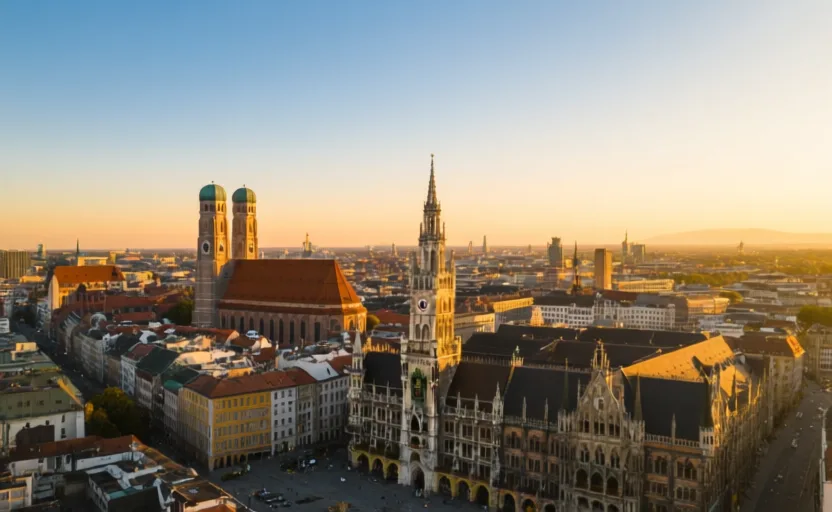 AI city illustration · Artistic impression
What people learn after moving
≈1.6 million in the city; ≈2.9 million in the metropolitan area
German, with Bavarian dialect widely spoken; English is common in the tech and international sectors
Euro (EUR)
CET (GMT+1); CEST (GMT+2) from late March to late October
AI city illustration · Artistic impressionCost of living in Munich
Check your eligibility
Pick your passport to see entry rules and the long-stay routes we have researched.
Pick your passport to see whether you can enter Germany — and what it takes to stay.
Germany's sequence is rigid and everything hangs off the first step: register your address (Anmeldung) within two weeks of moving in, which produces the confirmation you need for a tax ID, a bank account, health insurance and your residence permit. Munich's problem is appointment scarcity — Bürgerbüro slots are the hardest to get in Germany, and the whole chain stalls behind them.
EU and EEA licences remain valid in Germany without any action. Non-EU licences are valid for six months from taking up residence, after which you need a German licence — and whether you must retake tests depends entirely on which country and, for some countries, which state or province issued it. Check that list before assuming, because the difference is between a form and a full driving course.
You need a German account for your salary, your rent and almost every direct debit. Traditional banks require an Anmeldung before opening one, which creates a sequencing problem for new arrivals; the digital banks generally do not, which is why most newcomers start there. The deeper issue is Schufa: you arrive with no credit record at all, and in Munich's rental market that is the main obstacle to getting a flat.
Germany requires everyone to hold health insurance. Employees earning below an annually-set threshold must join the statutory system, where contributions are a percentage of income shared with the employer and dependants are covered free. Above the threshold, and for the self-employed, private insurance becomes available — cheaper when young and healthy, and considerably more expensive later. Moving from private back to statutory is difficult and gets harder with age.
Germany requires identity verification for every SIM, including prepaid — passport or ID, verified in a shop, by video call or by post office identification. Prepaid is straightforward and needs no Anmeldung or Schufa. Postpaid contracts run a Schufa check, which a newcomer will fail or pass marginally, so start prepaid and switch later once you have a record.
German income tax is progressive and deducted at source, with your tax class (Steuerklasse) determining how much comes off each month. Church tax adds 8% of your income tax liability in Bavaria — 9% in most other states — if you declared a religious affiliation at Anmeldung. A solidarity surcharge applies to higher incomes. Filing a return is optional for many employees but frequently produces a refund.
Each guide has verified costs, timelines, required documents, and the non-obvious gotchas — sourced from official government pages. Last verified August 2026.
Reading a list isn’t learning it. Globe Quest turns these into a trainer — hear each phrase spoken, drill them with spaced repetition, and get scored as you say them out loud.
You must register your address at a Bürgerbüro within two weeks of moving in, and everything downstream — tax ID, bank account, health insurance, phone contract — depends on it. Munich's appointment scarcity is the worst in Germany, routinely booked out weeks ahead. Start checking the online booking system the moment you know your move date, refresh it early in the morning when cancellations appear, and accept any appointment in any district office.
If you register as a member of a recognised church at your Anmeldung, you pay church tax as a percentage of your income tax — 8% in Bavaria and Baden-Württemberg, 9% in every other German state. Declaring no religious affiliation means no church tax. This is a real annual sum on a professional salary, and the declaration you make at registration is what triggers it.
Munich rents exceed Berlin's, Hamburg's and Frankfurt's, and the market is genuinely tight — viewings routinely have dozens of applicants. You will need a Schufa credit report, proof of income, a Mietschuldenfreiheitsbescheinigung from a previous landlord where possible, and speed. Newcomers with no Schufa history should ask their employer for a letter and consider offering a larger deposit, which is capped at three months' cold rent.
Everyone in Germany must hold health insurance. Employees below an income threshold join the statutory system (gesetzliche Krankenversicherung); above it you may opt for private cover. The choice is close to irreversible in practice — moving back from private to statutory later is difficult and gets harder with age. Take advice before choosing, and do not pick private cover purely on the first year's premium.
Every household in Germany pays a broadcasting fee regardless of whether anyone owns a television. It is billed per dwelling, not per person, so flatmates split one charge. Registering your address triggers it automatically, and ignoring the letters leads to enforcement. Budget for it and, if you share, agree who pays.
Munich sits close enough to the mountains that skiing, hiking and lake swimming are ordinary weekend activities rather than holidays. The Bayerische Regiobahn and the Bayern-Ticket make the trip cheap. This proximity is genuinely the strongest quality-of-life argument for Munich over Berlin or Hamburg, and it is why people accept the rents.
BMW, MAN, Audi (Ingolstadt), Knorr-Bremse, Webasto
BMW is headquartered here and the Bavarian automotive supply chain is one of the densest industrial clusters in Europe.
Allianz, Munich Re, HypoVereinsbank, Wirecard's successors
Munich Re and Allianz make this one of the world's most important reinsurance and insurance centres, employing heavily in actuarial and technology roles.
Siemens, Infineon, Apple, Google, Microsoft, Intel
Siemens is headquartered here and Apple has built its largest European chip design centre in the city — Munich is Germany's strongest hardware and semiconductor cluster.
Airbus Defence and Space, MTU Aero Engines, Rohde & Schwarz
A substantial aerospace presence around Ottobrunn and Taufkirchen, with significant space and satellite work.
Roche Diagnostics, Siemens Healthineers, Daiichi Sankyo Europe
The Martinsried and Grosshadern campuses form Germany's leading biotech cluster, anchored by the two universities and the Max Planck institutes.
Burda, Süddeutsche Zeitung, Personio, Celonis, Flixbus
Munich has produced several of Germany's largest startups — Celonis and Personio among them — and the venture scene is second only to Berlin's.
Nature · Central-north
One of the largest urban parks in the world, bigger than Central Park, with a standing river wave that surfers ride year-round.
Local tip: The Eisbach wave at the southern end runs all year and is genuinely difficult — watch rather than attempt it. Nude sunbathing in the park is legal and normal; do not be startled. The Chinesischer Turm beer garden is the classic stop.
Food · Altstadt
A permanent open-air food market running since 1807, with a beer garden in the middle that rotates its brewery.
Local tip: Expensive, and worth it for the cheese, game and produce stalls. The beer garden follows the Bavarian rule — bring your own food, buy the drinks — so assemble lunch from the stalls and sit down with a Maß.
Culture · Museumsinsel
The largest science and technology museum in the world, with mines, aircraft and a historic collection spanning centuries.
Local tip: Genuinely enormous — pick two or three sections rather than attempting it all. The reconstructed mine in the basement is the thing children remember, and the aviation hall is world class.
Nature · One hour south by train
Tegernsee, Starnberger See, the Zugspitze and the Karwendel — mountains and swimming lakes within an hour of the Hauptbahnhof.
Local tip: The Bayern-Ticket lets several people travel all day across Bavaria for a flat fare, which makes a mountain day trip absurdly cheap. Walchensee and Eibsee are the most beautiful; Tegernsee is the easiest.
Landmark · West
The Wittelsbach summer palace with a 200-hectare baroque park, canals and pavilions.
Local tip: The park is free and enormous, and in winter the canals freeze and locals skate on them. The Amalienburg hunting lodge inside is the finest rococo interior in Germany and most visitors walk past it.
Nature · South of the centre
A renaturalised stretch of the Isar with gravel beaches, barbecue spots and swimming, running right through the city.
Local tip: Munich rebuilt the Isar to be swimmable, and on a summer evening the banks fill with people grilling and swimming ten minutes from the centre. The Flaucher is the best stretch, and almost no visitor ever finds it.
Side-by-side cost of living, language, climate and careers — to help you choose.