
Population
Approaching 500,000 in the municipality — the seventh largest in Spain — but spread across an urban core and more than fifty outlying pedanías over 881 km²
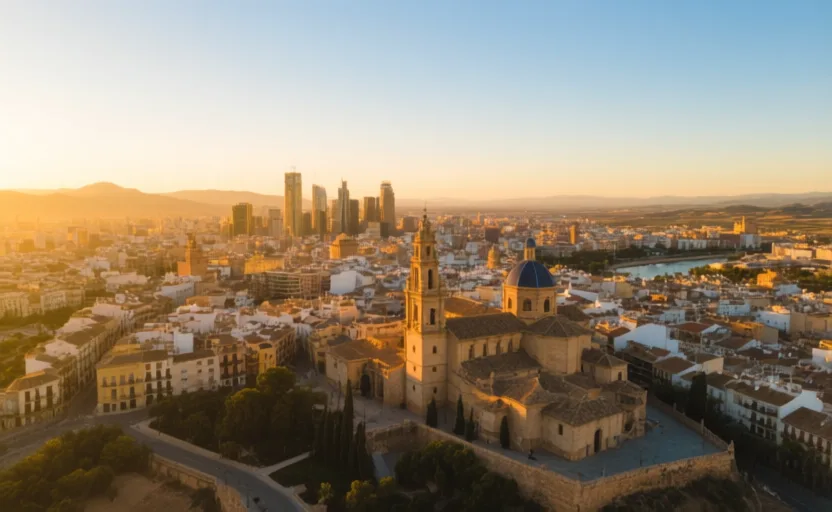 AI city illustration · Artistic impression
What people learn after moving
Approaching 500,000 in the municipality — the seventh largest in Spain — but spread across an urban core and more than fifty outlying pedanías over 881 km²
Castilian Spanish, the sole official language. The local speech is strongly marked — the huerta dialect known as panocho survives in vocabulary, and 'acho' is the regional signature
Euro (EUR)
CET (GMT+1); CEST (GMT+2) from late March to late October
AI city illustration · Artistic impressionCost of living in Murcia
Check your eligibility
Pick your passport to see entry rules and the long-stay routes we have researched.
Pick your passport to see whether you can enter Spain — and what it takes to stay.
Spanish residency is a sequence and the order matters: a NIE number, then municipal registration on the padrón, then a TIE card, then social security, then a health card. Each step is a prerequisite for the next and each needs a cita previa. Most residents use a gestor for part of it, and that is a rational choice. The Murcia-specific complication is scale: the municipality is enormous and its services are distributed across the pedanías, so knowing which district you belong to is the first practical question rather than an afterthought.
EU and EEA licences are exchangeable straightforwardly. For everyone else it depends entirely on whether Spain has a bilateral agreement with the issuing country — if it does, you exchange without a test; if not, you take the full Spanish theory and practical exams in Spanish. The six-month clock starts when you become resident. The city centre is flat and walkable with a tram line north to the university, but the municipality's pedanías, the coast and the region beyond are car country, and most households here have one.
Spanish banks distinguish sharply between resident and non-resident accounts, and the non-resident version carries higher fees and a certificate that must be periodically renewed. With a NIE and a padrón certificate you can open a resident account. Spanish banks charge maintenance fees far more readily than UK or US ones, so comparing them is worth real money, and the digital banks are a genuine alternative rather than a stopgap.
Spanish public healthcare is good and, once you are in it, free at the point of use — but entry runs through social security rather than through residency alone. The sequence is padrón, then social security registration, then the regional health card issued by the Servicio Murciano de Salud. Each depends on the one before it. Two things are locally specific: your centro de salud is assigned by pedanía in a municipality that covers 881 square kilometres, and summer heat is a genuine clinical risk here rather than a discomfort.
Spain requires every SIM to be registered against an identity document, so there is no anonymous pay-as-you-go. A prepaid SIM can be activated on a passport, which is what to do on arrival. Contract tariffs — much better value and usually bundled with fibre — generally require a NIE and a Spanish bank account. Fibre in the city is excellent and cheap. The local catch is that a great deal of the municipality is not city: provision in the outlying pedanías and the scattered huerta housing is genuinely uneven, and national statistics do not describe it.
You become a Spanish tax resident by spending more than 183 days in the country in a calendar year, or by having your main economic interests here — and Spanish tax residency is worldwide. Income tax is half national and half regional, and the Región de Murcia has cut its regional scale in recent years. On wealth tax the region has legislated a rebate structured so that it disappears at the point where the state's temporary solidarity tax on large fortunes takes over, which is a design several regions adopted and which is easy to misread as a full exemption. Tax residents must also declare foreign assets on the Modelo 720.
Each guide has verified costs, timelines, required documents, and the non-obvious gotchas — sourced from official government pages. Last verified August 2026.
Reading a list isn’t learning it. Globe Quest turns these into a trainer — hear each phrase spoken, drill them with spaced repetition, and get scored as you say them out loud.
The padrón is the municipal register of residents, and the certificate it produces is what unlocks the public health system, school places, your TIE appointment and your residency renewals. You register at the Ayuntamiento de Murcia with a passport and proof of address — a rental contract, a utility bill, or a signed authorisation from the property owner. Do it in your first fortnight. People treat it as a formality and then find they cannot get a health card, a school place or a driving licence exchange until it exists.
Murcia's municipality covers 881 square kilometres — the sixteenth largest in Spain — and is organised into the urban core plus more than fifty pedanías, each a village or district with its own name and identity. A listing that says 'Murcia' may be in the city, or it may be in Sangonera, Cabezo de Torres or Beniaján, twenty minutes out with a very different bus service. This is not a suburb-versus-centre distinction of the ordinary kind: it changes your school catchment, your health centre, your commute and your daily life. Get the pedanía name, then look it up.
Murcia sits in one of the driest and sunniest parts of Europe, with summer temperatures regularly past 40°C and very little rain in any month. Air conditioning is not optional and it is a genuine line in your budget from June to September. Daily life shifts accordingly — early mornings, a long shuttered afternoon, and everything social after nine. Winters, in exchange, are among the mildest on the Spanish mainland and heating is barely a consideration. If you are choosing a flat, orientation, blinds and insulation matter more here than the address.
This is the driest region in Spain and its agriculture depends on the Tajo-Segura transfer, whose volumes are repeatedly cut and repeatedly litigated. Downstream of that sits the Mar Menor, Europe's largest coastal salt lagoon, which has suffered repeated eutrophication crises and mass fish die-offs driven largely by agricultural nutrient run-off. In September 2022 Spain passed Ley 19/2022, granting the lagoon and its basin legal personality — the first ecosystem in Europe to be recognised as a subject of rights — after a citizen initiative gathered more than 600,000 signatures. Farming, water and the lagoon are the same argument here, and it is unavoidable rather than background.
Murcia has consistently been among the least expensive provincial capitals to rent in, with central one-bedroom flats well below Valencia or Alicante and family-sized space that is simply not available on the coast for the money. It is inland, but not landlocked in the way Zaragoza or Madrid are: the Mar Menor is about forty-five minutes, the Mediterranean beaches at Mazarrón and the undeveloped Calblanque park about an hour. That combination — cheap inland living with weekend coast — is the honest case for the city.
Región de Murcia International Airport at Corvera opened in 2019 and is genuinely close to the city, but its route network is thin and heavily seasonal. In practice most people fly from Alicante-Elche, about an hour away, which has far more destinations. High-speed rail from Madrid arrived in December 2022 and the Mediterranean Corridor works continue, so the rail picture is improving faster than the air one. Check actual routes for the places you need to reach before assuming a nearby airport solves the problem.
Grupo Fuertes / ElPozo, Hero España, G's España, Kernel Export, Primaflor, AMC Natural Drinks
The Region of Murcia is one of Europe's largest exporters of fruit and vegetables, and the packing, processing and cold-chain businesses around the huerta are the backbone of the private economy.
Repsol Cartagena, Sabic, Enagás, Iberdrola, Escombreras cluster
The Cartagena refinery, fifty kilometres away, is among Spain's largest, and the Escombreras valley concentrates refining, petrochemicals, gas and power generation.
Universidad de Murcia, UCAM, IMIDA, CEBAS-CSIC
Two large universities in the city and a third in Cartagena give Murcia a student population that visibly shapes the rental market and the nightlife, plus agri-science research institutes tied to the export sector.
Servicio Murciano de Salud, Hospital Virgen de la Arrixaca, IMIB, Bioarray
The Arrixaca is the region's tertiary referral hospital and a substantial employer, with a research institute attached and a small but real biotech cluster around it.
ZAL Murcia, Disfrimur, Primafrio, Transportes Caliche
Refrigerated road haulage is a Murcian speciality built directly on the export trade — Primafrio and Disfrimur run some of the largest cold-chain fleets in Spain from here.
Coastal resort operators, Mar Menor hospitality, regional developers
Less central to the city than to the coast, but the Mar Menor and Costa Cálida resorts, and the residential development that serves northern European buyers, are a major regional employer.
Landmark · Old city centre
A Gothic cathedral wrapped in one of the great baroque facades in Spain, on a square that functions as the city's outdoor living room.
Local tip: The facade is designed like an altarpiece and is best seen in late afternoon light. Climb the tower — it is one of the tallest in Spain, the ascent is a spiral ramp rather than stairs, and almost nobody does it. Then sit on the square, which is where the city actually is at eight in the evening.
Food · Central, north of the cathedral
Two adjoining squares that form the tapas heart of the city, ringed by bars that have been doing the same three things for decades.
Local tip: Order a marinera and a caña standing at the bar rather than sitting outside — the price and the service are different, and standing is how it is done. If a bar has a queue at nine on a weeknight, that is the recommendation.
Culture · Calle Trapería, central
A nineteenth-century gentlemen's club with a Moorish patio, an English library and a ballroom, opened to the public and immaculately restored.
Local tip: It costs very little to walk through and it is one of the most extravagant interiors in Spain — the Arab courtyard is modelled on the Alhambra and the ladies' powder room has a painted ceiling. Ten minutes off the main shopping street, and almost every visitor walks past the door.
Culture · Barrio del Carmen, west centre
The polychrome processional sculptures of Francisco Salzillo, the eighteenth-century master whose figures are carried through the city in Holy Week.
Local tip: Go before Easter rather than during it. Seeing the figures at eye level in a quiet room, then seeing the same ones carried at dawn on Good Friday, is the single best way to understand what Semana Santa here actually is.
Nature · Algezares, 8 km south
The city's patron sanctuary on the edge of the Carrascoy range, with the whole huerta laid out below it.
Local tip: Drive or cycle up in the early morning for the view over the plain — you can see the entire irrigated belt and understand the city's geography in one glance. The regional park behind it has walking routes that are usable most of the year, unlike almost anywhere else in the region in August.
Nature · 45–60 minutes south-east
Europe's largest coastal salt lagoon, in serious ecological difficulty, and beyond it a regional park of undeveloped beaches between the lagoon and the open sea.
Local tip: Calblanque is the reason to make the trip — protected, unbuilt, with a summer shuttle bus because private cars are restricted. Read the current water-quality notices for the Mar Menor before swimming in the lagoon itself; the situation genuinely varies year to year and the regional government publishes the status.
Side-by-side cost of living, language, climate and careers — to help you choose.