
Population
≈24.8 million in the municipality — the largest city proper in China
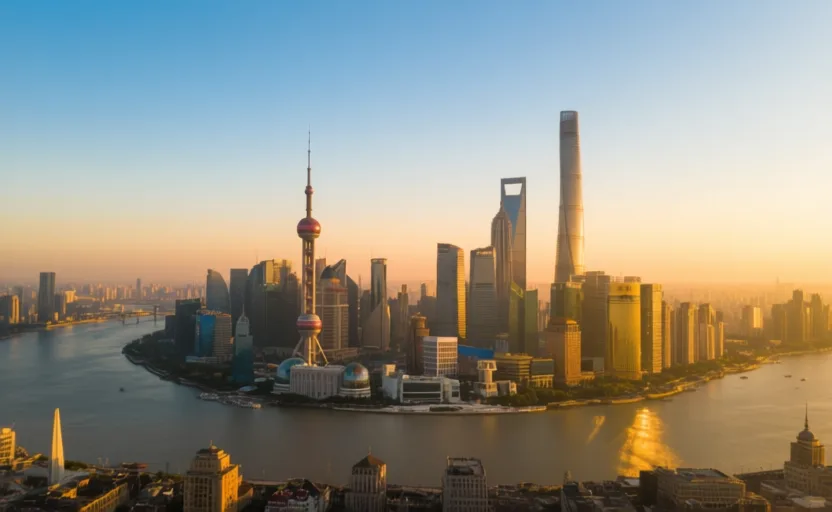 AI city illustration · Artistic impression
What people learn after moving
≈24.8 million in the municipality — the largest city proper in China
Mandarin is the working language; Shanghainese (a Wu dialect, not mutually intelligible with Mandarin) is still spoken at home by natives. English is common in international workplaces and rare outside them
Renminbi / Chinese yuan (CNY, ¥)
CST (GMT+8) — all of China runs on one time zone, and there is no daylight saving
AI city illustration · Artistic impressionCost of living in Shanghai
Check your eligibility
Pick your passport to see entry rules and the long-stay routes we have researched.
Pick your passport to see whether you can enter China — and what it takes to stay.
China separates the right to enter from the right to reside, and the sequence is unforgiving. Your employer obtains a Notification Letter of Foreigner's Work Permit, you convert it to a Z visa at a Chinese mission abroad, you enter, you collect the physical work permit card, and you apply for a residence permit within 30 days of entry. Layered on top of all that is a separate obligation nobody mentions: registering your address with the local police within 24 hours of moving into a private flat. Shanghai also runs its own Overseas Talent Residence Permit alongside the national scheme.
A foreign licence is not valid to drive in mainland China and an International Driving Permit is not recognised — China is not a party to the 1968 Vienna Convention. You convert by taking the written theory examination, which is available in English and several other languages at Shanghai's vehicle administration offices. The examination is the easy part. The hard part is that a Shanghai petrol-car number plate is sold at monthly auction, has repeatedly cleared prices in the region of RMB 90,000, and there is no way to buy a car around it.
Since the People's Bank of China's payment-convenience reforms, Alipay and WeChat Pay accept foreign Visa and Mastercard, with a single-transaction cap of USD 5,000 and an annual cumulative cap of USD 50,000 after verification. That solves visiting. Living here still runs on a local account, and a local account runs on a Chinese mobile number under real-name registration. Shanghai branches of the big four, and the domestic branches of HSBC and Standard Chartered, handle foreign customers routinely — but the order of operations is fixed.
Shanghai has the deepest medical infrastructure in China, and the practical question is which door you use. Ordinary public hospital outpatient departments are cheap, competent and completely Chinese-language. The same hospitals run international or VIP wings — Huashan, Ruijin, Zhongshan among them — with English-speaking staff, appointment systems and much higher prices. Private international hospitals sit above that again. Employer insurance normally determines which of the three you can actually use, and it is worth reading the policy before you need it.
Getting a SIM is easy and cheap — passport, a carrier shop, twenty minutes — and it is the first thing you should do, because everything else in China depends on having a number. What needs planning is the other half: a substantial part of the Western internet is not reachable from an ordinary Chinese connection, including services your work and your two-factor authentication may depend on. Larger employers provide a corporate route for work systems, and that is a legitimate question to ask at offer stage.
Employers withhold individual income tax monthly, and most employees also complete an annual reconciliation between March and June for the previous calendar year. Two things decide how much of your worldwide life China taxes: the 183-day residence test, and the six-year rule, which delays worldwide taxation and can be reset by a single trip abroad of more than thirty consecutive days. Separately, the preferential treatment of expatriate fringe benefits — housing, children's education, language training and more — has been extended, most recently to the end of 2027, and you must choose between it and the standard itemised deductions.
Each guide has verified costs, timelines, required documents, and the non-obvious gotchas — sourced from official government pages. Last verified August 2026.
Reading a list isn’t learning it. Globe Quest turns these into a trainer — hear each phrase spoken, drill them with spaced repetition, and get scored as you say them out loud.
Article 39 of the Exit and Entry Administration Law requires foreigners staying anywhere other than a hotel to register with the local public security organ within 24 hours of arrival. A hotel does it for you automatically, which is exactly why people who go straight into a rented flat never learn about it. You take your passport, your visa, your lease and your landlord to the neighbourhood pàichūsuǒ and come away with a registration slip. That slip is then requested again when you apply for your residence permit, when you renew it, and often when you open a bank account. Failing to register carries a warning and a fine of up to RMB 2,000, and it surfaces at the worst possible moment — during a renewal.
A Z visa gets you through the border and nothing more. Within 30 days of entry you must apply to the Shanghai Public Security Bureau's Exit–Entry Administration for a foreigner's residence permit, and in most cases collect the physical work permit card first, usually within about fifteen days of arrival. Newcomers routinely relax after landing because the visa in the passport looks valid; it is a single-entry entry document that expires and leaves you out of status. Your employer's HR usually drives this, but the deadline is legally yours.
Separate from the national Foreigner's Work Permit, Shanghai operates a residence permit for overseas talent administered by the Shanghai Talent Work Bureau. The current rules took effect on 1 July 2025 and run to 30 June 2030; holders of at least a bachelor's degree who are legally employed or running a business in Shanghai can qualify, validity runs from one to five years and up to ten in some cases, and the municipality has cut the approval window to five working days. Most foreign employees never hear about it because their employer only ever applies for the national permit. It is worth asking about.
Since the People's Bank of China's payment-convenience push, both apps accept Visa, Mastercard and others, with a single-transaction cap of USD 5,000 and an annual cumulative cap of USD 50,000 after identity verification. That solves visiting. It does not solve living: salary, rent transfers, utilities, deposits and most subscription services still assume a Chinese bank account, and the bank account assumes a Chinese mobile number, which in turn assumes real-name registration against your passport. The chain runs residence permit → phone number → bank account → everything else.
Google, Gmail, YouTube, Instagram, Facebook, WhatsApp, X and most Western news sites are not reachable from a normal Chinese connection. This is a practical relocation fact rather than a political one, and it has concrete consequences: your two-factor authentication, your calendar, your work email and your family group chat may all sit behind it. Larger employers typically provide a corporate connection that routes around it for work systems; that provision is a reasonable thing to ask about at offer stage. WeChat is not optional here — it is the phone book, the payment rail and the way your building manager contacts you.
The Huangpu river splits the city into Puxi — the old concessions, the plane trees, the small streets, most of the bars and most of the international schools' feeder neighbourhoods — and Pudong, which was farmland in 1990 and is now the financial district, the science parks, both major campuses of several multinationals, and Disney. Pudong is newer, greener, better laid out for cars and families, and duller. Puxi is denser, older, more walkable and more expensive per square metre. The metro crosses in minutes but the psychological river is real, and where your office is should probably decide it.
Shanghai Stock Exchange, ICBC, Bank of China, HSBC China, Ant Group
Lujiazui in Pudong is mainland China's financial centre, and the Shanghai Stock Exchange is among the largest in the world by market capitalisation. Most foreign banks base their China head office here rather than in Beijing.
SAIC Motor, Tesla Gigafactory Shanghai, NIO, Volkswagen and GM joint ventures
SAIC is China's largest carmaker and Tesla's Shanghai plant is its highest-volume factory anywhere. The city's Anting district is a genuine automotive cluster with the design and supplier base to match.
SMIC, Hua Hong, Zhangjiang Hi-Tech Park tenants
Zhangjiang in Pudong holds the densest concentration of Chinese chip design and fabrication in the country, alongside a large integrated-circuit research base.
WuXi AppTec, Roche China, Novartis, Zai Lab, Hengrui
Zhangjiang's biotech corridor is where most multinational pharma runs its China R&D, and WuXi AppTec made Shanghai a global centre of contract drug research.
COSCO, Shanghai International Port Group, Maersk China
The Port of Shanghai has been the world's busiest container port for well over a decade. The China (Shanghai) Pilot Free Trade Zone, established in 2013, was the first of its kind on the mainland.
L'Oréal China, Unilever, Nike Greater China, Alibaba's Tmall operations
Shanghai is where almost every global consumer brand runs its China marketing, which makes it the country's clearest concentration of foreign commercial and creative jobs.
Landmark · Huangpu, west bank
A mile of 1920s banking and trading houses facing the Pudong skyline across the river — the image of Shanghai.
Local tip: The famous view is from the Bund looking east, and it is crowded at every hour. The better walk is the other way: go up onto the Pudong side at the Binjiang promenade around dusk, when the historic facades are lit and the crowds are all behind you.
Neighborhood · Xuhui and Huangpu, west of the old city
Plane-tree streets, 1930s villas and lane houses, and the densest concentration of independent cafés, bars and shops in China.
Local tip: Wukang Road gets the crowds and the photo queue at the Wukang Mansion. Walk two streets over to Ferguson Lane, Anfu Road or Yongkang Road for the same architecture with people actually living in it.
Culture · Xuhui riverside, south-west
A former industrial waterfront rebuilt as a run of major art institutions — the Long Museum, Yuz Museum, and the Centre Pompidou's Shanghai outpost.
Local tip: The riverside path between them is continuous, flat and largely empty on weekday mornings — one of the best runs in the city. The museums cluster their new shows in the November art-week window.
Food · Huangpu, behind People's Square
Two old food streets in the middle of the city — soup dumplings, scallion oil noodles, and Cantonese roast meats, at prices the Bund forgot.
Local tip: Go for breakfast rather than dinner. Shanghai's real eating culture is a morning one: shēngjiān bāo, cōngyóu bàn miàn and dòujiāng, eaten standing up before eight, and it is far better than anything the same streets serve at night.
Nightlife · Jing'an and Xuhui
Where Shanghai actually drinks — small cocktail bars, natural wine rooms and speakeasies behind unmarked doors, rather than the Bund's expense-account rooftops.
Local tip: The scene turns over fast; a bar that was the place last year may have gone. Ask a colleague what opened this month rather than following a two-year-old list.
Nature · Northern central, Putuo to Hongkou
A continuous riverside walkway along the industrial creek that made Shanghai, opened along its central stretch in recent years and still largely used by locals.
Local tip: The stretch through Putuo past the old M50 art warehouses and the 1930s mills is the interesting one, and almost no visitor ever finds it. Start at Changshou Road and walk east; there are new bridges and the old lock gates on the way, and a genuinely quiet city on a Sunday morning.
Side-by-side cost of living, language, climate and careers — to help you choose.