
Population
422,000 in the autonomous district, ~340,000 in the city (2021 census)
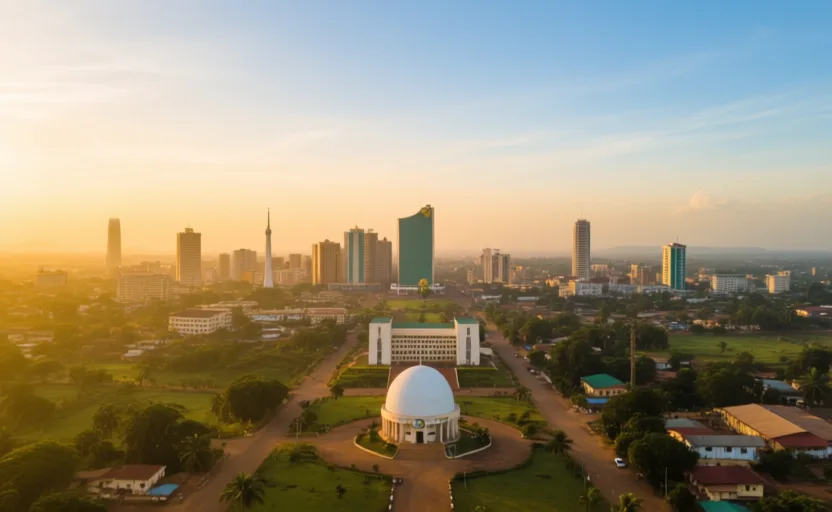 AI city illustration · Artistic impression
What people learn after moving
422,000 in the autonomous district, ~340,000 in the city (2021 census)
French (official); Baoulé across the region, Dioula in the markets
West African CFA franc (XOF) — pegged at €1 = 655.957
GMT (UTC+0, no daylight saving)
AI city illustration · Artistic impressionCost of living in Yamoussoukro
Check your eligibility
Pick your passport to see entry rules and the long-stay routes we have researched.
Pick your passport to see whether you can enter Ivory Coast — and what it takes to stay.
The national process is identical to Abidjan's: the employer has the contract stamped before you land, you apply for a carte de travail within three months of hiring, and ONECI issues a five-year biometric carte de résident at a flat XOF 300,000. The Yamoussoukro-specific fact is that ONECI's resident-card enrolment centres are in Abidjan and only Abidjan, so the biometric enrolment and the collection are both 236 km away.
Conversion costs XOF 98,500 in two payments to two bodies, both in Abidjan: XOF 10,000 for the DGTTC's autorisation d'échange, then XOF 88,500 at a Centre de Gestion Intégrée. The real bottleneck is your own embassy, which must certify your licence is genuine. Locally, the good news is that SICTA has an inspection station in Yamoussoukro, so the annual contrôle technique is one thing you do not have to drive south for.
Open a mobile-money wallet on day one with your passport and a bank account in your first month. The month matters: Société Générale's published eligibility accepts a passport with an entry stamp under three months old and switches to demanding residency documents beyond that — and since your resident card requires a trip to Abidjan, that window is worth more here than anywhere. Nineteen everyday services are legally free across the union, and if three banks refuse you the central bank can designate one that must open an account.
The CMU costs XOF 1,000 a month per person, split evenly with your employer through CNPS, and reimburses 70% of the public tariff at accredited facilities. Locally that means the CHR, refurbished and re-inaugurated in December 2019, and the Catholic Saint Joseph Moscati hospital opposite the Basilica. There is no CHU here — the newest teaching hospital in the country opened in Abidjan in 2017 — so a private policy with tiers payant and medical evacuation is not optional.
Registration is compulsory before activation under décret n° 2017-193, and the accepted documents must be biometric. The trap: your carte de résident is accepted for opening a mobile-money wallet but is NOT on the published list for identifying a SIM, so bring your passport. Buy only at an operator agency; street sales and pre-activated SIMs are both illegal. Set expectations on speed — the named 5G launch markets are Abidjan, Bouaké and San Pedro, and Yamoussoukro is not among them.
Your employer withholds one progressive tax on salaries at monthly bands of 0%, 16%, 21%, 24%, 28% and 32%, and CNPS takes 6.3% for the pension fund up to a ceiling, plus XOF 500 for health cover. The old deduction for professional expenses is gone, replaced by a fixed reduction based on family 'parts'. Residents are taxed on worldwide income. Any guide describing an IS + CN + IGR stack is describing a system that no longer exists.
Each guide has verified costs, timelines, required documents, and the non-obvious gotchas — sourced from official government pages. Last verified August 2026.
Reading a list isn’t learning it. Globe Quest turns these into a trainer — hear each phrase spoken, drill them with spaced repetition, and get scored as you say them out loud.
Yamoussoukro has been the official political and administrative capital since a law of March 1983, but four decades on only the Senate and the Chamber of Kings have genuinely moved here. The presidency, the National Assembly, every ministry and every embassy are still in Abidjan. Do not move here expecting to be near government.
ONECI enrols resident cards only in Abidjan, the DGTTC and the licence centres are in Plateau, and any serious medical procedure means the same drive. The Autoroute du Nord takes under three hours and a UTB bus is about XOF 4,500 — factor several of those trips into your first six months.
The city was laid out in the 1970s and 80s for a capital that never filled up, so you get eight-lane boulevards with very little on them and long gaps between quartiers. It is uncongested — nothing like Abidjan — but you will need a car or a daily wôrô-wôrô budget.
From December to February the dry northeasterly drops relative humidity to around 40%, a swing coastal Abidjan simply never experiences. Expect nosebleeds, cracked lips and dust in everything — keep laptops and cameras in sealed bags, because fine Saharan dust is what actually kills electronics here.
Checkpoints are routine on the Autoroute du Nord and around town, and British government advice is explicit that police will not always accept photocopies. Non-ECOWAS foreigners also need the carte de résident — and the office that issues it is in Abidjan.
The INP-HB has over 6,000 students in 3,008 campus rooms, and its entrance concours draws roughly 6,500 candidates for 650 places. Rents, maquis trade and nightlife all visibly swing with term dates — arrive in the long vacation and you will misjudge the place entirely.
Sénat de Côte d'Ivoire, Chambre Nationale des Rois et Chefs Traditionnels, District Autonome
The 99-member upper house was installed here in 2018, sat inside the Houphouët-Boigny Foundation from 2019, and moved into its own 8,000 m² building in December 2019. That, plus the chamber of traditional rulers, is what has actually relocated.
INP-HB (ESA, ESI, ESTP, ESMG, ESCPE, ESCAE, ESAS), Lycée scientifique
The country's flagship engineering school is here rather than in Abidjan — eleven schools, 6,000+ students, 8% of them from fifteen other African countries, on a 1,000-hectare campus.
CITA, SG Agro, Afcott Cashew (Kewalram Chanrai)
The real industrial employer. The state's cashew innovation centre opened in 2020 at 6,000 t a year, SG Agro runs 24,000 t on the industrial zone, and Afcott's plant at Loukoukro employs around 1,250 people, roughly 80% of them women.
Cocoa and coffee cooperatives, yam and plantain growers, Centre Horticole Moyé
About half the region works in agriculture: 4,000 coffee operators, 5,000 cocoa operators, and 133,000 tonnes of yam a year, which is the volume staple of Baoulé country.
CIE, CI-Énergies, Barrage de Kossou, Barrage de Taabo
Kossou's 174 MW on the Bandama, forty kilometres away, has anchored the regional grid since 1972; Taabo adds another 210 MW downstream.
Hôtel Président, Président Golf Club, Basilique Notre-Dame de la Paix
The monuments are an economy: a 285-room five-star hotel on twelve hectares, an eighteen-hole championship course, and a basilica that draws pilgrimage traffic and eighty-odd small neighbourhood hotels around it.
Landmark · On the Abidjan road, edge of town
Pierre Fakhoury's basilica, consecrated by John Paul II in September 1990: 158 metres tall, a 90-metre dome, 8,400 m² of stained glass — more, it is said, than all of France's cathedrals combined — on a 130-hectare site whose esplanade holds 300,000.
Local tip: Go late afternoon: the pink-stone colonnades and marble esplanade are brutal at midday, and the interior is one of the few reliably air-conditioned public spaces in the city. It is not the cathedral, incidentally — Saint Augustine, three kilometres away, is the bishop's seat.
Nature · Around the presidential compound
Three artificial lakes dug in the 1950s around Houphouët-Boigny's palace and stocked with Nile crocodiles since 1953 — animals approaching a tonne, which he treated as sacred and fed in person.
Local tip: Watch from the perimeter railing and keep the camera pointed at the water: this is a working presidential compound and photographing the palace will get you stopped. The long-serving keeper was killed by one of the crocodiles in August 2012, after which handlers were barred from entering the enclosure — so do not expect the old feeding show.
Culture · Central Yamoussoukro
Olivier-Clément Cacoub's thirty-metre marble complex, built between 1977 and 1987: a 2,000-seat amphitheatre with eight-language interpretation, a 5,200 m² library with restoration workshops, and a peace museum. UNESCO holds the keys and awards the Houphouët-Boigny Peace Prize here.
Local tip: This is the building the Senate physically sat in from 2019 until its own headquarters opened — so if you want to see the moment the capital transfer became real, it happened here rather than at the palace.
Neighborhood · North of the centre, three sites
A thousand hectares of engineering school: eleven grandes écoles, 3,008 student rooms, two university restaurants, three health centres and two sports complexes, feeding the country's toughest entrance concours.
Local tip: The maquis strip serving the campus is where the city's under-thirties actually are — livelier, cheaper and open far later than anything near the monuments.
Landmark · Beside the Hôtel Président
Eighteen holes by the Welsh architect Dave Thomas, opened by Houphouët-Boigny in March 1980 across 75 hectares, with a Roger Taillibert clubhouse of vast concrete tents. Gary Player and Vijay Singh have played it.
Local tip: The six-hectare central lake has crocodiles in it. Whatever the shot is worth, do not go in after your ball. Open Tuesday to Sunday, closed Mondays.
Nature · ~40 km northwest
A 1,700 km² reservoir stretching some 150 km behind a 174 MW dam finished in 1972, now landing around 20,000 tonnes of fish a year for communities that used to farm the valley floor.
Local tip: The history is not abstract: sixty villages went under and more than a hundred thousand people were displaced to build this. Grilled lake fish at the landing sites is the regional specialty and the reason to make the drive.
Side-by-side cost of living, language, climate and careers — to help you choose.