
Population
≈3.7 million — Japan's most populous municipality after the Tokyo special wards, in 18 wards
 AI city illustration · Artistic impression
What people learn after moving
≈3.7 million — Japan's most populous municipality after the Tokyo special wards, in 18 wards
Japanese. English support is better than most Japanese cities of comparable size, a legacy of the treaty port and the international community
Japanese yen (JPY)
JST (GMT+9) — Japan does not observe daylight saving
AI city illustration · Artistic impressionCost of living in Yokohama
Check your eligibility
Pick your passport to see entry rules and the long-stay routes we have researched.
Pick your passport to see whether you can enter Japan — and what it takes to stay.
Japan issues your residence card at the airport, but the card alone is not enough — you must register your address at your ward office within fourteen days, and that registration unlocks health insurance, banking and phone contracts. Yokohama has eighteen wards, more than any other Japanese city, and a large share of new arrivals work in Tokyo and assume their administration is Tokyo's. It is not.
Converting a foreign licence — gaimen kirikae — requires a knowledge check and, for most countries, a practical test on a closed course that is notoriously exacting. A defined list of countries is exempt. The rules tightened nationally on 1 October 2025: a jūminhyō is now compulsory for every applicant, so short-stay visitors are shut out of the route entirely, and the knowledge check went from ten questions at 70% to fifty questions at 90%. An International Driving Permit is valid for one year only. Yokohama's rail network makes a car unnecessary for commuting, but the Miura peninsula, Hakone and the Izu coast are the reason a fair number of residents here own one anyway.
Japanese banks vary enormously in how they treat new foreign residents, and several major banks effectively require six months of residence before opening a full account. Japan Post Bank and the online banks are the usual first stop because they do not. You need ward registration first. Bank of Yokohama is the dominant regional institution and worth knowing about, since local landlords and guarantor companies deal with it constantly.
Enrolment is a legal obligation, not a choice. Once enrolled you pay 30% of the cost of most treatment at the point of care and the scheme pays the rest, with a monthly ceiling that caps catastrophic costs. Pension enrolment is equally compulsory — and if you leave Japan you can claim a lump-sum withdrawal of part of what you paid, which a great many departing residents never do.
Japanese mobile has historically been expensive, dominated by three carriers with long contracts and heavy handset subsidies. Government pressure changed that, and the low-cost sub-brands and MVNOs now offer genuinely cheap plans on the same networks. You need a residence card and usually a Japanese bank account or credit card. Home fibre is fast and cheap, but what reaches your actual flat depends on the building.
Most employees never file a return — the employer's year-end adjustment handles it. The two things that catch foreign residents are residence tax, calculated on last year's income and billed from the following June, and the distinction between non-permanent and permanent tax residence, which determines whether Japan taxes your foreign income at all. In Yokohama there is a third: residence tax follows where you live on 1 January, not where you work.
Each guide has verified costs, timelines, required documents, and the non-obvious gotchas — sourced from official government pages. Last verified August 2026.
Reading a list isn’t learning it. Globe Quest turns these into a trainer — hear each phrase spoken, drill them with spaced repetition, and get scored as you say them out loud.
Yokohama is Japan's second-largest city by population and the capital of Kanagawa Prefecture — an entirely separate municipality from Tokyo, even though a large share of its residents commute there daily. Your ward office, your residence tax, your National Health Insurance premiums, your school zoning and your rubbish separation rules are all Yokohama's. People who think of themselves as living 'in Tokyo' and turn up at a Tokyo ward office are sent back, having burned a day against a fourteen-day legal deadline.
That is more than any other city in Japan, and they sprawl from the waterfront to genuinely suburban hills twenty kilometres inland. Ward registration within fourteen days of moving in produces the jūminhyō certificate and triggers your My Number, and without it you cannot enrol in health insurance, open most bank accounts, or complete a phone contract. Confirm which ward your address is in before you go rather than after.
Deposit, key money, agency fee, guarantor company fee, fire insurance and the first month. Key money is a gift to the landlord you never see again. Yokohama's monthly rents run meaningfully below central Tokyo for equivalent space, but the entry package is the same Japanese one and is calculated on the rent, so a cheaper flat lowers it proportionally rather than removing it.
Jūminzei is calculated on your previous calendar year's income and billed from the following June. Your first year feels cheap and your second is expensive. If you leave Japan you can still owe a full year's residence tax on income already spent, so appoint a tax representative or settle it before going. In Yokohama the bill combines the city and prefectural portions and arrives from Yokohama City.
Yokohama's value depends almost entirely on which railway you are on. The Tōkyū Tōyoko runs to Shibuya, the Keikyū to Shinagawa and Haneda, JR to Tokyo Station, and the Sōtetsu lines gained direct through-services to Shinjuku in 2019 and to Shibuya and Meguro in 2023 — which quietly transformed the commute from western Yokohama and has not fully shown up in rents yet. Two addresses the same distance from the centre can differ by twenty-five minutes and a change of train.
Yamate, Kōhoku and much of the inland west are built across steep ridges. A listing that says eight minutes from the station can mean eight minutes uphill with shopping, which is a different proposition in August humidity. Walk the route at the time of day you would actually walk it before signing anything — this is the single most common regret among people who chose a flat from a portal.
Nissan, Isuzu, Bosch Japan, JATCO
Nissan moved its global headquarters to Minato Mirai in 2009, and the wider Kanagawa corridor remains one of Japan's densest automotive engineering clusters.
Shiseido Global Innovation Center, Kyocera, Murata, LG Japan Lab, Apple
Minato Mirai's second phase has been deliberately built out as a research campus district, and several multinationals now run their principal Japanese R&D operations there rather than in Tokyo.
Port of Yokohama, Mitsubishi Heavy Industries, Kawasaki Kisen, Nippon Yusen
Yokohama opened to foreign trade in 1859 under the Harris treaty — a fishing village chosen over Kanagawa-juku — and remains one of Japan's largest ports, with the shipbuilding heritage visible in the docks that Minato Mirai was built on.
Kirin, Ajinomoto, Nissin Cup Noodles Museum, Shiseido
Kirin's brewery in Namamugi is one of Japan's oldest, and Yokohama's port history means several of Japan's first imported foods — beer, ice cream, bread — arrived and were first made here.
RIKEN Yokohama, Yokohama City University, Chugai Pharmaceutical, Kanagawa Institute of Industrial Science
The Tsurumi RIKEN campus and Yokohama City University's medical school anchor a life sciences cluster that Kanagawa Prefecture has backed with a dedicated life-innovation zone.
Yokohama National University, Yokohama City University, Keio Science & Technology, Kanagawa University
Keio's science and technology faculty sits in Kōhoku ward, and the concentration of engineering graduates is a large part of why the automotive and R&D employers are here.
Landmark · Nishi ward, waterfront
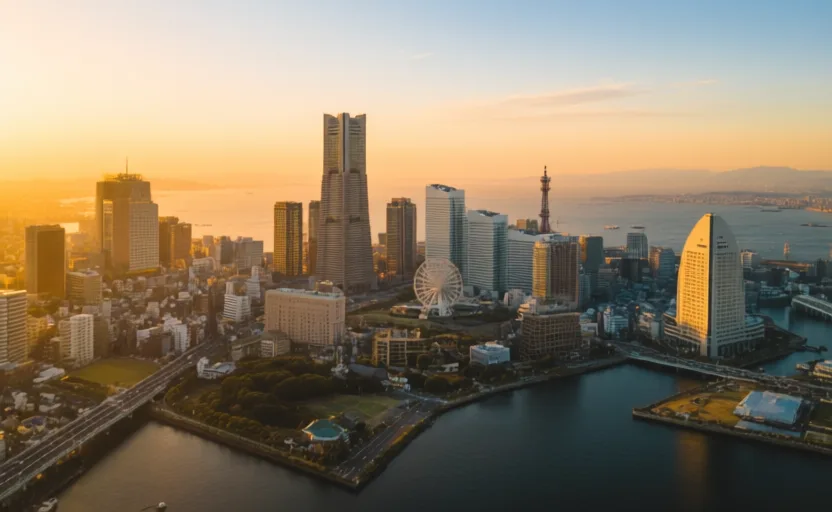
The redeveloped dockland — Landmark Tower, the Ferris wheel, the red brick warehouses and a long waterfront promenade.
Local tip: The observation deck charges; the free view is from the top floors of the Landmark Tower's shopping levels, and the better one is from the Ōsanbashi pier terminal, whose wooden roof deck is open, free and almost empty at sunset.
Food · Naka ward
The largest Chinatown in Japan, established by traders after the port opened in 1859, and still a working neighbourhood.
Local tip: The main streets are priced for visitors and heavy on all-you-can-eat. The genuine cooking is on the side lanes toward Ishikawachō station, and the Kantei-byō temple in the middle is free and worth the ten minutes.
Neighborhood · Naka ward, on the bluff
The old foreign settlement on the hill — Western-style houses, the foreign cemetery, and an elegant shopping street below it.
Local tip: Several of the Western houses are open free of charge and almost nobody goes in. Motomachi below is where Yokohama's old money shops. The whole area is a climb from the station, which is precisely why it stayed quiet.
Culture · Naka ward, southeast
A large traditional garden assembled by a silk merchant from historic buildings moved here from Kyoto and Kamakura.
Local tip: Genuinely one of the best gardens in the Kanto region and consistently overlooked because it is a bus ride from the station. Go in November for the maples or in February for the plum blossom, both well before Tokyo's crowds start moving.
Nightlife · Naka ward, behind Sakuragichō
A dense grid of tiny post-war bars and standing izakaya, five minutes from Minato Mirai's towers and a century away in feel.
Local tip: This is where locals drink rather than where visitors do. Most counters seat six people, cash is expected, and the etiquette is to have one or two and move on rather than to settle in.
Nature · 30–50 minutes south by train
Temples, a coastline and hiking trails, at the southern end of the same railway lines that run into Yokohama.
Local tip: Yokohama residents get to Kamakura in half an hour where Tokyo residents need an hour, and the Miura peninsula beyond it is emptier still. This proximity is one of the genuine, under-discussed advantages of living here rather than in Tokyo.
Side-by-side cost of living, language, climate and careers — to help you choose.