
Population
About 720,000 before 2022; the wartime figure moves with displacement in both directions and no reliable current count exists
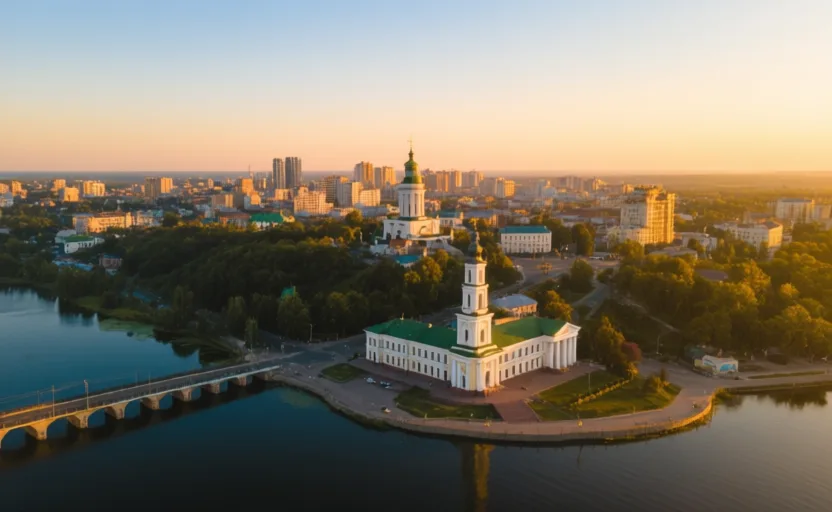 AI city illustration · Artistic impression
What people learn after moving
About 720,000 before 2022; the wartime figure moves with displacement in both directions and no reliable current count exists
Ukrainian is the sole state language and dominates public life; Zaporizhzhia was a Russian-speaking industrial city and both are heard daily
Ukrainian hryvnia (UAH, ₴) — about ₴44.8 to the US dollar at the NBU official rate, August 2026
EET (GMT+2), EEST (GMT+3) from late March to late October
AI city illustration · Artistic impressionCost of living in Zaporizhzhia
Check your eligibility
Pick your passport to see entry rules and the long-stay routes we have researched.
Pick your passport to see whether you can enter Ukraine — and what it takes to stay.
The law is national and identical to Kyiv's: a TEMPORARY residence permit (посвідка на тимчасове проживання) issued by the State Migration Service on a ground in Article 4 of the Law on the Legal Status of Foreigners, and a separate PERMANENT residence instrument reached only through a prior immigration permit granted by category. Time on a temporary permit accumulates towards nothing. Three things are specific to doing this from a front-line oblast capital. The realistic grounds are narrower — international technical assistance project registration, NGO employment and media accreditation rather than ordinary corporate work permits, with the salary floor dropping from ten minimum wages to five for public associations, charities and educational institutions. The industrial sector that dominates local employment is largely closed to foreign nationals for national-security reasons. And administrative capacity is thinner than in Kyiv, with counters suspending during alerts, so confirm what is open before you travel to it.
Exchange happens in person at a сервісний центр МВС and the head service centre states explicitly that it cannot be done online. You need your identity document, your РНОКПП tax number, the foreign licence with a certified Ukrainian translation, a driver's medical examination, and a confirmation from the issuing country's competent authority — or its diplomatic mission in Ukraine — that the licence was issued and that you have not been disqualified. Exams are NOT required where the licence was issued by a party to the 1968 Vienna Convention and the document conforms; a theory and a practical exam ARE required where it was not. Exchange is available at ANY territorial service centre regardless of registration, which from Zaporizhzhia usually means doing it in Dnipro if the local centre is disrupted. The far more consequential point in this oblast is not the plastic but the map: curfew hours, security designations and access restrictions change over short distances south of the city.
Ukraine has one of the most advanced retail banking sectors in Europe — monobank is card-only and opened by phone, PrivatBank's Privat24 does in minutes what takes days elsewhere, and card-to-card transfers by phone number are how people split a bill. For a foreign resident the practical path is a passport plus a residence permit plus a РНОКПП tax number; a non-resident individual with no РНОКПП is recorded with nine zeros in its place. The National Bank has also permitted account opening with the digital passport in Diia, which matters more here than in Kyiv: an app-first bank does not stop working because a branch closed or lost power. Before you move money, learn the wartime FX regime — purchases of foreign currency, cash withdrawals abroad and cross-border card transfers are all capped and the caps change. The most useful recent change for a foreign employee is the April 2026 easing that lets non-residents buy and transfer abroad the foreign-currency equivalent of salary and civil-law-contract payments received into their Ukrainian hryvnia accounts on or after 1 May 2026. And if your income is grant- or project-funded, which in this city it very likely is, your project's finance function is the right first call rather than the bank.
Ukraine funds healthcare through the Programme of Medical Guarantees, administered by the National Health Service of Ukraine (НСЗУ), which pays contracted providers directly at national tariffs. Access is defined by the Law on State Financial Guarantees of Medical Services (No. 2168-VIII), and the insured population is citizens, foreigners and stateless persons PERMANENTLY RESIDING in Ukraine, and recognised refugees and persons needing complementary protection. A temporary residence permit is not permanent residence — which is why ДМС makes medical insurance a listed condition of that permit. Two Zaporizhzhia specifics sit on top. First, insurance exclusions: a policy that carves out injury from hostilities excludes the main risk in a front-line oblast capital, and that clause is the whole product. Second, radiological preparedness: with Europe's largest nuclear plant under military control about fifty kilometres away and a permanent IAEA presence on site, local civil-defence guidance covers iodine prophylaxis and sheltering in place. Read the official guidance once, keep tablets, and take them only when instructed.
Three operators cover the country: Kyivstar, Vodafone Ukraine and lifecell. You can buy a prepaid SIM at a kiosk, a supermarket or an operator shop and use it immediately without producing a document. What the operators offer instead is voluntary REGISTRATION or 'personification' — linking the number to your identity document through the shop, the app, Diia or BankID. Register, because an unregistered number cannot be recovered if the phone is lost or stolen, cannot be ported, and is not accepted for identity-linked services. Kyivstar caps registrations at ten numbers per document. In Zaporizhzhia, add three local habits: follow the oblast military administration's own channel rather than an aggregator, because curfew changes, security designations and any civil-defence instruction appear there first; carry a second SIM on another network if your work takes you outside the city, where coverage thins and infrastructure has been damaged; and keep a battery-powered radio, because a notification you cannot receive is not a warning system.
Two things to get right. First, the РНОКПП — the taxpayer registration number, still universally called the identification code — is the single most load-bearing number in Ukrainian life after your permit. Foreigners apply to the regional State Tax Service; a foreigner holding a temporary or permanent residence permit registers at the tax inspection covering the address on that permit, which here means the Zaporizhzhia oblast head office and its taxpayer service centres. Second, the rates: employment income is taxed at 18% personal income tax plus a 5% military levy. The levy was 1.5% until Law No. 4015-IX of 10 October 2024 raised it to 5% with effect from 1 December 2024 — still routinely misreported, and the difference between a 19.5% and a 23% deduction. Employers withhold both. Ukraine also runs the simplified ФОП regime and the separate Diia City regime for registered IT companies. The Zaporizhzhia-specific issue is that most foreign income here is grant- or project-funded rather than salaried, and international technical assistance engagements have a treatment of their own that no general summary should be used for.
Each guide has verified costs, timelines, required documents, and the non-obvious gotchas — sourced from official government pages. Last verified August 2026.
Reading a list isn’t learning it. Globe Quest turns these into a trainer — hear each phrase spoken, drill them with spaced repetition, and get scored as you say them out loud.
The Zaporizhzhia Nuclear Power Plant at Enerhodar, about fifty kilometres away, is Europe's largest and has been under Russian military control since March 2022. Its reactors have been shut down, the IAEA has kept a permanent presence on site since September 2022, and the plant has repeatedly lost all off-site power and run on emergency diesel generators. What that means for you practically: know where your building's shelter is, know the difference between an air-raid alert (go to the shelter) and a radiation instruction (shelter in place, close windows and ventilation), have potassium iodide and know that you take it ONLY when the authorities instruct — never pre-emptively, never on a rumour. Local officials publish this guidance; read it once, act on it, and then get on with your life, which is what everyone here does.
By the oblast Defence Council's decision announced on 3 November 2025, curfew is 00:00-05:00 in Zaporizhzhia city and most of Zaporizhzhia district, and 21:00-06:00 in the Kushuhum community and in the Ukrainian-controlled parts of Vasylivka and Polohy districts. That is a three-hour difference across a short drive, and it is the single most useful thing to internalise about where you are. Never plan a journey inside the oblast on the city's hours. Check the destination community's current order — they are announced by the oblast administration and they do move.
People leaving Melitopol, Berdyansk and Enerhodar arrive in Zaporizhzhia. So do the aid organisations, the reunification services and the reception centres built around them, and much of the city's volunteer effort goes into that work. Two things follow. First, if you are here for humanitarian, medical, legal-aid or documentation work, this is one of the most consequential places in the country to do it. Second, be careful with the subject socially: on 30 September 2022 a Russian strike hit a civilian convoy assembling in the city to drive towards occupied territory, killing around thirty people, and a great many residents have family on the other side of a line they cannot cross.
LUN put the median one-bed at ₴7,500 a month in early August 2026, level with Kharkiv and roughly half of Odesa, with two-beds at ₴10,000 and three-beds at ₴15,000. But the trend is the story: two-bed rents rose around 43% over the preceding six months. A front-line oblast capital with a shrunken housing stock and a steady inflow of displaced people is a tightening market, not a soft one, so do not assume last year's price is this year's, and do not assume the flat will still be there tomorrow.
Zaporizhzhia has trams, trolleybuses and buses but no metro, so 'get to the station' is not the plan here that it is in Kharkiv or Kyiv; the shelter is a marked basement or a purpose-built room and you need to know exactly where. On fares, the city rewards cashless: as of May 2026 municipal transport cost ₴20 in cash and ₴15 paying by card, with marshrutkas at ₴25. Sobornyi Avenue, one of the longest straight urban avenues in Europe at around eleven kilometres, is the spine everything runs along, so where you sit on it determines your journey more than the district name does.
Zaporizhzhia's economy is steel, special alloys, aero engines, transformers and hydroelectric generation, and that infrastructure is attacked. Scheduled outages run by queue with a day's notice and emergency outages run with none. Before you sign a lease, ask which черга the building is in, whether there is a generator or an inverter and what it actually powers, and how high the flat is — a fifth floor with no lift during an outage is a different flat from the one you viewed. A large power bank, a head torch and a UPS for the router are the standard local kit.
Zaporizhstal, Dniprospetsstal, and the plants and foundries around them
One of Ukraine's largest steel complexes and the reason the city exists in its modern form. Employment is substantial, the work is skilled, and the plants are both major employers and strategic targets — a duality every industrial employee here lives with.
Motor Sich, Ivchenko-Progress and their supply chain
Zaporizhzhia designs and builds aircraft and helicopter engines, a genuinely world-class capability concentrated in one city. Ownership and control of Motor Sich have been through a long legal and national-security process; hiring foreigners into this sector is heavily restricted, so treat it as closed unless you are told otherwise.
Zaporizhtransformator, Ukrainian Graphite, Ukrhydroenergo's DniproHES station
Transformers, electrodes and hydroelectric generation — the components a country rebuilding a bombed grid needs most. The 1932 DniproHES dam is both a working power station and a national industrial monument, and it has been struck.
International agencies and NGOs, reception and reunification services, documentation and legal-aid providers
The sector that defines the city's civic life. Zaporizhzhia is the arrival point for people leaving occupied southern Ukraine, and the work around that — reception, medical triage, documentation, family reunification, psychosocial support — is where most internationally hired staff here are employed.
The oblast hospital network, trauma and rehabilitation services, international medical NGOs
A front-line oblast capital carries a hospital load to match, and the rehabilitation and prosthetics capacity has grown accordingly. Experienced clinical staff are in demand and the work is unlike anything a Western hospital will have prepared you for.
Grain and oilseed traders, processors, hauliers and warehousing
Zaporizhzhia oblast is prime agricultural land and a large share of it is occupied, so the sector operates on a fraction of its former base with far more complicated logistics. It is still a significant employer and the trading and haulage side pays accordingly.
Landmark · In the Dnipro, between the two halves of the city
The largest island on the Dnipro and a national reserve — twelve kilometres of steppe, oak wood, granite cliffs and Scythian burial mounds in the middle of an industrial city, and the historic heartland of the Zaporizhzhian Cossacks.
Local tip: Go to the northern cliffs at the end of the day and walk south. It is genuinely wild in a way no other Ukrainian city has inside its boundary, and it is where Zaporizhzhians go to stop thinking about everything else for two hours.
Landmark · At the head of Khortytsia, spanning the river
The 1932 hydroelectric dam that industrialised the whole region — a monumental curved wall of concrete and one of the defining engineering projects of its century, still generating and still, therefore, a target. It was struck in 2024.
Local tip: You will cross it or see it constantly; look at it properly once from the Khortytsia side. Understanding that this dam is why the steelworks, the engine plant and the city are all here explains the entire place in about ninety seconds.
Culture · Northern Khortytsia
A reconstructed Cossack fortress settlement on the island — church, watchtowers, palisade and workshops — built as a museum of the self-governing warrior republic that gave the city and the whole region its name and its idea of itself.
Local tip: Read a little about the Sich before you go or it will look like a film set. With the history in your head it becomes the clearest statement of why 'Zaporizhzhia' means what it means to people here, which matters a great deal right now.
Neighborhood · The spine of the city, roughly eleven kilometres end to end
One of the longest straight urban avenues in Europe, running from the old town down through the Stalin-era civic centre to the industrial districts — the address of the city's shops, offices, theatres and most of its life.
Local tip: Everything in Zaporizhzhia is described by where it is on Sobornyi. Learn the sequence of the main junctions early and the city stops being confusing; the middle stretch around the civic centre is where you want to be for cafés and evenings.
Food · Off Sobornyi Avenue, city centre
The city's main market — produce from the surviving half of one of Ukraine's best agricultural oblasts, dairy and pickle rows, meat and fish halls, and the cheapest food in Zaporizhzhia by a distance.
Local tip: Go early with cash and small notes. The dairy and pickle rows are the reason; the imported fruit is not. Prices soften at volume and asking is expected.
Nature · Shevchenkivskyi district, on the left bank
A remnant of ancient oak forest turned into a park in the middle of the left-bank residential districts — mature trees, quiet paths and a completely different city from the one Sobornyi Avenue shows you.
Local tip: The under-visited one. If you end up living on the left bank near the plants, this is where you will walk, and knowing it exists makes that side of the river a far better place to live than the map suggests.
Side-by-side cost of living, language, climate and careers — to help you choose.