
Population
≈700,000 in the municipality — the fourth largest in Spain, having overtaken Seville; roughly half of the whole population of Aragón
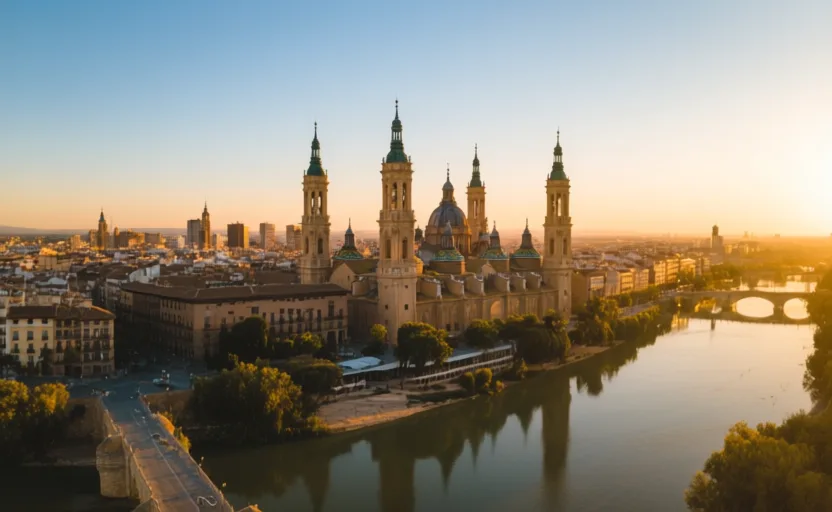 AI city illustration · Artistic impression
What people learn after moving
≈700,000 in the municipality — the fourth largest in Spain, having overtaken Seville; roughly half of the whole population of Aragón
Castilian Spanish is the sole official language. Aragonese and Catalan have protected status as lenguas propias of Aragón but are not co-official and are not used administratively in the city
Euro (EUR)
CET (GMT+1); CEST (GMT+2) from late March to late October
AI city illustration · Artistic impressionCost of living in Zaragoza
Check your eligibility
Pick your passport to see entry rules and the long-stay routes we have researched.
Pick your passport to see whether you can enter Spain — and what it takes to stay.
Spanish residency is a sequence and the order matters: a NIE number, then municipal registration on the padrón, then a TIE card, then social security, then a health card. Each step is a prerequisite for the next and each needs a cita previa. Most residents use a gestor for at least part of it, and that is a rational choice rather than a defeat. Zaragoza's advantage over Madrid, Málaga or Alicante is queue length rather than any difference in the rules.
EU and EEA licences are exchangeable straightforwardly. For everyone else it depends entirely on whether Spain has a bilateral agreement with the issuing country — if it does, you exchange without a test; if not, you take the full Spanish theory and practical exams in Spanish. The six-month clock starts when you become resident. Zaragoza is flat and has a good tram, but it is also the one big Spanish city where owning a car is genuinely defensible, because everything worth reaching at a weekend is an hour or two of motorway away.
Spanish banks distinguish sharply between resident and non-resident accounts, and the non-resident version carries higher fees and a certificate that must be periodically renewed. With a NIE and a padrón certificate you can open a resident account. Spanish banks charge maintenance fees far more readily than UK or US ones, so comparing them is worth real money, and the digital banks are a genuine alternative rather than a stopgap.
Spanish public healthcare is good and, once you are in it, free at the point of use — but entry runs through social security rather than through residency alone. The sequence is padrón, then social security registration, then the regional health card, which in Aragón is issued by the Servicio Aragonés de Salud, known as Salud. Each depends on the one before it. Zaragoza itself is unusually well served for a city its size, because the region's two big hospitals and its medical school are all here.
Spain requires every SIM to be registered against an identity document, so there is no anonymous pay-as-you-go. A prepaid SIM can be activated on a passport, which is what you should do on arrival. Contract tariffs — much better value and usually bundled with fibre — generally require a NIE and a Spanish bank account, so the practical sequence is prepaid first, contract once the paperwork lands. Zaragoza's fibre is excellent; rural Aragón is where the national coverage statistics stop being true.
You become a Spanish tax resident by spending more than 183 days in the country in a calendar year, or by having your main economic interests here — and Spanish tax residency is worldwide. Income tax is half national and half regional, so the same salary is taxed differently in Zaragoza than in Madrid. On wealth tax, Aragón used to be the harshest region in Spain with a EUR 400,000 exempt minimum; that was raised to EUR 700,000 with effect from 1 January 2023 and with indefinite validity, and because the region has not approved a scale of its own the state scale applies above it. Tax residents must also declare foreign assets on the Modelo 720.
Each guide has verified costs, timelines, required documents, and the non-obvious gotchas — sourced from official government pages. Last verified August 2026.
Reading a list isn’t learning it. Globe Quest turns these into a trainer — hear each phrase spoken, drill them with spaced repetition, and get scored as you say them out loud.
The padrón is the municipal register of residents, and the certificate it produces is what unlocks the public health system, school places, your TIE appointment and your residency renewals. You register at the Ayuntamiento de Zaragoza with a passport and proof of address — a rental contract, a utility bill, or a signed authorisation from the property owner. Do it in your first fortnight. People delay it because it looks like a formality and then discover they cannot get a health card, a school place or a driving licence exchange until it exists.
For years Aragón had the lowest wealth tax exempt minimum in Spain at EUR 400,000, which is why it appears in older articles as the region to avoid if you have assets. That changed: the exempt minimum was raised to EUR 700,000 with effect from 1 January 2023 and with indefinite validity, and Aragón has not approved a scale of its own, so the state scale applies above it. That puts the region on the ordinary Spanish default rather than at the punitive end. Anything you read quoting EUR 400,000 is out of date, and the regional half of IRPF matters far more to a salaried arrival than the wealth tax does.
Zaragoza sits in a funnel between the Pyrenees and the Iberian System, and the cierzo — a dry, cold north-westerly — accelerates down the Ebro valley for days at a time, most often in winter and spring. It is not a breeze. It changes what clothes work, it makes the riverside unusable on the worst days, and it is the reason a Zaragoza winter feels considerably harsher than the temperature suggests. The compensation is that it clears the fog and the air, and that summers are dry rather than muggy. Rent a flat with decent glazing and check which way it faces.
Aragón has become the centre of gravity for Spanish cloud infrastructure. Amazon's Spanish AWS region is here, with sites at Villanueva de Gállego, El Burgo de Ebro and Huesca and further locations announced at San Mateo de Gállego and La Puebla de Híjar; Microsoft has committed a further multi-billion-euro campus next to Puerto Venecia in Zaragoza itself. That is a genuine change to the local technical labour market. It is also politically contested locally over water and grid use in a region that is not water-rich, so expect the subject to come up — this is a live argument here, not settled background.
Zaragoza's whole geography is that it is the middle. High-speed rail puts Madrid and Barcelona each a little over an hour away, Valencia and Bilbao are reachable in a day trip, and the Pyrenees are about two hours by car. What it does not have is a beach — the nearest sea is around three hours away on the Catalan coast. If a weekend at the sea is load-bearing for you, this is the wrong Spanish city. If cheap space and being able to reach everywhere else is, it is the right one.
Zaragoza overtook Seville to become the fourth-largest municipality in Spain, and it is priced nothing like the other four. Central one-bedroom flats let for meaningfully less than Valencia, let alone Madrid or Barcelona, and the gap widens outside the centre. The trade is a smaller professional job market than Madrid's and no international-expat infrastructure to speak of — English goes much less far here than it does in Málaga or Alicante, and you should plan on Spanish being necessary rather than optional.
Amazon Web Services, Microsoft, Blackstone/QTS, Box2Bit
Aragón hosts Amazon's Spanish AWS region and a Microsoft cloud build-out running to billions of euros, which has made the province Spain's densest concentration of hyperscale data centre construction.
Stellantis Figueruelas (formerly Opel/GM), Grupo Antolin, Adient, Faurecia
The Figueruelas plant twenty kilometres outside the city is one of the largest car factories in Europe and has anchored a deep regional supplier network since 1982.
PLAZA platform tenants, Inditex, Amazon, Grupo Sesé, Mercadona
PLAZA is one of Europe's largest logistics platforms, built on Zaragoza's position roughly equidistant from Madrid, Barcelona, Valencia and Bilbao — the reason so much Spanish distribution is routed through here.
Forestalia, Endesa, Iberdrola, Siemens Gamesa, Saeta Yield
Aragón has one of the highest concentrations of installed wind and solar capacity in Spain, which is exactly why the data centres came, and it supports a substantial engineering and O&M workforce.
Grupo Térvalis, Bodegas Aragonesas, Pastas Alimenticias Romero, Cárnicas Cinco Villas
Ternasco lamb, the Somontano, Cariñena and Campo de Borja wine denominations and a large irrigated arable belt along the Ebro give the region a food-processing sector out of proportion to its population.
Universidad de Zaragoza, CSIC, Instituto Tecnológico de Aragón, Fundación CIRCE
The Universidad de Zaragoza dates from 1542, is the region's largest employer of graduates, and its engineering and materials research feeds directly into the local energy and automotive clusters.
Landmark · Riverside, old town
The vast baroque basilica with eleven tiled domes on the bank of the Ebro, and the enormous square in front of it that the city uses as its living room.
Local tip: Take the lift up the Torre de San Juan for the view along the river — almost no visitor does, it costs very little, and it is the only vantage point that explains how the basilica sits against the Ebro. Then walk fifty metres to La Seo, the other cathedral, whose Mudéjar exterior wall is the better building.
Landmark · West of the centre
An eleventh-century Islamic palace, later a Christian royal residence and now the Aragonese parliament — the northernmost great work of Andalusi architecture in Spain.
Local tip: It is UNESCO-listed as part of the Mudéjar architecture of Aragón and it is genuinely world-class, but because it doubles as a working parliament the opening hours are irregular. Check the day before, book ahead, and go for the Taifa-period courtyard rather than the Catholic Monarchs' upper floor.
Food · Behind Plaza del Pilar
A knot of narrow lanes packed with tapas bars, each one known for a single dish, where Zaragoza actually eats.
Local tip: The rule is one tapa per bar and then move — bars here specialise, and staying put means eating the worse half of a menu. Ask for the house speciality rather than reading the list, and do not start before 9pm on a weekend or you will be alone.
Culture · Old town, four separate sites
Zaragoza is built directly on a Roman colony, and four museums cover the forum, the river port, the public baths and a 6,000-seat theatre.
Local tip: Buy the combined ticket for all four — it costs barely more than one and they take half a day together. The theatre is the one to see if you only do one, and the river port museum is the one nobody visits despite being the only excavated Roman river port in Spain.
Nature · South of the centre, and along the river
The city's big formal park on the rise above the centre, plus the rebuilt riverside walks that came out of the Expo 2008 works.
Local tip: The park's Fuente de la Hispanidad steps are the local running route. Along the river, walk from the Puente de Piedra west to the Expo site to see the Pabellón Puente — a Zaha Hadid bridge-building that most residents have not been inside — and be aware that the riverside is where the cierzo hits hardest.
Neighborhood · Between Plaza del Pilar and the old walls
A restored 1903 iron-and-glass market hall with the Roman wall on one side and the city's most walkable food streets on the other.
Local tip: The market reopened after a long restoration and the stalls are genuinely for locals rather than tourists. Buy borrajas — a stalk vegetable barely eaten outside Aragón — and ask the stallholder what to do with them; that conversation is the fastest way to be treated as a resident rather than a visitor.
Side-by-side cost of living, language, climate and careers — to help you choose.