
Population
≈410,000 in Al Khobar city at the 2022 census, ≈660,000 in the governorate; part of a ≈2.2 million metro area with Dammam and Dhahran
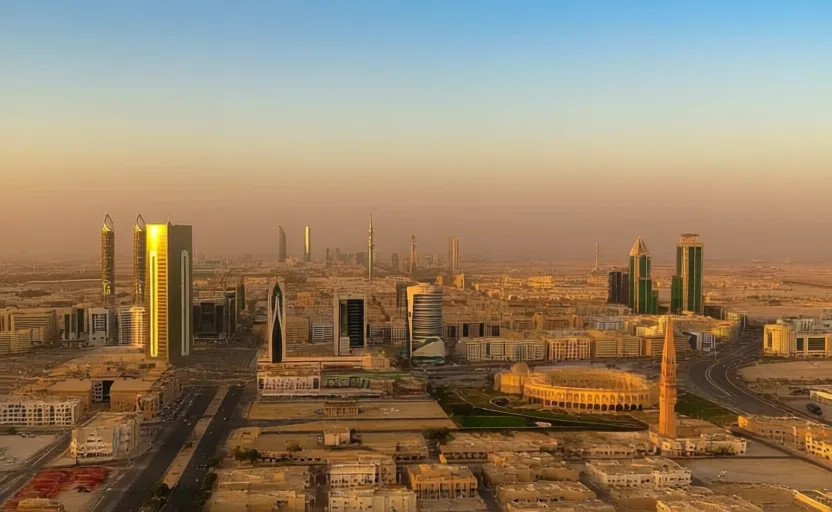 AI city illustration · Artistic impression
What people learn after moving
≈410,000 in Al Khobar city at the 2022 census, ≈660,000 in the governorate; part of a ≈2.2 million metro area with Dammam and Dhahran
Arabic in a Gulf dialect close to Bahraini. English is the working language across the energy sector and widely spoken in shops and restaurants
Saudi Riyal (SAR), pegged at 3.75 to the US dollar
Sunday to Thursday; weekend is Friday–Saturday
AI city illustration · Artistic impressionCost of living in Al Khobar
Check your eligibility
Pick your passport to see entry rules and the long-stay routes we have researched.
Pick your passport to see whether you can enter Saudi Arabia — and what it takes to stay.
The visa stamped abroad is an entry permit; your residence permit is created here, by your employer, after a Saudi medical, and the law allows 90 days from entry. Until the Iqama exists you cannot bank properly, hold a SIM in your name, drive or leave the country. In Al Khobar there is a fifth consequence the rest of the Kingdom rarely thinks about: no Iqama means no exit and re-entry permit, and no exit permit means the causeway to Bahrain — the region's default weekend — is closed to you.
If your licence comes from a country on Muroor's approved list, conversion is paperwork: certified Arabic translation, an Efada medical that includes a blood-type check printed onto the card, an Absher appointment and a fee. All of it requires a live Iqama. Then there is the part that is specific to this city — driving to Bahrain requires vehicle documents in order, insurance that is actually valid there, a toll, and a border crossing whose timing determines whether the trip takes forty-five minutes or four hours.
A resident account requires an Iqama. Before you have one, SAMA's rulebook caps what a bank may move for a newcomer at SAR 10,000 and forbids the arrangement continuing past three months without in-person Iqama verification. Once residency exists, opening takes ten minutes inside a bank app authenticated by Nafath, provided your SIM is in your name and you hold a National Address. Almost every official payment then runs through SADAD — including the traffic fines that gate your exit permit.
Cooperative health insurance is compulsory for every expatriate, is your employer's legal duty for you and every dependant on your Iqama, and is verified electronically against the CHI register — no valid policy means the Iqama cannot issue or renew. Al Khobar has the densest cluster of private hospitals in the Eastern Province, so the constraint is almost never availability. It is the class of policy you hold, and which hospitals that class admits you to.
Every Saudi line is registered against a verified identity with a live fingerprint capture in person, and each ID may hold only a small number of lines. Visitors register on passport and visa, residents on the Iqama, and postpaid needs an active Iqama. The line must be in your own name, because Nafath authenticates against it and everything else authenticates through Nafath. Then there is the local twist: Bahraini networks reach across the water, and an unlocked handset on automatic selection will happily roam onto one while you sit on your own balcony.
Saudi Arabia levies no personal income tax on salaries and there is no personal return to file, so the gross on your offer is broadly what lands. As a non-Saudi you contribute nothing to GOSI; the employer pays a 2% occupational-hazard premium and you accrue no Saudi pension. The real costs are 15% VAT on spending, the dependant levy if family come, and the way an energy-sector package is split between base salary and allowances. Living beside a lower-VAT neighbour tempts people into cross-border shopping arithmetic that mostly does not survive the customs allowance.
Each guide has verified costs, timelines, required documents, and the non-obvious gotchas — sourced from official government pages. Last verified August 2026.
Reading a list isn’t learning it. Globe Quest turns these into a trainer — hear each phrase spoken, drill them with spaced repetition, and get scored as you say them out loud.
Leaving Saudi Arabia on an Iqama requires a valid exit and re-entry permit, and a Friday afternoon in Bahrain counts. Since the 2021 reforms you request it yourself on Absher rather than needing your sponsor's signature, but the permit itself still exists and issuance checks that your Iqama is valid, your passport has enough life left and you have no outstanding traffic violations. Eastern Province highways are heavily camera-enforced, so an unnoticed speeding ticket is the classic reason a crossing collapses on the day. If you cross monthly, get a multiple-entry permit rather than buying single-use ones repeatedly.
Bahrain permits alcohol; Saudi Arabia does not, and the Passport Island customs post on the return leg is thorough — vehicles are searched and bags X-rayed. Bringing alcohol, pork products or restricted medicines back into the Kingdom risks fines, detention, deportation and cancellation of your residency. This applies to anything in the car, including a colleague's bag. Treat the return crossing as a genuine border into a jurisdiction with different law, because that is exactly what it is.
A standard Saudi motor policy generally does not cover you across the border. You need short-term cover valid in Bahrain, purchased before or at the crossing, along with a current Istimara registration in your own name or a certified authorisation from the owner if the car belongs to someone else — a company car or a spouse's car both count. There is a toll, and toll and insurance are commonly handled through the causeway's own app. Sort all of this on a quiet weekday, not in the Thursday queue.
The crossing is busiest outbound on Thursday afternoon and evening and inbound on Friday and Saturday night, and it becomes extreme around Eid and school holidays when queues at the border posts can run for hours. Crossing early on a Friday morning and returning before Saturday evening avoids most of it. Ride-hailing and bus services run the route if you would rather not drive; leaving your car on the Saudi side is a legitimate strategy for a weekend trip.
Aramco's headquarters is in Dhahran and the provincial government is in Dammam, but Khobar is where the residential compounds, the international schools, the Western-facing restaurants and the coffee scene concentrate. That means higher rents than Dammam for equivalent space, and a social life that is easier to plug into if you have just arrived from abroad. Many people work in Dhahran or Dammam and live here on purpose — the drive is fifteen to twenty-five minutes.
The Bahraini networks reach across the water, and handsets left on automatic network selection along the Khobar coast and near the causeway approach will occasionally register on a Bahraini operator and start billing international roaming from inside Saudi Arabia. It shows up as an unexplained charge weeks later. Lock the network to your Saudi carrier manually or turn off data roaming, and the problem simply goes away.
SLB, Halliburton, Baker Hughes, Wood, Worley, NOV, Weatherford
Al Khobar is where the international service companies put their Saudi offices, close enough to Aramco's Dhahran headquarters to be there in fifteen minutes — the reason so much of the region's professional hiring is contractor rather than operator.
Saudi Aramco, Aramco Digital, Dhahran Techno Valley tenants
Aramco's headquarters and its research and technology cluster sit immediately west of Khobar, and a very large share of the city's residents commute into it or work for someone who supplies it.
Al Fozan Holding, Al Muhaidib, Zamil Group, Al Turki, Nesma
Several of the Kingdom's largest family industrial and trading groups were founded on this coastline and remain headquartered here rather than in Riyadh — a different, more relationship-driven corporate culture.
Cenomi Centres, Al Rashid Mall, Mall of Dhahran, Al Othaim, Panda
The mall economy here is unusually large because it doubles as the region's climate-controlled public space for five months of the year, and it draws Bahraini weekend traffic across the causeway.
Bank Al Bilad, SNB, Riyad Bank regional operations, Bupa Arabia, Tawuniya
Corporate and trade finance for the industrial belt is run from here, and the insurance sector has a strong Eastern Province presence servicing the energy and contracting industries.
Almana General Hospitals, Dr Sulaiman Al Habib, Prince Mohammed bin Fahd University, international schools
Khobar holds the densest cluster of private hospitals and international schools in the province, which is a large part of why families base themselves here even when the job is elsewhere.
Landmark · West of Khobar, 25 km across the Gulf
The road and bridge link to Bahrain, opened in 1986, with the two countries' border posts sharing an artificial island in the middle.
Local tip: The observation tower on the border island is open to people crossing and gives a strange, excellent view back at both coastlines. Crossing early on a Friday morning and returning before Saturday evening avoids the worst of the queues; Eid weekends are best avoided entirely.
Landmark · Eastern seafront
Sixteen kilometres of seafront promenade, parks and sculpture, anchored by the 1970s water tower that is the city's silhouette.
Local tip: Come after Isha prayer, when families arrive with picnic mats and the whole strip fills up. In daylight in summer it is empty for a reason. The northern end near the causeway approach is quieter than the central section by the towers.
Neighborhood · Behind the Corniche, inland Khobar
The older, denser quarter of tailors, electronics shops, spice merchants and small restaurants — the working city behind the malls.
Local tip: This is where the good cheap eating is: Filipino, Keralan, Egyptian and Yemeni places that never appear on a delivery app. It is also where to get clothes made — Thuqbah tailors will copy a garment from a photograph in a few days for a fraction of retail.
Food · Al Ulaya and Al Aqrabiyah
A dense cluster of specialty roasteries and cafés that has made Khobar one of the Gulf's more serious coffee cities.
Local tip: Saudi third-wave coffee is genuinely excellent and cheap, and the cafés function as the social infrastructure that bars provide elsewhere — meetings, dates and long evenings all happen here. Ask for the single-origin filter rather than the espresso menu.
Nature · About 25 minutes south
A wide, shallow crescent of sheltered water backed by dunes, with beach resorts, kite surfing and a lot of weekend traffic.
Local tip: The resort stretches are worth the day fee for the shade and facilities; the public stretches get very busy on Fridays. October to April is the window — in high summer the water is too warm to cool you down and the wind is wrong for kiting.
Nature · About two hours south, past Al-Ahsa
A near-empty white sand spit beside the ruins of the Gulf's oldest port, where the 1922 Uqair Protocol drew borders that still exist.
Local tip: One of the most beautiful places on this coast and almost nobody from Khobar goes. Take everything with you — there is no shade, no shop and patchy signal. The old customs house and fort are unrestored and unstaffed, which is much of the appeal.
Side-by-side cost of living, language, climate and careers — to help you choose.