
Population
≈345,000 in the city of Honolulu; about 1 million on Oʻahu, which is roughly 70% of the state
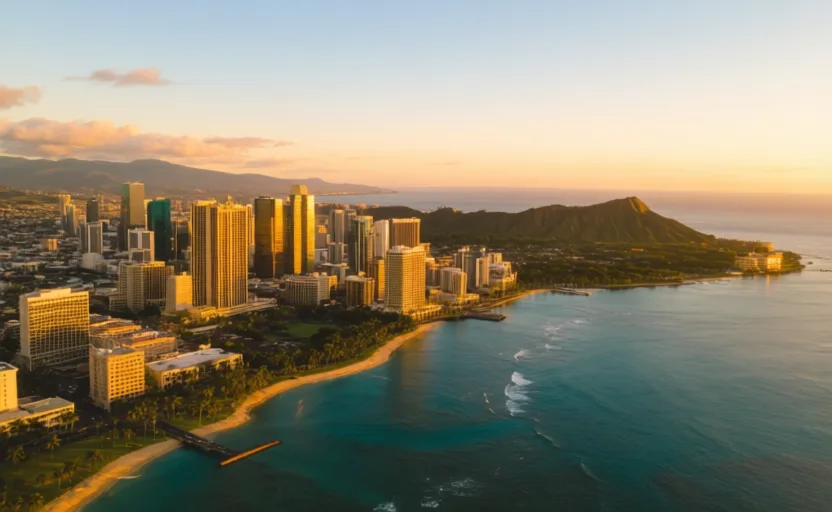 AI city illustration · Artistic impression
What people learn after moving
≈345,000 in the city of Honolulu; about 1 million on Oʻahu, which is roughly 70% of the state
English and Hawaiian are both official languages of the state; Hawaiian Pidgin (Hawaiʻi Creole English) has been counted by the US Census as a language spoken at home since 2015, alongside large Ilocano, Tagalog, Japanese and Chinese-speaking communities
United States dollar (USD)
HST (GMT-10) all year — Hawaiʻi does not observe daylight saving time, so the gap to the US mainland and to Europe changes twice a year while the clock here never moves
AI city illustration · Artistic impressionCost of living in Honolulu
Check your eligibility
Pick your passport to see entry rules and the long-stay routes we have researched.
Pick your passport to see whether you can enter United States — and what it takes to stay.
There is no post-arrival registration in the US: your I-94 record is your status. In the first weeks you need a Social Security number if work-authorised, or an ITIN if not. The Hawaiʻi difference is the licensing counter — driver licences and state IDs are issued by the county rather than by a state DMV, so on Oʻahu you book with the City and County of Honolulu's Department of Customer Services at a driver licensing centre or one of the satellite city halls. That is also the credential that unlocks kamaʻāina resident pricing on flights, hotels and attractions, which over a year is worth more than most people expect.
A vehicle brought to Oʻahu must be registered, or issued an out-of-state permit, within 30 days of arriving on the island, and Hawaiʻi requires a periodic safety inspection at a licensed station before registration will issue. All of it is handled by the county, not by a state DMV. The prior question is whether to bring a car at all: shipping one across the Pacific is expensive, the urban core is dense and flat, TheBus is one of the better city bus systems in the country, and Skyline's second segment opened in October 2025 running through to the airport and Middle Street. Directions here are given mauka and makai rather than by compass, which takes about a fortnight to internalise.
You can open a US account without a Social Security number: federal rules let a bank use your passport number and country of issuance, or an ITIN, as the identifying number. Hawaiʻi's retail market is unusual in being led by home-grown institutions — Bank of Hawaiʻi, First Hawaiian, Central Pacific, American Savings — rather than by the national brands, and the large military-linked credit unions are open to a broader membership than their names suggest. The credit problem is the standard American one: no US file scores worse than a bad one. The local twist is that the move-in cash requirement here is among the highest in the country once rent, deposit and the first electricity bill land together.
Coverage comes from an employer, from Med-QUEST (Hawaiʻi's Medicaid programme, which the state expanded), or from HealthCare.gov. What makes Hawaiʻi different is the Prepaid Health Care Act: employers must provide health coverage to any employee working 20 or more hours a week for four consecutive weeks, and the employee's own share of the single-coverage premium is capped at 1.5% of monthly wages. That is dramatically stricter than the federal ACA employer mandate, and it is why Hawaiʻi has had one of the lowest uninsured rates in the country for fifty years. The practical consequences for a newcomer: part-time work carries insurance here, and a job offer's health benefit is a legal floor rather than a negotiating chip.
The US has no SIM registration requirement, so getting connected is trivially easy: buy a prepaid SIM or eSIM and it works immediately. The friction is postpaid contracts, which run a credit check you cannot pass on arrival. Locally, two things matter more than the plan. First, check that your carrier's Hawaiʻi coverage is real rather than roaming — coverage on Oʻahu is good but drops away on the windward valleys, the North Shore and every neighbour island. Second, leave wireless emergency alerts switched on: Hawaiʻi's tsunami and hurricane warnings arrive that way, alongside the outdoor sirens tested at 11:45 a.m. on the first working day of each month.
Hawaiʻi's income tax runs across twelve brackets from 1.4% to 11% — the second highest top rate in the country after California — but Act 46 of 2024 is phasing in wider brackets and a much larger standard deduction in steps from tax year 2024 through 2031, and withholding tables changed in January 2025. The tax that surprises people is the other one: Hawaiʻi has no sales tax, and instead levies a general excise tax on the seller's gross business income at 4% plus a 0.5% Oʻahu county surcharge. Because it taxes the business rather than the transaction, it reaches residential rent, groceries, medical services and professional fees. Property tax runs the other way: the City and County of Honolulu's owner-occupier residential rate is $3.50 per $1,000 of net taxable value, which is very low by US standards — but a home worth over $1 million without a home exemption on file falls into the much dearer Residential A class.
Each guide has verified costs, timelines, required documents, and the non-obvious gotchas — sourced from official government pages. Last verified August 2026.
Reading a list isn’t learning it. Globe Quest turns these into a trainer — hear each phrase spoken, drill them with spaced repetition, and get scored as you say them out loud.
Hawaiʻi has the most expensive electricity in the United States by a wide margin — residential rates run in the mid-forties of US cents per kilowatt-hour against a national average under twenty. The reason is structural rather than cyclical: each island runs an isolated grid with no interconnection to another island or to the mainland, and much of the generation still burns imported oil. A flat with old windows, no cross-ventilation and a wall air-conditioner can cost two or three times one that catches the trade winds. Ask for a specific unit's actual bills before signing, and treat 'has trade wind exposure' as a financial feature.
Hawaiʻi levies no sales tax. It levies a general excise tax on the seller's gross business income — 4% statewide plus a 0.5% county surcharge on Oʻahu — and because it is a tax on the business rather than on the sale, it applies to things a mainland sales tax exempts: residential rent, groceries, medical and dental services, professional fees. Businesses may pass it on visibly at up to 4.712% on Oʻahu, which is higher than 4.5% because the tax applies to the passed-on tax itself. Budget for it on almost every line of your spending, not just retail.
The Hawaiʻi Prepaid Health Care Act of 1974 requires employers to provide health coverage to any employee working 20 or more hours a week for four consecutive weeks, and caps the employee's own contribution to the single-coverage premium at 1.5% of monthly wages. It is far stricter than the federal ACA employer mandate, which only reaches employers with 50 or more full-time staff. Hawaiʻi holds the only state exemption from ERISA that Congress has ever granted, which is why no other state has copied it. The practical consequence: a 20-hour job here carries health insurance, and part-time work is worth more than the wage suggests.
Hawaiʻi has no statewide motor vehicle agency. Driver licensing, state ID and vehicle registration are run by each county, so on Oʻahu you are dealing with the City and County of Honolulu's Department of Customer Services through its driver licensing centres and satellite city halls, booked through the county's online appointment system. Guides that tell you to 'visit the Hawaii DMV' are describing something that does not exist. Book the appointment before you need it — availability, not the legal deadline, is what determines when this actually happens.
Oʻahu sits in a tsunami and hurricane zone and the state runs an outdoor siren network tested at 11:45 a.m. on the first working day of every month. Learn whether your address and your workplace are inside a tsunami evacuation zone — the maps are in the front of the phone book and online — and know the difference between the monthly test and a real activation. Hawaiʻi also sent an erroneous ballistic missile alert to every phone in the state in January 2018, which is why locals are more attentive to the official channels than to social media in an emergency.
Act 46 of 2024 is the largest income tax cut in Hawaiʻi's history, phasing in wider brackets and a larger standard deduction in steps from tax year 2024 through 2031. Withholding tables changed in January 2025, so take-home pay moved before the filing math did, and any calculator or article written before mid-2024 overstates what you will actually pay. The top marginal rate remains 11% across twelve brackets — the second highest in the country after California — so this is a real cut on a genuinely high base rather than a low-tax state emerging.
US Indo-Pacific Command at Camp H.M. Smith, Joint Base Pearl Harbor-Hickam, Schofield Barracks, Marine Corps Base Hawaiʻi at Kāneʻohe Bay, plus a large defence-contracting layer
Oʻahu hosts the headquarters of the combatant command responsible for most of the planet's surface, and defence is the second pillar of the state economy after tourism. Most uniformed and many contractor roles require US citizenship and often a clearance, so treat this as the reason the local economy is shaped the way it is rather than as a job market you can walk into on arrival.
The Waikīkī hotel cluster, Hawaiian Airlines, Alaska Air Group, Polynesian Cultural Center, the cruise and tour operator layer
The single largest private employment base, and the one that sets the wage floor. It is also the sector most exposed to shocks — the pandemic and the 2023 Maui wildfires both cut visitor numbers sharply and quickly. Hawaiian Airlines, headquartered here, was acquired by Alaska Air Group in 2024, which reshaped the aviation employment picture.
The Queen's Health Systems, Hawaiʻi Pacific Health (Straub, Kapiʻolani, Pali Momi), Kaiser Permanente Hawaiʻi, Adventist Health Castle, Tripler Army Medical Center
Concentrated in and around Punchbowl and Moanalua. Queen's is the state's largest private employer and its only Level I trauma centre; Kapiʻolani is the state's only children's hospital. Because the Prepaid Health Care Act insures such a large share of workers, the sector's commercial base is unusually broad for a state this small.
State of Hawaiʻi, City and County of Honolulu, the University of Hawaiʻi system with its Mānoa flagship, the Hawaiʻi State Department of Education
Honolulu is a state capital, a county seat and a university town at once. Hawaiʻi runs the only single statewide school district in the United States — there are no local school boards and no district-shopping — which makes the Department of Education one of the largest employers in the state by headcount.
Matson, Pasha Hawaii, Young Brothers, Horizon Lines legacy operations, Hawaiian Dredging, Nan Inc., Kiewit
Honolulu Harbor is the funnel through which roughly four-fifths of everything consumed in the state arrives, and inter-island freight moves on barges from here. Because the Jones Act restricts domestic ocean cargo to US-built, US-flagged and US-crewed vessels, this is a small, capital-intensive and politically consequential sector. Construction runs on public infrastructure — the Skyline rail line above all — as much as on private development.
NOAA Inouye Regional Center on Ford Island, the Pacific Tsunami Warning Center, University of Hawaiʻi School of Ocean and Earth Science and Technology, the Institute for Astronomy, East-West Center
The Pacific Tsunami Warning Center issues warnings for the entire Pacific basin from here. The University's ocean science school and the Institute for Astronomy — which operates the Maunakea telescopes from an administrative base on Oʻahu — anchor a genuine research economy, though the astronomy side is inseparable from a long-running dispute over the mountain's use.
Nature · East Honolulu
The tuff cone that ends every postcard, with a paved-and-stepped trail to a coastal artillery observation post at the rim and a 360-degree view of the south shore.
Local tip: Out-of-state visitors must reserve entry online in advance; Hawaiʻi residents with a state ID enter without a reservation and without the fee. Go at opening, then walk down into Kaimukī on Waiʻalae Avenue for breakfast — it is the best eating street in the city and almost no visitor finds it.
Culture · Downtown, west end
One of the oldest Chinatowns in the United States, still a working market district of lei stands, fishmongers and noodle houses, with galleries and bars layered over the top on Nuʻuanu and Hotel Streets.
Local tip: First Friday is the long-running gallery walk and the easiest way to meet people in your first month. Go to the markets in the morning for produce at a fraction of supermarket prices — this is the single biggest lever on a Honolulu grocery bill.
Neighborhood · Between downtown and Ala Moana
The city's fastest-changing district: former warehouses and light industry now interleaved with high-rise towers, the largest concentration of street murals in the state, and the SALT block of independent shops and restaurants.
Local tip: POW! WOW! Hawaiʻi repainted these walls annually for a decade, so the murals genuinely change — the walk is different year to year. Kakaʻako Waterfront Park at sunset is where locals go to avoid the Waikīkī crowd two kilometres away.
Nature · Windward side, 30–40 minutes from town
The windward coast's two best-known beaches, with turquoise water, offshore islets and a small-town main street behind them, reached through the tunnels under the Koʻolau range.
Local tip: There is no public parking at Lanikai and the residential streets are heavily enforced — park in Kailua town and cycle or walk in. Go on a weekday; the Pali and Likelike tunnels back into town at weekend rush are the island's worst traffic.
Landmark · ʻAiea / Joint Base Pearl Harbor-Hickam
The site of the 7 December 1941 attack, with the memorial built over the sunken battleship, plus the Bowfin submarine, the Missouri and the Pacific Aviation Museum on Ford Island.
Local tip: Arizona Memorial programme tickets are released on a rolling schedule online and the walk-up allocation goes early; book rather than arriving hopeful. Skyline's Makalapa station now puts the visitor centre within reach without driving, which was not true before October 2025.
Nature · Windward and central Oʻahu
Beyond the four or five trails on every visitor list is a much larger network across the Koʻolau range — knife-edge ridges, waterfalls and windward views — administered by the state's Nā Ala Hele trail system.
Local tip: Check Nā Ala Hele for whether a trail is actually legal and open before you go; several of the most photographed routes on Oʻahu, including the Haʻikū Stairs, are closed and enforced. The stairs were physically removed in 2024, so any guide still recommending them is out of date.
Side-by-side cost of living, language, climate and careers — to help you choose.