
Population
About 318,000 — Germany's twentieth-largest city, and the centre of a Rhine-Neckar metropolitan region of well over two million spread across three federal states
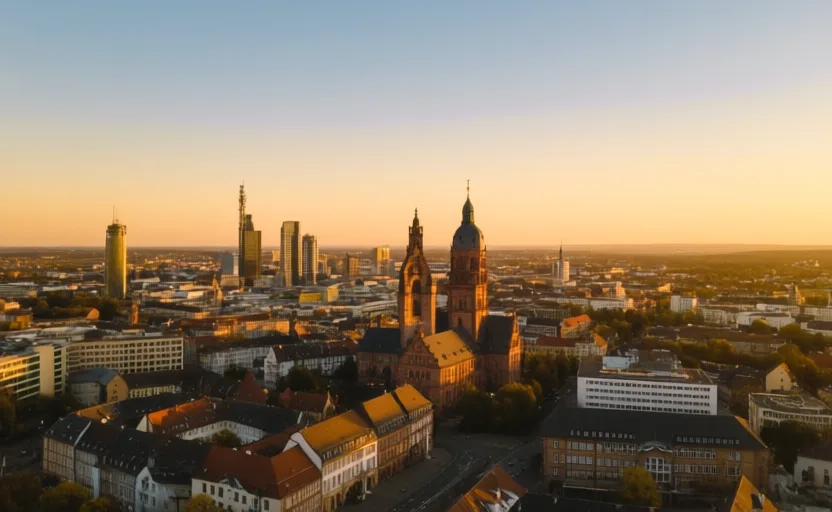 AI city illustration · Artistic impression
What people learn after moving
About 318,000 — Germany's twentieth-largest city, and the centre of a Rhine-Neckar metropolitan region of well over two million spread across three federal states
German, with Kurpfälzisch underneath it — a Rhine-Franconian dialect belonging to neither Baden nor Swabia; English is normal at the university and in the pharmaceutical sector
Euro (EUR)
CET (GMT+1); CEST (GMT+2) from late March to late October
AI city illustration · Artistic impressionCost of living in Mannheim
Check your eligibility
Pick your passport to see entry rules and the long-stay routes we have researched.
Pick your passport to see whether you can enter Germany — and what it takes to stay.
Germany's sequence is rigid and identical everywhere: register your address within two weeks of moving in, which produces the confirmation needed for a tax ID, bank account, health insurance and residence permit. Mannheim's structural advantage is that it is a Stadtkreis — a city that is its own district — so there is no county or regional authority to be handed on to, unlike Aachen or Hannover where the permit sits a tier up. One city government does the whole sequence, which is one fewer queue than a lot of German cities of this size.
EU and EEA licences remain valid without action. Non-EU licences are valid for six months from taking up residence, after which you need a German licence — and whether tests are required depends on the issuing country and, for federal countries, the specific state or province. Mannheim is flat, compact and served by one of the denser tram networks in Germany, and the VRN fare area stretches across three federal states, so the practical case for a car is weaker than the city's automotive history suggests.
You need a German account for salary, rent and the direct debits German life runs on. Traditional banks require an Anmeldung first, creating a sequencing problem; digital banks generally do not. Mannheim's rental market is more affordable than Stuttgart or Frankfurt but no longer sits under the state rent cap, which puts more weight on the ordinary levers a tenant has: a complete application folder, a Schufa report in hand, and an employer letter a local landlord recognises.
Germany requires everyone to hold health insurance. Employees below an annually-set income threshold must join the statutory system, where contributions are a percentage of income shared with the employer and dependants are covered free. Above the threshold, and for the self-employed, private cover becomes available — cheaper when young and healthy, considerably more expensive later, and very difficult to leave. Mannheim's advantage is supply: the Universitätsmedizin Mannheim is a full university hospital and Heidelberg's is twenty minutes away, which makes the Rhine-Neckar one of the best-covered regions in the country for specialist and tertiary care.
Germany requires identity verification for every SIM including prepaid — passport or ID, verified in a shop, by video call or at a post office. Prepaid needs no Anmeldung or Schufa. Postpaid contracts run a Schufa check a newcomer will fail or pass marginally, so start prepaid and switch once you have a record. Mannheim's local wrinkle is address handling: provider order forms are built around street names, and a Quadrat address is not one, so availability checks and installation appointments go wrong here more often than they should.
German income tax is progressive and deducted at source, with your tax class determining monthly withholding. Church tax adds 8% of your income tax liability in Baden-Württemberg — the reduced rate shared only with Bavaria. A solidarity surcharge applies to higher incomes. The genuinely different piece is property tax: Baden-Württemberg declined the federal valuation model and taxes only the plot area multiplied by the official land value, ignoring the building entirely, with a 30% reduction where the use is predominantly residential. Mannheim set its Grundsteuer B multiplier at 365% from 2025.
Each guide has verified costs, timelines, required documents, and the non-obvious gotchas — sourced from official government pages. Last verified August 2026.
Reading a list isn’t learning it. Globe Quest turns these into a trainer — hear each phrase spoken, drill them with spaced repetition, and get scored as you say them out loud.
This inverts the advice in every generic guide to renting in Germany. Baden-Württemberg's new Mietpreisbegrenzungsverordnung, adopted on 16 December 2025 and in force from 1 January 2026, redrew the map: 130 municipalities in, 84 of them newly added, 43 dropped — and Mannheim is one of the ones dropped. So a new letting here is no longer held to 10% above the local comparative rent. The Kappungsgrenze uses the same area definition, which means increases inside a running tenancy revert from 15% to the federal 20% over three years. The instrument you have left is the city's qualified Mietspiegel, and it matters much more here than in a city that still has the cap.
Declaring membership of a recognised church at your Anmeldung triggers automatic deduction of church tax on top of your income tax. Baden-Württemberg and Bavaria charge 8% of the income tax liability; every other German state charges 9%. On a middle income the difference is small but real, and the choice is made in a five-minute appointment most newcomers do not realise carries an annual cost. Leaving formally later needs its own appointment and a fee.
Mannheim's centre has 144 numbered blocks instead of named streets, a layout descending from the grid laid out when the city and fortress were founded in 1607. Blocks west of the central axis are lettered A to K and those east of it L to U, running south to north, with no J. The number rises as you move outward from the axis, and — this is the part that catches people — the house numbers of a single Quadrat are distributed around all four of its sides. Your flat in P7 may be nowhere near the corner your map drops you at. Satnavs handle it; humans need one afternoon.
Baden-Württemberg refused the federal valuation model and legislated its own modified land-value model, applied from 2025. Only two things go into the calculation: the plot area and the official land value. The building on it is irrelevant — a bungalow and an apartment block on identical plots owe identical tax before the residential discount. The state Steuermesszahl is 1.3 per mille, reduced by 30% to 0.91 per mille where the property is predominantly residential, and Mannheim set its Grundsteuer B multiplier at 365% from 2025. If you are buying, this is a completely different calculation from the one your friends in Cologne or Bremen are doing.
Ludwigshafen is a five-minute tram ride and a different Bundesland. Rhineland-Palatinate charges 9% church tax rather than 8%, uses the federal property-tax model rather than the land-value one, has its own school holidays and its own tenancy ordinances — and hosts BASF's Ludwigshafen site, the largest integrated chemical complex in the world, which employs a substantial share of the Mannheim region. The VRN transport network spans three states and hides the border completely; the paperwork does not.
Everyone resident in Germany must hold health insurance. Employees below an annually-set income threshold join the statutory system, where contributions are shared with the employer and dependants are covered free; above it, private cover becomes available and is very hard to leave. For urgent but non-emergency problems, 116117 is the national medical on-call number. The poison information centre designated for Baden-Württemberg is the Vergiftungs-Informations-Zentrale at the Freiburg university hospital on 0761 19240 — two hours away and the correct number regardless.
John Deere European headquarters and Mannheim works, Daimler Truck's Mannheim engine plant and foundry
John Deere runs its European operations from Mannheim and the tractor works here is one of the largest industrial sites in the city; Daimler's Mannheim plant builds engines and bus chassis on the site where Carl Benz built the first automobile in 1886.
Roche Diagnostics, the Universitätsmedizin Mannheim research network
Mannheim is Roche's largest site in Germany and the historical home of its diagnostics business, which makes the city an unusually deep market for laboratory, regulatory and manufacturing-science careers.
BASF across the river in Ludwigshafen, Bilfinger SE, Fuchs SE, Südzucker AG
Three DAX-adjacent groups keep their headquarters in Mannheim itself, and BASF's Ludwigshafen site — the largest integrated chemical complex in the world — sits five minutes away in a different federal state and pulls thousands of Mannheim residents across the Rhine each morning.
MVV Energie, Siemens Energy, ABB and Alstom's Mannheim operations
MVV Energie is headquartered here with several thousand staff, and the Käfertal industrial belt has been building turbines, switchgear and rail traction equipment for over a century.
Universität Mannheim, Mannheim Business School, Hochschule Mannheim, Popakademie Baden-Württemberg
The University of Mannheim occupies the Baroque palace and is the country's reference address for business and economics; the Popakademie, the state's music-industry school, sits in the Jungbusch and is the reason Mannheim holds a UNESCO City of Music designation.
Hafen Mannheim, Contargo, the Rhine–Neckar freight and forwarding sector
Mannheim has one of the largest inland ports in Europe and one of Germany's busiest ICE junctions in the same city, which is why so much of the regional economy is about moving things rather than making them.
Landmark · Schlossplatz, south end of the Quadrate
One of the largest Baroque palaces in Europe, built for the Electors Palatine from 1720 and rebuilt after the war — and today the main building of the University of Mannheim.
Local tip: Most of it is a working university, so you can walk in and through it on a weekday like any student. The restored Baroque state rooms and the palace church are separately ticketed and worth an hour. Approach along the Kurpfalzstraße from the water tower so the whole 450-metre facade arrives at once.
Neighborhood · Inside the ring
The 144 lettered and numbered blocks that make up the centre, laid out on the grid drawn when city and fortress were founded in 1607, with the Paradeplatz and its Grupello pyramid at the middle.
Local tip: Walk one full block boundary and the system stops being confusing: the four sides of one Quadrat carry that block's house numbers between them. The shopping is on the Planken, the drinking is nearer the Jungbusch, and the best food in the centre is in the small streets around the market square rather than on the main axis.
Culture · East end of the Planken
Mannheim's emblem — an 1889 water tower standing over one of the largest Art Nouveau squares in Germany, with arcades, fountains and formal gardens laid out around it.
Local tip: Come back after dark when the fountains are lit; the square was designed for exactly that and it is the one view of Mannheim that outsiders recognise. The Kunsthalle on the far side has a serious modern collection and a striking 2017 extension that locals still argue about.
Nature · Oststadt, across the Neckar side
One of the most visited parks in Germany, extended and remade for the 2023 federal garden show, with a lake, gondolas, a butterfly house and a television tower over it.
Local tip: The Gondoletta boats across the lake are the local ritual and cost almost nothing. Combine it with the Herzogenriedpark on the other side of the Neckar — the 2023 garden show connected them, and the walk between the two is how residents actually use the parks rather than as separate day trips.
Nightlife · Between the centre and the Rhine harbour
The old dockworkers' quarter — the most mixed and most argued-about district in the city, now home to the Popakademie, a strip of bars and the closest thing Mannheim has to a scene.
Local tip: Jungbuschstraße after ten on a Friday is where the city's music economy actually socialises. It is also genuinely a working-class immigrant neighbourhood rather than a themed one, which is the point — eat at the Turkish and Balkan places rather than the ones with the design website.
Food · G1, Quadrate
The market square, with a market on Tuesdays, Thursdays and Saturdays — and a single 18th-century building that is half town hall and half parish church, joined by a shared bell tower.
Local tip: The building is the hidden thing: civic authority and the church were deliberately built into one structure with one tower, which is not something you find elsewhere and which almost no visitor notices. Go on a Saturday morning for the market, then stand in the middle of the square and look at the two halves of the façade.
Side-by-side cost of living, language, climate and careers — to help you choose.