
Population
≈1.7 million in the municipality, ≈3.2 million across the Puebla–Tlaxcala metropolitan zone — Mexico's fourth largest
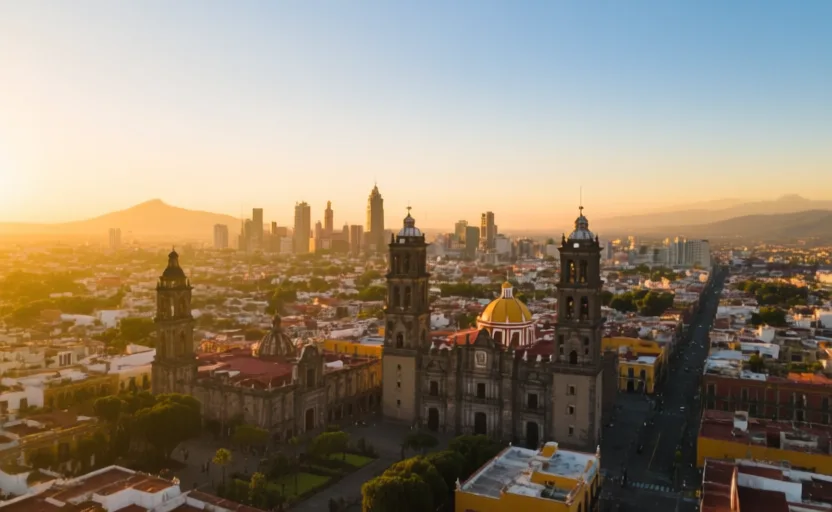 AI city illustration · Artistic impression
What people learn after moving
≈1.7 million in the municipality, ≈3.2 million across the Puebla–Tlaxcala metropolitan zone — Mexico's fourth largest
≈2,135 m (7,005 ft) — high enough that the nights are cool all year and the sun is fierce at midday
Spanish, with Náhuatl still spoken across the state. English is common inside the universities and the automotive multinationals
Mexican peso (MXN, $)
AI city illustration · Artistic impressionCost of living in Puebla
Check your eligibility
Pick your passport to see entry rules and the long-stay routes we have researched.
Pick your passport to see whether you can enter Mexico — and what it takes to stay.
Mexican temporary residency starts outside Mexico. A consulate abroad issues a visa sticker, you enter Mexico with the entry record marked for canje, and you then have 30 days to begin the exchange at INM for the physical Tarjeta de Residente. Puebla's practical wrinkle is arrival: most people fly into Mexico City rather than into Puebla's small airport, so the entry record is created at AICM and the canje is then filed in Puebla — which is fine, but means the 30-day clock starts before you have even reached the city. The card carries your CURP, and the CURP is what unlocks the bank account, IMSS, a postpaid phone line and an RFC.
You may drive in Mexico on a valid foreign licence, and an International Driving Permit is a translation rather than an authorisation. Puebla issues licences with three-year and five-year validity and does not offer a permanent one, so anyone arriving from Mexico City expecting a lifetime card is in the wrong state. The process involves a theory exam of ten to thirty multiple-choice questions, a visual acuity check and, in the state's current arrangements, a driving simulator element. What is genuinely local after that is maintenance: volcanic ash is abrasive and reaches the city several times a year, and it goes straight into air filters, paintwork and windscreens.
Mexican accounts are tiered by regulation. A Nivel 2 account from a fintech opens from your phone in minutes with a passport and CURP and no proof of address, but caps monthly deposits. A Nivel 4 account has no cap, can receive a salary, and needs a comprobante de domicilio and usually an RFC. In Puebla the practical wrinkle is the same shape as elsewhere in Mexico with a local twist: water is supplied under a private municipal concession and billed to the property, so CFE electricity, a fibre contract or your predial receipt are the documents a tenant can realistically move into their own name.
A formal Mexican job enrols you in IMSS automatically and by law, and in Puebla that means most of the automotive workforce. Everyone else can buy into IMSS voluntarily through Seguro de Salud para la Familia, with waiting periods and permanent exclusions, or buy private cover — which most professionals do, because premiums are a fraction of US or European prices. Puebla's specific advantage is medical education: BUAP, UPAEP and Ibero all run medical schools, so the city has an unusually deep pool of specialists and teaching hospitals for its size, and private care costs noticeably less than in Mexico City an hour and a half away.
Buy a prepaid SIM at any OXXO on arrival and start on Telcel Amigo for the widest coverage. Linking every Mexican line to a CURP and a photo ID became compulsory on 9 January 2026, and unregistered prepaid numbers are being suspended through the second half of 2026 on a calendar set by the last digit — the non-biometric successor to the PANAUT registry the Supreme Court struck down. Fixed internet in Puebla is fast and cheap, but the Centro Histórico is a protected colonial grid where visible cabling and external equipment are restricted, and the buildings themselves are thick stone with internal patios. A modern flat in Angelópolis and a colonial house four kilometres away are completely different connectivity problems.
Income tax in Mexico is federal. If a Mexican company employs you, it withholds ISR through payroll and most single-employer staff never file a return. Freelancers and small businesses can elect RESICO, taxing gross receipts at 1–2.5% up to MXN 3.5 million a year. Puebla's state payroll tax is 3%, in line with the national norm and well below Baja California's or Quintana Roo's, and it never reaches your payslip. The genuinely unusual local feature is municipal: since 2025 Puebla city has charged its property acquisition tax (ISABI) on a progressive scale rather than the flat rate most Mexican municipalities use, and the 2026 Ley de Ingresos kept it while updating values for inflation.
Each guide has verified costs, timelines, required documents, and the non-obvious gotchas — sourced from official government pages. Last verified August 2026.
Reading a list isn’t learning it. Globe Quest turns these into a trainer — hear each phrase spoken, drill them with spaced repetition, and get scored as you say them out loud.
The volcano has been erupting continuously since 1994 and CENAPRED has kept the volcanic alert at yellow throughout, with the phase within yellow moving up and down; through 2026 it has generally sat at Amarillo Fase 2 with routine daily exhalations, some carrying ash. When the wind sends it east, Puebla gets a grey morning. The practical consequences are mundane and worth knowing before your first one: close the windows, wear a mask outdoors, do not sweep or hose ash dry because it scratches everything it moves across, change the car's air filter more often than the manual says, and never run the windscreen wipers over dry ash. Check CENAPRED's daily monitoring bulletin rather than social media, and note that heavy ash can close Puebla's airport and occasionally Mexico City's.
The 19 September 2017 magnitude 7.1 earthquake had its epicentre in Puebla state and did severe damage across the region, bringing down churches and buildings in the city and the surrounding towns. Puebla is inside the SASMEX early-warning network, so you may get seconds of warning via the alert tone, a phone app or a loudspeaker. Learn what it sounds like before you hear it for real, find out whether your building predates or postdates the current construction norms, identify the safest spot in your flat, and ask the administración whether there is a drill. Colonial buildings in the historic centre are beautiful and are not, by construction, seismically modern.
Puebla's Centro Histórico was inscribed on the World Heritage List in 1987, and the protected zone covers a large grid of colonial blocks. Works to a listed or contributing building — façades, windows, roofs, signage, colour, even air-conditioning units — need approval from the federal heritage authority as well as the municipality, and the process is slower and stricter than newcomers expect. If you are renting, it mostly means the landlord cannot fix things quickly. If you are buying with any intention of renovating, get the permitting position in writing before you exchange money, because 'we will sort the windows later' is not a plan inside the perimeter.
Most Mexican municipalities charge a flat percentage when you buy property. Since 2025 the municipality of Puebla has applied the Impuesto sobre Adquisición de Bienes Inmuebles (ISABI) on a progressive scale, so the rate depends on the property's value — some lower-value purchases fall into an exempt band and higher-value ones reach around 3%. The 2026 Ley de Ingresos kept the scheme and the rates, updating values and tariffs for roughly 4% inflation rather than raising them. If you are budgeting a purchase, get the band for your specific value from the municipality or the notario rather than assuming the 2–3% flat figure that circulates for Mexico generally.
Buses to Mexico City run from CAPU and from Puebla's east-side terminals at a frequency closer to a metro than an intercity service, and the journey is roughly two hours to Mexico City's airport or the south of the city. That makes Puebla a place people live while working, flying and doing business in the capital — and it is the reason a poblano address costs a fraction of a Roma or Condesa one. Puebla's own airport is small and serves a handful of routes, so plan on Mexico City for anything international and factor the bus into the total journey time.
The dish appears when the criollo walnuts and the pomegranates do — roughly late July through September, peaking around Independence in mid-September — and every restaurant in the state competes over it. Outside that window, a restaurant offering them is using frozen or imported ingredients, which locals will tell you about at length. It is a small thing and it is the fastest way to demonstrate you have paid attention to the place you moved to.
Volkswagen de México (Puebla plant), Audi México (San José Chiapa)
VW has assembled here since the 1960s and the Puebla plant is one of its largest outside Germany; Audi's San José Chiapa plant builds the Q5 for global export. Both are under live US tariff pressure, and both were still expanding in 2026 — Audi announced around 800 new positions for the year, with Q5 output up roughly 37% and exports up over 70% year on year in the first four months.
Several hundred tier-one and tier-two suppliers across the Puebla–Tlaxcala corridor, plus the Ciudad Modelo park around Audi
The supplier base is the larger employer and the more accessible entry point — stamping, injection moulding, seats, electronics, logistics and the quality and engineering functions attached to them. It is also the part of the cluster most exposed when an assembler adjusts volumes.
BUAP, UDLAP, Tec de Monterrey campus Puebla, Ibero Puebla, UPAEP, INAOE
One of Mexico's great student cities. BUAP is among the country's largest public universities, UDLAP in Cholula is a well-known private campus, and INAOE at Tonantzintla is a national astrophysics, optics and electronics research institute — an unusual specialism to have on the doorstep.
Regional textile mills, bakeries, Talavera workshops, mole and confectionery producers
Puebla was a colonial textile and ceramics centre and both survive as industries rather than as museums. Talavera carries a denomination of origin covering specific workshops in Puebla and Tlaxcala, which is why a certified piece costs what it does.
Hotels in the Centro Histórico, Cholula and Atlixco operators, Talavera and gastronomy tourism
A UNESCO World Heritage centre, the largest pyramid in the world by volume ten kilometres away at Cholula, and a food reputation that draws domestic visitors all year. Weekend tourism from Mexico City is a substantial part of the local economy.
Regional back offices, IT services firms, and the professional services attached to the automotive cluster
A large bilingual graduate output and costs well below Mexico City have brought a steady flow of shared-service and outsourcing operations, which is the most realistic office-job route for a foreign professional who is not in automotive.
Culture · Centro Histórico
A seventeenth-century chapel finished in gilded plasterwork so dense that contemporaries called it the eighth wonder of the world. It has to be seen rather than described.
Local tip: Go on a weekday morning when the light comes through the upper windows and the church is nearly empty. Sit at the back for ten minutes before you look at anything closely — the room only makes sense as a whole first.
Culture · Centro Histórico, Calle 5 Oriente
The first public library in the Americas, founded in 1646, with its original carved shelving and thousands of early printed books still in place.
Local tip: It is small, it costs very little, and almost nobody stays more than fifteen minutes. Ask the staff about the chained books and the Nuremberg Chronicle — they know a great deal and are rarely asked.
Landmark · San Andrés / San Pedro Cholula, 10 km west
The largest pyramid in the world by volume, grassed over into a hill, with a colonial church on top and the two volcanoes behind it.
Local tip: Do the tunnel through the pyramid's interior first — it is claustrophobic, strange and usually quiet — and then climb to the church at the end of the afternoon, when Popocatépetl is most likely to be clear of cloud.
Food · Centro Histórico, near the Templo del Carmen
Where the city eats cemitas: sesame rolls the size of a plate, filled to order with milanesa, quesillo, avocado leaf and chipotle.
Local tip: Order pierna or milanesa with quesillo and ask for it 'con papalo' — the herb is the thing that makes a cemita a cemita, and stalls leave it out for people they assume are visitors.
Neighborhood · Centro Histórico, south-east of the zócalo
A cobbled antiques quarter with a weekend market, next to a small square of open painters' studios.
Local tip: The Saturday and Sunday antiques market on Los Sapos is the good version; the weekday bars are the tourist version. Come Sunday morning, then eat at a fonda rather than on the square itself.
Nature · Valsequillo, 20 km south-east
A serious drive-through conservation park on the reservoir, dating from the 1970s and far better regarded than the format suggests.
Local tip: Go on a weekday morning in your own car with the windows up and the roof clean. It is the single best thing to do here with children, and locals treat it as a routine outing rather than a one-off.
Side-by-side cost of living, language, climate and careers — to help you choose.