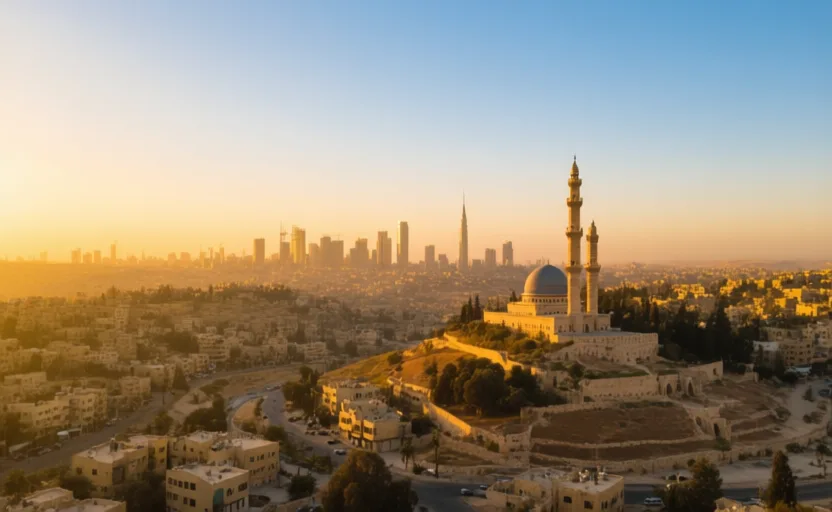
 Amman · AI city illustration · Artistic impression
City · Middle East
Amman
Saved in this browser — no account needed. Sign in later and it comes with you.
Where it is
Amman sits on hills at the edge of the Jordanian plateau, around 800 to 1,100 metres up, where the cultivated highlands give way eastward to desert. The city was originally built across seven hills around a valley with a seasonal stream; it now covers many more, and the numbered circles along the ridge road are how people navigate. Water is the defining constraint: Jordan is among the most water-scarce countries in the world, and the city sits well above the rivers it might have drawn on.
The land and water around it
The seven hillsmountains
The original jabals around the downtown valley. Building across steep ground is why the city has stairways as streets and why its neighbourhoods are so socially legible by altitude — the higher ground is generally the wealthier.
The Zarqa valleyriver
The seasonal stream through the old centre, now largely culverted beneath the downtown. A city built around a watercourse that it then covered over.
The desert edgedesert
East of the city the rainfall drops away quickly and the badia begins. Amman is on the last line of ground where rain-fed farming works, which is exactly where you would expect a city.
Its history, in short
The citadel hill has been occupied for a very long time — Neolithic, then Ammonite Rabbath Ammon, then the Hellenistic and Roman city of Philadelphia, one of the Decapolis. It shrank to a village by the Ottoman period and was effectively refounded in 1878 when the Ottoman authorities settled Circassian refugees from the Caucasus there. The Hejaz Railway arrived in 1904, and Amman became the seat of the Emirate of Transjordan in 1921 and the capital of Jordan in 1946. Its growth since has been driven overwhelmingly by displacement: Palestinians in 1948 and 1967, Iraqis after 1990 and 2003, and Syrians after 2011.
Timeline
Dates are shown on a timeline rather than as changing shapes on the map. The globe draws modern boundaries only, and tinting a modern outline to stand for a historical one would state something we cannot source.
First cities & states
c. 13th century BCE onward
Rabbath Ammon
The citadel is the centre of the Ammonite kingdom, which gives the modern city its name. It is known from its own inscriptions and from neighbouring states' accounts of it.
Approximate dateEncyclopædia Britannica
Classical world
3rd century BCE
Philadelphia
Refounded and renamed by Ptolemy II. Under Rome it becomes one of the Decapolis cities, and the theatre cut into the hillside below the citadel dates from this period.
Approximate dateEncyclopædia Britannica
Post-classical world
8th century
The Umayyad palace
A large complex is built on the citadel under the Umayyads, whose desert castles across the region — Quseir Amra among them — are the best surviving evidence of early Islamic secular art.
Approximate dateUNESCO World Heritage Centre
Industrial & imperial
1878
Refounded by refugees
Ottoman authorities settle Circassian refugees, displaced from the Caucasus by Russian conquest, on the ruins of the old city. Amman's modern existence begins as a resettlement scheme.
Well attestedEncyclopædia Britannica1904
The Hejaz Railway
The line from Damascus toward Medina reaches Amman, connecting a small town to an imperial network and making it worth something strategically for the first time in centuries.
Well attestedEncyclopædia Britannica1921
Capital of Transjordan
Abdullah bin Hussein makes Amman the seat of the new emirate under British mandate. Independence follows in 1946.
Well attestedEncyclopædia Britannica
Contemporary
1948 and 1967
Displacement, twice
Large numbers of Palestinian refugees arrive after the 1948 war and again after 1967. Jordan extended citizenship to many, unlike its neighbours, and a majority of the country's population is of Palestinian origin — a fact whose political implications are handled carefully in Jordanian public life.
Well attestedEncyclopædia Britannica2011 onward
Syria
Several hundred thousand Syrian refugees register in Jordan, most living in cities rather than camps, with Amman absorbing a large share. The pressure on housing and on water is direct.
Well attestedNASA Earth Observatory
Places that carry meaning
The CitadelNeolithic onward
One hill carrying Ammonite, Roman, Byzantine and Umayyad remains in a single stratigraphy, with the modern city visible in every direction from it.
Quseir Amra8th century
A small Umayyad bath-house in the desert east of Amman, painted inside with hunting scenes, bathers and a zodiac ceiling — figurative art in an early Islamic building, which is why it matters so much to art historians.
As-SaltLate 19th–early 20th century
A nearby town of yellow limestone houses, inscribed in 2021 for its record of Muslim–Christian and rural–urban coexistence during the late Ottoman period rather than for a monument.
Languages here
Places are usually multilingual. This lists what is actually spoken, not one language per border.
ArabicSemitic family
The national language.
Jordanian Arabic contains audibly distinct urban, rural and bedouin varieties, and after 1948 the Palestinian varieties of the refugee population reshaped the city's speech — accent in Amman carries information about origin that people can and do read.
CircassianNorthwest Caucasian family
Spoken by the community that refounded the city.
Adyghe, brought from the Caucasus in the nineteenth century, maintained through community schools and associations and now shifting to Arabic in younger generations. Its consonant inventory is among the largest of any language.
EnglishGermanic family
Widely taught and used in business and higher education.
A legacy of the mandate period reinforced by the labour market, and a strong class marker in schooling.
Learn the language here
- 1Understand which languages are spoken hereAmman is multilingual. Start with which languages are used, by whom, and for what — the phrase list only covers one of them.Written by Globe Quest
- 2Learn 11 phrasesCurated everyday phrases for Amman, with audio and a written form.Written by Globe Quest
- 3Say them out loudSpeaking practice with pronunciation feedback, one phrase at a time.Globe Quest material, your own additions
- 4Come back to themSpaced review, so what you learned this week is still there next month.Written by Globe Quest
- 5Practise with people: Arabic practice · DohaAn in-person practice circle. It is a prepared plan and needs a host before it runs.Run by members
Check yourself
How did modern Amman begin?
As an 1878 Ottoman resettlement scheme for Circassian refugees
The citadel is ancient, but the modern city was refounded by displaced people — the pattern its whole growth has followed since.
Why does Quseir Amra matter to art historians?
It carries figurative painting inside an early Islamic building
Hunting scenes, bathers and a zodiac ceiling — evidence that early Islamic secular art was not what later assumptions suggest.
Worth arguing about
- A city built and rebuilt by successive waves of displaced people. What does that do to how it thinks about the next wave?
- Neighbourhood altitude tracks wealth here quite closely. Where else does topography sort a city, and can planning undo it?
What we have not established
These are open questions, listed rather than filled in. We would rather show a gap than a plausible guess.
How many people live in Amman, and how many are refugees?
Registered refugee counts and resident population are collected on different bases, and unregistered residents are by definition not in either. Jordanian census figures and UNHCR registrations are not directly comparable, so we describe the pattern without a total.
Sources
- Britannica · AmmanEncyclopædia Britannica · encyclopedia · checked 2026-09-08
- Britannica · Arabic languageEncyclopædia Britannica · encyclopedia · checked 2026-09-08
- UNESCO · Quseir AmraUNESCO World Heritage Centre · intergovernmental · checked 2026-09-08
- UNESCO · As-Salt - The Place of Tolerance and Urban HospitalityUNESCO World Heritage Centre · intergovernmental · checked 2026-09-08
- NASA Earth Observatory · Amman, JordanNASA Earth Observatory · government · checked 2026-09-08
Reviewed by Globe Quest editorial on 2026-09-08.