 Globe Quest
 Human Quest · LearningSign in
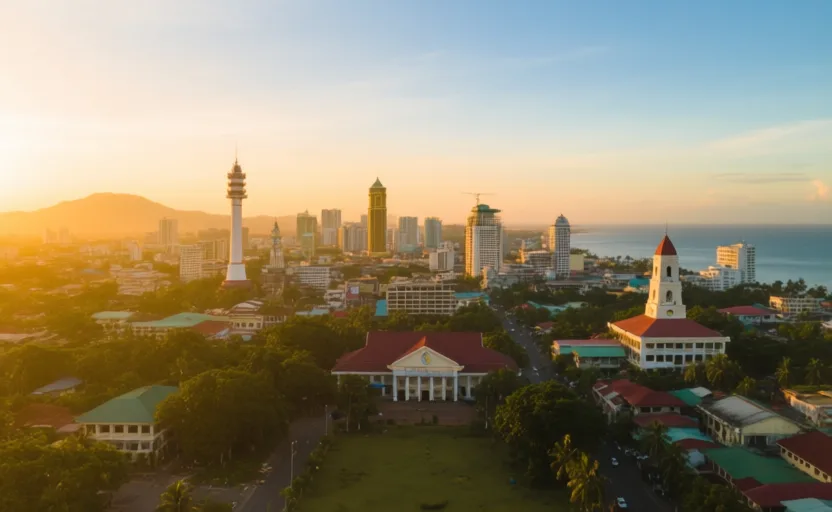 Cebu · AI city illustration · Artistic impression
City · Southeast Asia
Cebu
Saved in this browser — no account needed. Sign in later and it comes with you.
Where it is
Cebu is a long, thin island, about 196 kilometres from north to south and only 32 across at its widest, in the middle of the Visayas, with Negros to its west and Leyte and Bohol to its east. Narrow coastal plains, limestone plateaus and ranges that rise above 1,000 metres fill the interior, and the surrounding waters are among the richest marine areas in the Coral Triangle. The climate is tropical with a dry and a wet season; typhoons are rare in the south but more frequent in the north. Cebu City and its neighbours Mandaue and Lapu-Lapu, which stands on the offshore island of Mactan, form the main urban area.
The land and water around it
Cebu Islandisland
A narrow ridge of limestone plateau and hills running north to south, with coastal plains on both sides. It is the ninth largest island in the Philippines and supports more than 5.2 million people, which is why settlement is packed onto the thin ribbon of flat land by the sea.
Mactan and the surrounding islandsisland
Cebu belongs to a province of 167 smaller islands and islets, including Mactan, Bantayan, Malapascua, Olango and the Camotes. Mactan, off the city’s coast, carries the airport and Lapu-Lapu City, and Bantayan and the Camotes have their own local languages.
Coral Triangle watersreef
Cebu’s coastline is ranked as an area of top importance for marine life in the Coral Triangle. The surrounding seas supply rich fishing grounds, beaches and coral atolls.
Its history, in short
Cebu was an established native kingdom before the Spanish came. Visayan folklore credits its founding to Sri Lumay, a half-Malay, half-Tamil prince from Sumatra, whose capital was named Singhapala, “Lion City”. In March 1521 Magellan’s fleet, directed here by a local ruler on another island, traded with Rajah Humabon, who was baptised with about 400 followers after Magellan raised a wooden cross on the shore. Magellan was killed soon afterwards, and when Miguel López de Legazpi landed in 1565 he was ready for war, but the Spanish settled instead, and Cebu became their first base and the first Spanish capital in the archipelago. Spain ceded the island to the United States in 1898, and Cebu became a chartered city in 1937. Japanese forces landed in April 1942 and used it as a base, while Cebuano guerrillas fought them. Under Marcos, Cebu was a centre of opposition, and in 1986 the civil disobedience campaign against him was relaunched from a traffic circle in Cebu City. In 2013 a magnitude 7.2 earthquake and then Typhoon Haiyan struck the area.
Timeline
Dates are shown on a timeline rather than as changing shapes on the map. The globe draws modern boundaries only, and tinting a modern outline to stand for a historical one would state something we cannot source.
Early modern & oceanic
March–April 1521
Magellan arrives
After reaching the Philippines on 16 March, Magellan is told by Rajah Kolambu of Mazaua to sail to Cebu. There he befriends Rajah Humabon, erects a large wooden cross on 14 April, and Humabon is baptised with about 400 people.
Well attestedWikipedia27 April 1565
Legazpi lands
Miguel López de Legazpi arrives with the aim of making peace but ready for war, since these were the people who had killed Magellan 44 years earlier. After a brief stand-off the Spanish land and settle.
Well attestedWikipedia
Industrial & imperial
1898
Passed to the United States
After the Spanish–American War and the Philippine–American War the island passes to the United States, which governs it by the Americans for a short period from 1901.
Well attestedWikipedia24 February 1937
Chartered city
Cebu becomes a chartered city, governed independently by Filipino politicians.
Well attestedWikipediaApril 1942 – 1945
Japanese occupation
Japanese soldiers land in April 1942, and the densely populated island becomes a Japanese base. Philippine Commonwealth Army units and Cebuano guerrillas conduct anti-Japanese operations until September 1945. A Japanese businessman set up the island’s first “comfort station”, where kidnapped girls and teenagers were held in sexual slavery.
Well attestedWikipedia
Contemporary
11 June 1985
Fr. Rudy Romano disappears
Redemptorist priest Rudy Romano, a prominent critic of Marcos, is seized by armed men in Labangon and never seen again; his colleague Levi Ybañez is taken the same day. They are among the martial-law desaparecidos from Cebu.
Well attestedWikipedia22 February 1986
Civil disobedience relaunched in Cebu
The opposition relaunches its civil disobedience campaign against Marcos and his associates from Fuente Osmeña circle in Cebu City. The Carmelite Monastery in Mabolo shelters Corazon Aquino and Salvador Laurel on the first day of People Power, because it was not yet safe to return to Manila.
Well attestedWikipediaOctober–November 2013
Earthquake and typhoon
A record 7.2 magnitude earthquake strikes Cebu and Bohol in October, leaving 222 dead and collapsing buildings including five historical churches. A month later Typhoon Haiyan devastates the north of the province.
Well attestedWikipedia
Places that carry meaning
Basilica Minore del Santo NiñoFrom 1565
Home of the Santo Niño de Cebú, a statue of the infant Jesus that is the earliest Christian image in the country. The Spanish found an image of the Child Jesus in 1565, probably the one Magellan gave the chief’s consort in 1521. Cebu is called the birthplace of Christianity in the country.
Fuente Osmeña1986
A circle in Cebu City from which the civil disobedience campaign against Marcos was relaunched on 22 February 1986, in the days before he fell.
Carmelite Monastery, Mabolo1986
The refuge where Corazon Aquino and Salvador Laurel stayed on the first day of the People Power revolution.
Bantayan Island and its Holy WeekSince 1824
Bantayan keeps a Vatican exemption from the traditional Lenten fast, the Bantayan Indult signed by Pope Leo XII on 27 July 1824, and its Holy Week processions with lifelike scenes of the Passion are described as the grandest in the Visayas.
Languages here
Places are usually multilingual. This lists what is actually spoken, not one language per border.
CebuanoAustronesian family
The language of daily life across Cebu, much of the Visayas and Mindanao.
In Metro Cebu the main language of most residents is an urban form of Cebuano, and Tagalog has been much diluted there. In the rest of the province most people are native bilingual speakers of Cebuano and Tagalog.
Tagalog (Filipino)Austronesian family
The second language of most Cebuanos, learnt alongside Cebuano.
Filipino, the national language, is spoken by many Cebuanos as a second language, and the two are mixed in the countryside.
Porohanon and BantayanonAustronesian family
Island languages of the Camotes and Bantayan.
People on the Camotes Islands, especially in Poro, speak Porohanon, a Visayan language with Masbateño and Waray influences. On Bantayan some residents speak Bantayanon, another Visayan language, which is close to Waray.
Philippine HokkienSino-Tibetan family
Spoken privately by Chinese Filipinos.
Hokkien is used among fellow speakers in the Chinese-Filipino community, while Mandarin is taught in the community’s schools.
Learn the language here
- 1Understand which languages are spoken hereCebu is multilingual. Start with which languages are used, by whom, and for what — the phrase list only covers one of them.Written by Globe Quest
- 2Learn 11 phrasesCurated everyday phrases for Cebu, with audio and a written form.Written by Globe Quest
- 3Say them out loudSpeaking practice with pronunciation feedback, one phrase at a time.Globe Quest material, your own additions
- 4Come back to themSpaced review, so what you learned this week is still there next month.Written by Globe Quest
Check yourself
Who did Magellan befriend on Cebu in 1521?
Rajah Humabon, who was baptised with about 400 followers
Humabon, a chief on Cebu, allied himself with the expedition and was baptised along with about 400 people. Legazpi came 44 years later, in 1565.
What happened at Fuente Osmeña in Cebu City on 22 February 1986?
The opposition relaunched its civil disobedience campaign against Marcos
From the circle, opposition supporters renewed their civil disobedience campaign, and the nearby Carmelite Monastery sheltered Aquino and Laurel when it was still unsafe to return to Manila.
Worth arguing about
- Cebu claims to be the oldest city and the birthplace of Christianity in the Philippines, while Manila became the capital. How should a country weigh first settlement against later centrality?
- Most of the people on a long, thin island live on its coastal strip. What does that shape of settlement do to transport, farming and exposure to storms?
What we have not established
These are open questions, listed rather than filled in. We would rather show a gap than a plausible guess.
How many people live in Cebu City?
The 2024 census counts 964,169 in Cebu City itself, about 2.9 million in the Metro Cebu area, 3.4 million in the province without its three independent cities and about 5.15 million with them. Which number is meant depends on where the line is drawn.
What does the name Cebu originally refer to?
It is unclear whether the name first belonged to the island or to the settlement where Magellan’s crew arrived. It may come from a root meaning to wade into water, but no source settles it.
Sources
- Wikipedia · CebuWikipedia · encyclopedia · checked 2026-11-24
Reviewed by Globe Quest editorial on 2026-11-24. Drafted with AI assistance and checked against the sources above before publication.