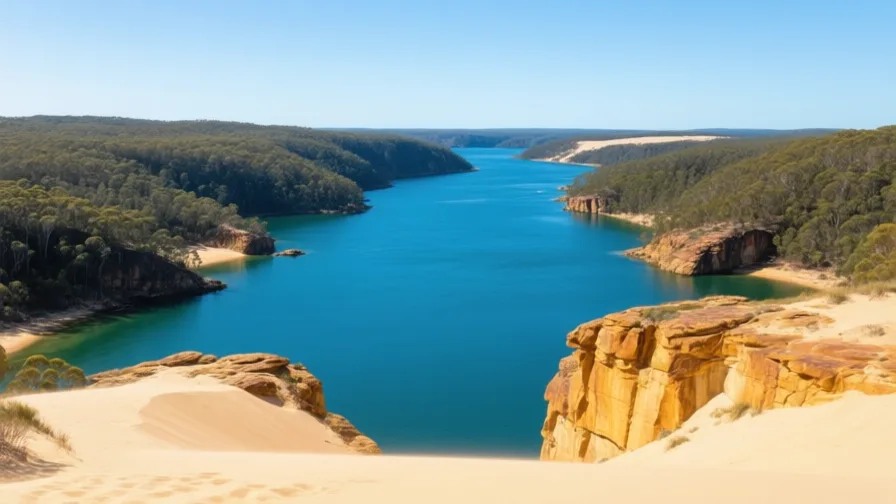
 Sydney Harbour · AI landscape illustration · Artistic impression
Natural feature · Oceania
Sydney Harbour
Also known as Port Jackson, Warrane
A deep drowned river valley on Australia's east coast, and the reason a settlement was placed here in 1788.
Saved in this browser — no account needed. Sign in later and it comes with you.
Where it is
Sydney Harbour is a ria — a river valley drowned when sea level rose after the last glacial maximum, roughly 20,000 to 6,000 years ago. That origin explains its shape: deep water reaching far inland, a branching outline with many sheltered coves and headlands, and steep sandstone sides. It is the country of the Eora, including the Gadigal, whose name for the cove where the First Fleet anchored is Warrane.
The land and water around it
The drowned valleyharbour
Port Jackson: deep, branching and sheltered because it is a river valley the sea came into rather than a bay the sea carved.
The Hawkesbury sandstoneplateau
The rock the harbour is cut into. It is soft enough to carve, which is why the region holds so many rock engravings, and it weathers into the overhangs that were used as shelters.
Parramatta Riverriver
The harbour's upper reach, running west to the fresher water and better farmland the colony moved to when Sydney Cove's soil proved inadequate.
Its history, in short
People lived on and around this harbour for many thousands of years, leaving rock engravings, shell middens and a continuing cultural connection. In January 1788 the First Fleet arrived at Botany Bay, found it inadequate, and moved north to this harbour within days. Within about a year a smallpox epidemic killed a very large proportion of the Aboriginal population around it. The harbour then became a working port, a naval base, and — after container shipping moved the freight elsewhere in the late twentieth century — increasingly a recreational and residential waterfront with the Opera House on one of its most conspicuous points.
Timeline
Dates are shown on a timeline rather than as changing shapes on the map. The globe draws modern boundaries only, and tinting a modern outline to stand for a historical one would state something we cannot source.
Early human world
c. 18,000–6,000 years ago
The sea comes in
Post-glacial sea-level rise floods the river valley, creating the harbour. People were living in the region throughout, so the drowning of the valley happened within human occupation rather than before it.
Approximate dateEncyclopædia Britannica
Early modern & oceanic
January 1788
The First Fleet
The fleet arrives at Botany Bay, judges it unsuitable for lack of fresh water and shelter, and relocates to Port Jackson. A penal colony is established at Warrane, renamed Sydney Cove.
Well attestedEncyclopædia Britannica1789
The smallpox epidemic
An outbreak kills a very large proportion of the Aboriginal population around the harbour within about a year of the fleet's arrival. Its source — the fleet, earlier contact from the north, or another route — is still argued among historians.
DisputedEncyclopædia BritannicaThe source of the 1789 outbreak is genuinely contested among historians, including whether it originated with the First Fleet. The scale of mortality is not contested.
Industrial & imperial
1932
The Harbour Bridge
The bridge opens, connecting the two shores by road and rail for the first time and fixing the harbour's most reproduced image.
Well attestedEncyclopædia Britannica
Contemporary
1973
The Opera House
Jørn Utzon's building opens at Bennelong Point, sixteen years after the competition and far over budget, having driven advances in structural engineering and computation to build the shells at all. Utzon had resigned in 1966 and never saw it complete.
Well attestedUNESCO World Heritage Centre2007
Inscribed as World Heritage
The Opera House is inscribed — one of very few twentieth-century buildings listed, and one of the few inscribed while its architect was alive.
Well attestedUNESCO World Heritage Centre
Places that carry meaning
Bennelong PointContinuous
Named for Woollarawarre Bennelong, a Wangal man taken captive in 1789 who became an intermediary, travelled to Britain and returned. The Opera House stands on the point; the name carries a much longer and more complicated story than the building.
Eora countryPre-colonial, continuing
The harbour's shores are the country of the Eora, among them the Gadigal at Warrane and the Wangal upriver. The clan names are also the language geography: the boundaries that mattered here were linguistic and kin-based rather than territorial in the sense the colony assumed.
Languages here
Places are usually multilingual. This lists what is actually spoken, not one language per border.
DharugPama-Nyungan family
The language of the harbour's country, including the Eora coastal dialect.
Severely disrupted by colonisation and the subject of active reclamation work by Dharug people using early wordlists. Australian English carries its words without acknowledging them — dingo, woomera and others.
EnglishGermanic family
The dominant language.
Australian English absorbed vocabulary from Dharug and other Aboriginal languages in the colony's first decades, mostly for things the arrivals had no words for.
Learn the language here
Check yourself
How did Sydney Harbour form?
A river valley drowned by post-glacial sea-level rise
A ria — which is why it is deep, branching and sheltered, and why the First Fleet moved here from Botany Bay.
Which aspect of the 1789 epidemic is genuinely contested?
Where the smallpox came from
The mortality is established; the source of the outbreak remains an open historical question.
Worth arguing about
- The harbour was named, used and carved for thousands of years before 1788. How should a city present a place whose history predates it by that much?
- The Opera House was late, over budget, and cost its architect the job. What does that suggest about how we judge projects while they are running?
What we have not established
These are open questions, listed rather than filled in. We would rather show a gap than a plausible guess.
How many people lived around the harbour before 1788?
Estimates for the Sydney region vary considerably and rest on early colonial observations made after epidemic mortality had already begun. Any figure understates the pre-contact population by an unknown margin.
How many rock engravings survive around the harbour, and how fast are they being lost?
Thousands are recorded across the Sydney sandstone, but the registers are held by state heritage bodies and Aboriginal land councils under access restrictions we have not sought, and no public count we could cite and re-check exists. We describe Eora country without asserting a number.
Sources
- UNESCO · Sydney Opera HouseUNESCO World Heritage Centre · intergovernmental · checked 2026-09-08
- Britannica · Port JacksonEncyclopædia Britannica · encyclopedia · checked 2026-09-08
- Britannica · First FleetEncyclopædia Britannica · encyclopedia · checked 2026-09-08
- Britannica · Australian Aboriginal languagesEncyclopædia Britannica · encyclopedia · checked 2026-09-08
Reviewed by Globe Quest editorial on 2026-09-08.
Related places
Themes: Seas & navigation, Indigenous & living cultures, Migration & diaspora, How cities work