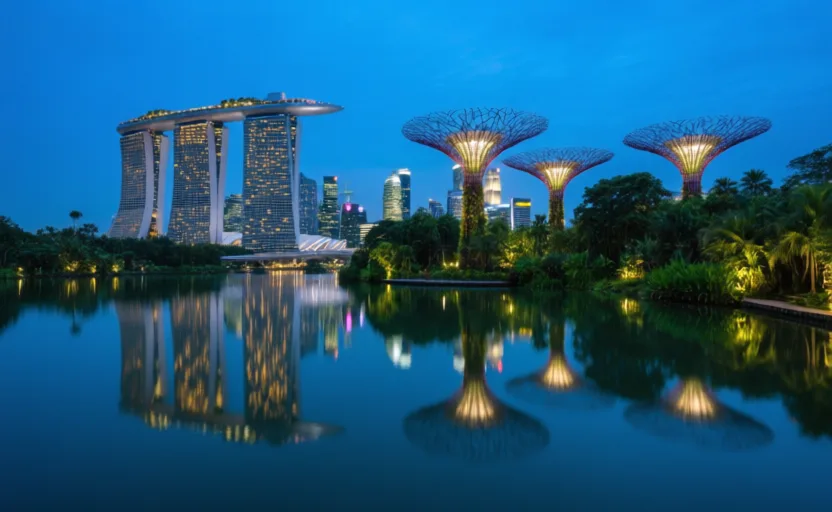
 Singapore · AI city illustration · Artistic impression
City · Southeast Asia
Singapore
Also known as Temasek, Singapura
Saved in this browser — no account needed. Sign in later and it comes with you.
Read its story
Where it is
Singapore is an island at the southern tip of the Malay Peninsula, at the narrow end of the Strait of Malacca where it meets the South China Sea. It is small — a few hundred square kilometres, enlarged by roughly a quarter through land reclamation — with no significant natural resources, no agricultural hinterland and, historically, not enough fresh water. What it has is position, and a deep-water anchorage next to the world's busiest short route between two oceans.
The land and water around it
The Strait of Malaccastrait
The short route between the Indian Ocean and the South China Sea, narrowing near Singapore to a few kilometres of navigable width.
Reclaimed landharbour
Roughly a quarter of the island's present area has been added by reclamation, using sand imported from neighbours — which has made the sand itself a diplomatic question.
The central catchmentforest
Reservoirs and remnant rainforest in the island's middle, kept as water catchment. A city-state that protects forest for hydrological reasons rather than aesthetic ones.
Its history, in short
There was a settlement here called Temasek before the modern city; Britain established a trading post in 1819 and made it a free port, which drew merchants and labour migration from China, India and the archipelago. It became the administrative centre of the Straits Settlements, fell to Japan in 1942 in a defeat that ended British prestige in the region, joined Malaysia in 1963 and was expelled in 1965 — becoming independent involuntarily, with no resources and a divided population. The strategy since has been to sell position: ports, an airport built around connecting traffic, a free-trade zone, finance, and enough investment in water to remove the one dependency it could not negotiate away.
Timeline
Dates are shown on a timeline rather than as changing shapes on the map. The globe draws modern boundaries only, and tinting a modern outline to stand for a historical one would state something we cannot source.
Post-classical world
c. 14th century
Temasek
A settlement and trading port exists on the island, attested archaeologically and in regional texts, well before any European arrival.
Approximate dateUNESCO World Heritage Centre
Industrial & imperial
1819
A British trading post
Britain establishes a settlement at the strait's southern tip and declares it a free port, which is the decision that draws the traffic.
Well attestedUNESCO World Heritage CentreFebruary 1942
The fall of Singapore
Japanese forces take the island. The occupation that followed included the Sook Ching massacres of Chinese civilians. The defeat permanently damaged British authority across Southeast Asia.
Well attestedUNESCO World Heritage Centre
Contemporary
9 August 1965
Independence, involuntarily
Singapore is expelled from Malaysia after two years, becoming a sovereign state that had not sought sovereignty, with no resources and an imported water supply.
Well attestedUNESCO World Heritage Centre2003 onward
NEWater and desalination
Large-scale water recycling and desalination begin operating, reducing dependence on imported supply. Water is the clearest case of the state buying its way out of a structural vulnerability.
Well attestedUNESCO World Heritage Centre2008
Melaka and George Town inscribed
The two older Straits ports are inscribed as World Heritage. Singapore, the port that displaced them, is not part of that listing.
Well attestedUNESCO World Heritage Centre
Places that carry meaning
The Port of Singapore1819 onward
Among the busiest container ports in the world, and being relocated westward to Tuas to free the central waterfront. A port that moves itself is a statement about how central it is.
Changi Airport1981 onward
Built and repeatedly expanded around connecting traffic rather than local demand — the aviation version of the entrepôt strategy.
Languages here
Places are usually multilingual. This lists what is actually spoken, not one language per border.
EnglishGermanic family
The working language of administration, business and school instruction.
Chosen partly because it belonged to no local community in particular. Singlish, the colloquial variety, draws on Malay, Hokkien and Tamil and has been the target of official discouragement campaigns.
MalayAustronesian family
The national language, used in the anthem and in state ceremony.
National in status and not the most widely used in daily life — a deliberate distinction between symbolic and working roles.
MandarinSinitic family
An official language, promoted since 1979 in place of other Chinese varieties.
The Speak Mandarin Campaign explicitly discouraged Hokkien, Teochew, Cantonese and others, which were the actual home languages of most Chinese Singaporeans. That policy substantially succeeded, and the cost fell on older speakers.
TamilDravidian family
An official language, spoken by part of the Indian Singaporean population.
Official status covers Tamil specifically, while Singapore's Indian communities also include speakers of Malayalam, Punjabi, Telugu, Hindi and others without that status.
Learn the language here
- 1Understand which languages are spoken hereSingapore is multilingual. Start with which languages are used, by whom, and for what — the phrase list only covers one of them.Written by Globe Quest
- 2Learn 12 phrasesCurated everyday phrases for Singapore, with audio and a written form.Written by Globe Quest
- 3Say them out loudSpeaking practice with pronunciation feedback, one phrase at a time.Globe Quest material, your own additions
- 4Come back to themSpaced review, so what you learned this week is still there next month.Written by Globe Quest
- 5Read why the language is what it isThe quest for this place covers how its languages got here and who speaks them.Written by Globe Quest
Check yourself
What does an entrepôt economy sell?
The convenience of being where goods change hands
Handling, refining, financing and re-exporting things that come from and go elsewhere.
Why is English the working language?
It belonged to no local community in particular, so no group was privileged
Language policy in a multilingual state is a political settlement rather than a neutral default.
Worth arguing about
- Singapore removed its water dependency by spending heavily. What dependency does your country have that money could remove — and should it?
- The Speak Mandarin Campaign worked, at the cost of the languages people actually spoke at home. Was that a reasonable trade?
What we have not established
These are open questions, listed rather than filled in. We would rather show a gap than a plausible guess.
What share of Singapore's water is now domestically produced?
The national water agency publishes targets and capacity figures, but the operational share varies with rainfall and demand, and published percentages are often targets rather than measurements. We describe the strategy rather than quoting a share.
Sources
- UNESCO · Melaka and George Town, Historic Cities of the Straits of MalaccaUNESCO World Heritage Centre · intergovernmental · checked 2026-09-08
Reviewed by Globe Quest editorial on 2026-09-08.