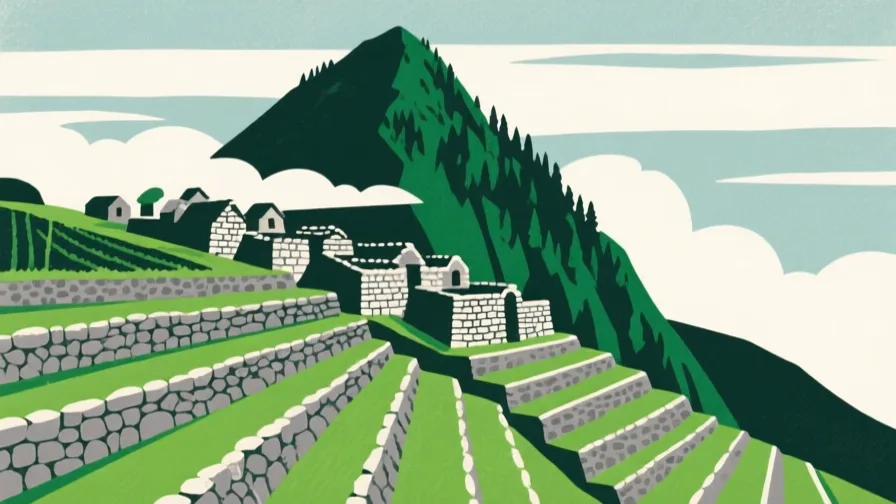
 Machu Picchu · AI illustration, not a photograph
Historical place · Latin America
Machu Picchu
Also known as Machupikchu
An Inca settlement on a ridge above the Urubamba valley, built with fitted stone and agricultural terracing.
Saved in this browser — no account needed. Sign in later and it comes with you.
Where it is
Machu Picchu occupies a ridge between two peaks about 2,430 metres above sea level, roughly 1,000 metres above the Urubamba river which loops around it on three sides. It sits on the eastern flank of the Andes where the mountains fall toward the Amazon basin, so the climate is wetter and warmer than Cusco's — cloud forest rather than high grassland. The site is steep, seismically active and extremely wet, which makes what was built there more impressive rather than less.
The land and water around it
The Urubamba valleyriver
A deep gorge cutting from the highlands toward the Amazon, looping around the ridge on three sides. The river is a thousand metres below the site.
Huayna Picchumountains
The peak at the northern end of the ridge, with terracing and structures near its summit — building at the least convenient point available.
The cloud forestforest
Wet montane forest on the eastern Andean slope. High rainfall on steep terrain is the site's central engineering problem.
Its history, in short
Built in the fifteenth century, most likely as an estate associated with the ruler Pachacuti, it was occupied for perhaps a century before being left around the time of the Spanish conquest. It was never found by the Spanish, which is why it survives without a colonial church built on top of it — the fate of most Inca sites. It was known to local families farming there when Hiram Bingham's expedition publicised it in 1911. Objects removed to Yale were the subject of a long dispute and were returned to Peru from 2011.
Timeline
Dates are shown on a timeline rather than as changing shapes on the map. The globe draws modern boundaries only, and tinting a modern outline to stand for a historical one would state something we cannot source.
Early modern & oceanic
c. mid-15th century
Built
Construction is associated with Pachacuti's reign. Dating rests on architecture, radiocarbon and later Spanish-era documents, and is given as a range.
Approximate dateUNESCO World Heritage Centrec. mid-16th century
Left
The site is abandoned around the period of the conquest. Why is not established: the collapse of the estate system that supported it, epidemic mortality and the wars of the conquest are all plausible and not mutually exclusive.
DisputedUNESCO World Heritage CentreNo single cause of abandonment is established. Specialists cite the end of the royal estate system, epidemic mortality and conquest-era disruption; the evidence does not separate them.
Industrial & imperial
1911
Publicised internationally
Hiram Bingham's Yale expedition reaches the site, guided by local people who were farming there, and publishes it to international attention. 'Discovery' describes the publication, not the knowledge.
Well attestedUNESCO World Heritage Centre
Contemporary
1983
Inscribed as World Heritage
Inscribed as a mixed site — for its cultural remains and for the cloud-forest ecology around it, which is why the protected area is far larger than the ruins.
Well attestedUNESCO World Heritage Centre2011 onward
Objects returned
After a long legal and diplomatic dispute, Yale begins returning the material Bingham removed. The collection is now held in Cusco.
Places that carry meaning
The terraces15th century
Agricultural terracing on very steep ground, built in layers — coarse stone, gravel, then soil — so that heavy rain drains through rather than washing the terrace away. Most of the engineering here is underground.
The Intihuatana15th century
A carved stone outcrop whose alignments have been read as astronomical. Specific claims about what it measured are interpretations, some better supported than others.
Astronomical interpretations of the Intihuatana range from well-argued alignment studies to speculation. There is no Inca text to check them against.
Languages here
Places are usually multilingual. This lists what is actually spoken, not one language per border.
QuechuaQuechuan family
The language of the region and of the state that built the site.
The site's name is Quechua — 'old peak'. The name of the settlement in the fifteenth century is not known; this one describes the mountain.
SpanishRomance family
The dominant public language of Peru today.
The language most interpretation, ticketing and scholarship reaches visitors in, including for Quechua-speaking Peruvians.
Learn the language here
Check yourself
What is the main engineering achievement of the terracing?
Layered drainage beneath, so heavy rain passes through rather than washing it away
Coarse stone, gravel and soil in layers. Most of the work is invisible, which is usually where the work is.
What did the 1911 expedition actually do?
Publicised internationally a site local families were farming
It was known locally throughout. 'Discovery' names the publication, not the knowledge.
Worth arguing about
- Machu Picchu survived because the Spanish never found it. How much of what we take as typical of a period is really just what survived?
- Objects taken in 1911 were returned a century later after a dispute. What should the default be?
What we have not established
These are open questions, listed rather than filled in. We would rather show a gap than a plausible guess.
What was the site's original name?
'Machu Picchu' is the Quechua name of the mountain, applied to the ruins in the twentieth century. Colonial documents mentioning an estate in this area use other names, and which if any refers to this site is argued.
Sources
- UNESCO · Historic Sanctuary of Machu PicchuUNESCO World Heritage Centre · intergovernmental · checked 2026-09-08
- UNESCO · City of CuzcoUNESCO World Heritage Centre · intergovernmental · checked 2026-09-08
Reviewed by Globe Quest editorial on 2026-09-08.
Related places
Themes: Mountains, deserts & islands, Empires & independence, Indigenous & living cultures