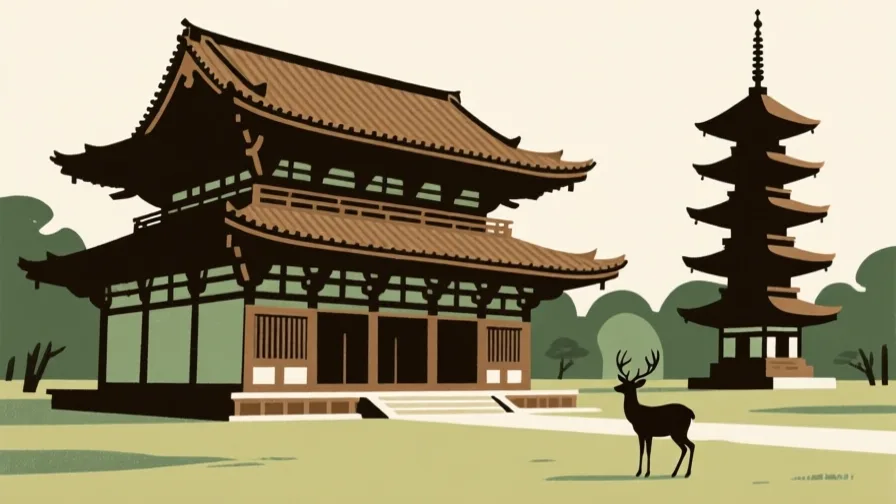
 Nara · AI illustration, not a photograph
Historical place · East Asia
Nara
Also known as Heijō-kyō, 奈良
Japan's capital during the eighth century, laid out on a grid modelled on Chinese capital planning.
Saved in this browser — no account needed. Sign in later and it comes with you.
Where it is
Nara sits in a basin at the southern end of the Yamato plain, ringed by low wooded hills and about forty kilometres inland from Osaka Bay. It was laid out in 710 as Heijō-kyō, on a rectangular grid modelled on the Chinese capital at Chang'an — a planned city, dropped onto farmland, on a plan borrowed from a thousand kilometres away.
The land and water around it
The Nara basinbasin
Flat, enclosed and well watered — the heartland of the early Japanese state, dense with burial mounds long before the grid was laid out.
Mount Kasuga's primeval forestforest
Hunting and felling were prohibited there from the ninth century, which is why an old-growth forest sits against a city. Protection for religious reasons preserved an ecosystem as a side effect.
The Yamato riverriver
Drains the basin west toward Osaka Bay. It gave the inland capital its link to the sea and to the continent beyond it.
Its history, in short
Before Nara, the seat of government moved on the death of each sovereign. Heijō-kyō was an attempt to build a permanent capital in the Chinese manner, and it held for most of the eighth century — long enough to give its name to a period, and to see the state commission Buddhist temples on a scale that strained it. The court moved away in 784 and then to Heian-kyō, now Kyoto, in 794, reportedly in part to escape the political weight of the Nara temples. The capital's departure is why so much eighth-century fabric survives here: the city stopped growing over itself.
Timeline
Dates are shown on a timeline rather than as changing shapes on the map. The globe draws modern boundaries only, and tinting a modern outline to stand for a historical one would state something we cannot source.
Post-classical world
c. 607, rebuilt after 670
Hōryū-ji
A temple is founded south-west of the later capital. Its rebuilt core is generally held to include the oldest surviving wooden buildings in the world; the date of the reconstruction after a recorded fire has been argued over for more than a century.
Approximate dateUNESCO World Heritage Centre710
Heijō-kyō is laid out
The capital moves to a newly planned grid city modelled on Tang Chang'an, with a central avenue running south from the palace. Unlike its model it was never walled.
Well attestedEncyclopædia Britannica752
The Great Buddha is dedicated
The bronze image at Tōdai-ji is consecrated at a ceremony attended by envoys from across Asia; the eye-opening brush was held by an Indian monk. Casting it consumed an enormous share of the country's copper.
Well attestedUNESCO World Heritage Centre756 onward
The Shōsōin
A timber storehouse at Tōdai-ji receives the possessions of a deceased sovereign and keeps them, largely undisturbed, for over twelve centuries — glass, textiles and instruments from as far as Persia. It is an eighth-century collection surviving above ground rather than excavated.
Well attestedEncyclopædia Britannica784–794
The court leaves
The capital moves to Nagaoka-kyō and then to Heian-kyō. Contemporary and later accounts attribute the move in part to the political power the Nara temples had accumulated, though the weight of that motive against others is not settled.
DisputedEncyclopædia BritannicaThe reasons for the move are inferred from court chronicles written afterwards and are argued between historians; the temples' influence is one proposed cause among several.
1180
Tōdai-ji burns
The temple is burned during civil war and rebuilt; it burns again in 1567. The present Great Buddha Hall is an early-eighteenth-century rebuilding, and is narrower than the original.
Well attestedUNESCO World Heritage Centre
Contemporary
1998
Inscribed as World Heritage
Eight component sites — temples, a shrine, the palace remains and the Kasuga forest — are listed together as the historic monuments of ancient Nara.
Well attestedUNESCO World Heritage Centre
Places that carry meaning
Tōdai-ji8th century, rebuilt
Built as the head of a national network of provincial temples. The scale was a statement about the state as much as about the religion.
Hōryū-ji7th century
South-west of the city, with a pagoda and hall generally dated to the seventh century — the reason claims about the world's oldest wooden buildings point here.
The Heijō palace site710–784
Largely open ground, excavated rather than built over, because the capital left and the fields returned. Reconstructed gates stand among the archaeology.
Languages here
Places are usually multilingual. This lists what is actually spoken, not one language per border.
JapaneseJaponic family
The language of the place, then and now.
Old Japanese is recorded here in the Man'yōshū, an eighth-century poetry anthology written with Chinese characters used for their sound. It preserves distinctions the language later lost, and is the main evidence for how the language sounded.
Literary ChineseSinitic family
The written language of government, law and Buddhist scripture.
Official records and sutras were written in Chinese and read in Japanese by a system of annotation marks — a way of reading a foreign written language in your own without translating it.
Learn the language here
Check yourself
What was Heijō-kyō's plan copied from?
The Tang Chinese capital at Chang'an
A grid on the Chang'an model, laid out on farmland — though unlike its model Nara was never walled.
Why does so much eighth-century fabric survive at Nara?
The capital left, so the city stopped building over itself
Losing capital status preserved the palace site as archaeology instead of as foundations under a later city.
Worth arguing about
- A capital was moved partly to escape the influence of its own temples. What does a state do today when an institution it built grows too strong?
- Nara is well preserved because it was abandoned. How much of what we can see of the past is an accident of decline?
What we have not established
These are open questions, listed rather than filled in. We would rather show a gap than a plausible guess.
How much copper did the Great Buddha consume?
Figures circulate for the bronze and gold used, and for the mines drawn on, but they derive from later chronicles rather than production records. We describe the scale without quoting a tonnage.
Sources
- UNESCO · Historic Monuments of Ancient NaraUNESCO World Heritage Centre · intergovernmental · checked 2026-09-08
- UNESCO · Buddhist Monuments in the Horyu-ji AreaUNESCO World Heritage Centre · intergovernmental · checked 2026-09-08
- Britannica · NaraEncyclopædia Britannica · encyclopedia · checked 2026-09-08
Reviewed by Globe Quest editorial on 2026-09-08.
Related places
Themes: Religion & pilgrimage, How cities work, Empires & independence