 Globe Quest
 Human Quest · LearningSign in
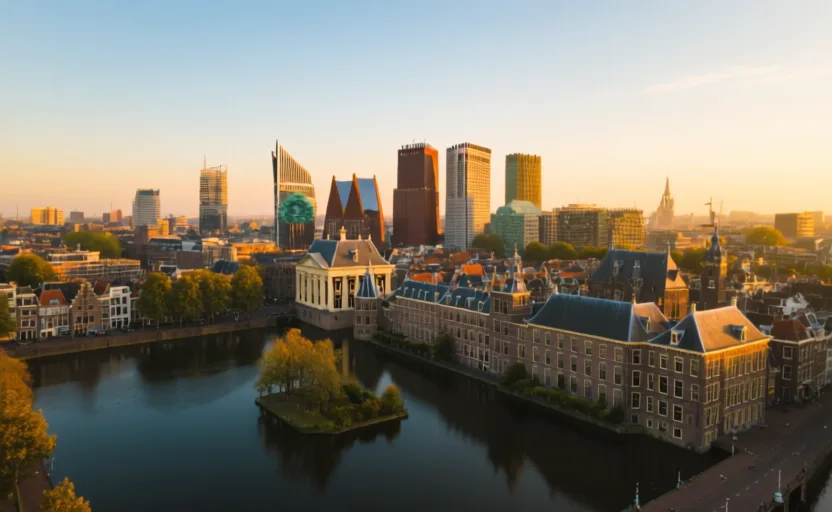 The Hague · AI city illustration · Artistic impression
City · Europe
The Hague
Also known as Den Haag, 's-Gravenhage
Saved in this browser — no account needed. Sign in later and it comes with you.
Where it is
The Hague is the one big Dutch city that faces the North Sea directly, on the coast of South Holland, with the seaside district of Scheveningen on its north-western side. It has no ring of walls or canals around a cramped core. Instead it spreads out around a pond, the Hofvijver, and a medieval court, with spacious streets lined with large eighteenth-century houses. Westland and Delft lie to the south and south-east, Leiden to the north-east, and the Rotterdam conurbation is close enough that the two are sometimes treated as one. Being on the coast gives it milder winters and cooler summers than the interior, though it can be very windy and humid.
The land and water around it
The North Sea coast and Scheveningencoast
The coast gives the city its beach resort, which draws about ten million visitors a year, and its milder, windier climate. The city is the largest on the Dutch North Sea shore.
The Hofvijverlake
The pond beside the Binnenhof, next to the court that Floris IV’s house acquired in 1229. Life in the old centre still gathers around it and around the buildings of the States General.
The Randstad’s south wingplain
The Hague sits at the south-western corner of the Randstad and of the Rotterdam–The Hague metropolitan area. The Randstad as a whole is a ring of cities, including Amsterdam and Utrecht, with about 6.7 million people.
Its history, in short
The name first appears in 1242, as Die Haghe, from a word for a hedge or enclosure, and the fuller 's-Gravenhage, the count’s enclosure, appears in 1347. The place grew around a court by the present Hofvijver that the Counts of Holland bought in 1229. William II turned it into a palace, the Binnenhof, once he had been chosen King of the Romans in 1248, and his son Floris V completed parts of it, including the Ridderzaal. The Counts made it their main residence in 1358, and in 1588 it became the lasting home of the provincial States of Holland and the republic’s States General. It never got a city charter until Louis Bonaparte granted one in 1806. When Belgium left in 1830 the government stayed here while Amsterdam remained the capital. German occupation brought the Atlantic Wall through the city, and in March 1945 an Allied bombing aimed at V-2 rocket sites fell instead on the Bezuidenhout quarter, killing 511 people. It is now known as a centre of international law.
Timeline
Dates are shown on a timeline rather than as changing shapes on the map. The globe draws modern boundaries only, and tinting a modern outline to stand for a historical one would state something we cannot source.
Post-classical world
1229
The court by the pond
Count Floris IV is thought to have bought a court by what is now the Hofvijver. He died in 1234 before building anything large.
Approximate dateWikipedia1248
The Binnenhof begins
Once chosen as King of the Romans, William II has the court turned into a royal palace. It is called the Binnenhof, and the Ridderzaal is the most prominent part finished under his son Floris V.
Approximate dateWikipedia1358
Main residence of the Counts
The village becomes the Counts of Holland’s primary residence and the seat of many government institutions, and grows to the size of a city without ever receiving city rights.
Well attestedWikipedia
Early modern & oceanic
1588
Seat of the Republic
From now on both the States of Holland and the Dutch Republic’s States General sit permanently in The Hague.
Well attestedWikipedia
Industrial & imperial
1806
City rights
Louis Bonaparte, king of the Kingdom of Holland, grants the settlement city rights.
Well attestedWikipedia1830
Capital elsewhere, government here
After Belgium separates, Amsterdam remains the capital while the government stays in The Hague. The city expands from 1850 for the civil servants and the retired colonial administrators of the East Indies.
Well attestedWikipedia
Contemporary
3 March 1945
The Bezuidenhout bombing
The Royal Air Force aims at a V-2 launch site in the Haagse Bos but, through navigational errors, bombs a densely populated and historic quarter, causing 511 deaths.
Well attestedWikipedia
Places that carry meaning
The Binnenhof and the Ridderzaal13th century onward
The cluster of buildings around the Inner Court where the States General meet. The Ridderzaal, the Knights’ Hall, is still intact and used for the king’s speech from the throne on Prinsjesdag.
The international courtsModern
The International Court of Justice and the International Criminal Court sit here alongside the Permanent Court of Arbitration, Europol and some 200 other international organisations. The city’s name is often used as shorthand for the courts themselves.
BezuidenhoutRebuilt after 1945
The quarter hit by the 1945 bombing. Nobody planned its reconstruction at first, and the later Jokinen Plan to reshape the stations was not carried out.
Languages here
Places are usually multilingual. This lists what is actually spoken, not one language per border.
DutchGermanic family
The language of national government, which sits here.
The city has two names in Dutch: the short Den Haag and the formal 's-Gravenhage. Residents are Hagenaars, a term of the upper classes, or informally Hagenezen.
Languages of diplomacy and migration
Spoken by the embassies, the international organisations and the migrant communities.
Most foreign embassies are in the city, and 34.4 per cent of residents have at least one parent born in a non-Western country, with communities of Indonesian, Turkish, Moroccan and Surinamese origin. The expatriate presence gives the centre many foreign shops and events.
Learn the language here
- 1Understand which languages are spoken hereThe Hague is multilingual. Start with which languages are used, by whom, and for what — the phrase list only covers one of them.Written by Globe Quest
- 2Learn 11 phrasesCurated everyday phrases for The Hague, with audio and a written form.Written by Globe Quest
- 3Say them out loudSpeaking practice with pronunciation feedback, one phrase at a time.Globe Quest material, your own additions
- 4Come back to themSpaced review, so what you learned this week is still there next month.Written by Globe Quest
Check yourself
How does The Hague relate to the Dutch capital?
It is the seat of government, while Amsterdam is the official capital
The States General, cabinet, Supreme Court and Council of State are in The Hague, but Amsterdam is the official capital, a split that dates to the time of the Dutch Republic.
What does 's-Gravenhage mean?
The count’s enclosure
It means “the count’s enclosure”. The count was the Count of Holland, and the hag(h)e element means a hedge, enclosure or hunting ground.
Worth arguing about
- The Hague never had city walls and for centuries no city charter, yet it was the seat of the republic. What kind of city grows around a court rather than a market?
- A city that hosts courts judging war crimes and settling disputes between states: does hosting them change how a city sees itself?
What we have not established
These are open questions, listed rather than filled in. We would rather show a gap than a plausible guess.
How many people live in The Hague?
The municipality had 549,163 inhabitants on 1 January 2021, while the Greater The Hague urban area has over 800,000 and the Rotterdam–The Hague metropolitan area about 2.6 million. Which total is meant depends on the boundary.
Sources
- Wikipedia · The HagueWikipedia · encyclopedia · checked 2026-11-24
Reviewed by Globe Quest editorial on 2026-11-24. Drafted with AI assistance and checked against the sources above before publication.