 Globe Quest
 Human Quest · LearningSign in
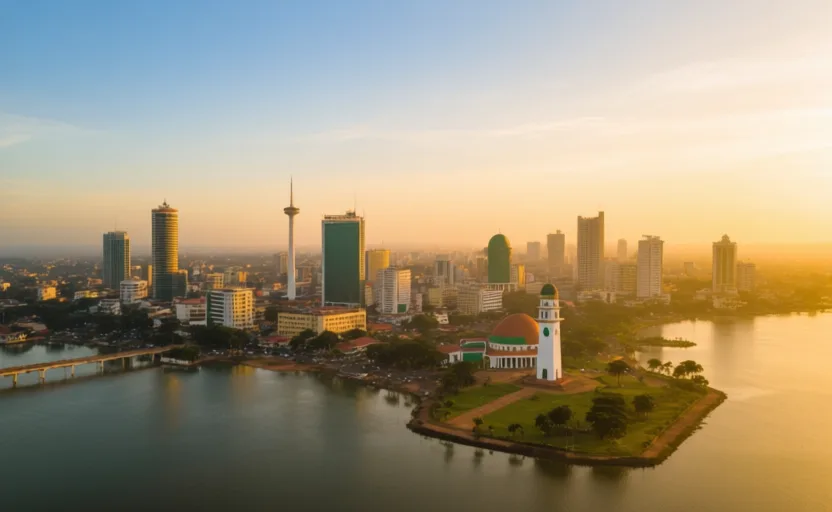 Abidjan · AI city illustration · Artistic impression
City · Africa
Abidjan
Saved in this browser — no account needed. Sign in later and it comes with you.
Where it is
Abidjan is built around the Ébrié Lagoon on the south-east coast of Côte d'Ivoire, where the lagoon system meets the Gulf of Guinea. The lagoon splits the city in two. The business district of Le Plateau and the northern communes of Cocody, Adjamé, Abobo and Yopougon lie on one side, while Treichville, Marcory and Port-Bouët, with the airport and the main seaport, lie on the other and face the open sea. Rain comes in a long season from March to July and a short one from September to November, with a short dry spell in August and a longer one from December to February.
The land and water around it
The Ébrié Lagoonlagoon
The lagoon is the organising fact of the city, dividing it into northern and southern halves joined by bridges. It gave the colonists more land and better room for trade than Grand-Bassam, and its edge is where Plateau, Treichville and Cocody sit.
The Vridi Canal and the Gulf of Guinea coastharbour
Port-Bouët, south of the lagoon, holds the airport, the refinery, a lighthouse and the main seaport. The canal opened in 1951 and linked the lagoon to the sea, which is what made Abidjan a major port rather than a lagoon town.
A climate on the edge of two typesclimate
Abidjan's climate is tropical wet and dry, closely bordering tropical monsoon, with two separate rainy seasons. One 2019 study estimates that by 2050 the city's climate will resemble that of present-day Manila.
Its history, in short
The site was a small Atchan fishing village when, in 1896, French colonists left Grand-Bassam after deadly yellow fever epidemics and, in 1898, chose this lagoon shore instead. It became an official town in 1903 and a railway terminus in 1904, but the capital of the colony stayed at nearby Bingerville until 1934. A new wharf in 1931, a floating bridge between Plateau and Treichville, and the rail line to the north made Abidjan the colony's gateway, and it became the third capital by decree in 1934. The Vridi Canal, finished in 1951, cut open the sandbar to the sea and turned the lagoon city into a real ocean port. After independence in 1960 the city grew from about 180,000 people to 1,269,000 in 1978, and new districts such as Cocody were built. From the 1980s officials' neglect, corruption and decay set in, and in 1983 political functions began to move inland to Yamoussoukro. Abidjan then bore the worst of the 2002–2007 and 2010–2011 conflicts, and Laurent Gbagbo was captured here in April 2011. Growth picked up again after peace returned in 2012.
Timeline
Dates are shown on a timeline rather than as changing shapes on the map. The globe draws modern boundaries only, and tinting a modern outline to stand for a historical one would state something we cannot source.
Industrial & imperial
1896–1898
Colonists move from Grand-Bassam
After yellow fever epidemics, the French move to a safer site on the lagoon. The settlement becomes an official town in 1903, and the rail terminus is placed here in 1904.
Well attestedWikipedia1931
Wharf and floating bridge
A new wharf and a floating bridge between Plateau and what becomes Treichville open up the city. Street addresses begin to be assigned for the first time.
Well attestedWikipedia1933–1934
Third capital of the colony
Abidjan succeeds Grand-Bassam and Bingerville as capital, helped by the railway that connects the north and south. Treichville is named for the colony's first administrator.
Approximate dateWikipedia
Contemporary
1951
The Vridi Canal
Completion of the canal makes Abidjan an important sea port.
Well attestedWikipedia1960–1978
Explosive growth after independence
Population grows from about 180,000 to 1,269,000 and the skyline of the era, with districts such as Cocody, is built in a period of prosperity.
Well attestedWikipedia1983
Political capital moves to Yamoussoukro
Abidjan is kept as the economic capital, and many political institutions and all foreign embassies remain here.
Well attestedWikipediaNovember 2004
Riots and the prison escape
After French forces destroy Ivorian air power, pro-Gbagbo groups riot in Abidjan and target French homes and businesses, and 4,000 prisoners escape from the country's largest prison.
Well attestedWikipediaApril 2011
Gbagbo captured
The 2010–2011 crisis ends with Gbagbo's capture in Abidjan after an offensive by forces loyal to Alassane Ouattara, backed by France and the United Nations.
Well attestedWikipedia
Places that carry meaning
Le PlateauColonial period onward
The central business district, where the grid-plan colonial city put its settlers. Office towers and apartment blocks went up here between the 1970s and the mid-1980s, among them the trade centre building completed in 1982.
Treichville1934 onward
The district south of Plateau across the lagoon, formed when the village of Dugbeo was moved to Anoumabo and renamed in 1934 for Marcel Treich-Laplène. Its street speech gave the city's colloquial French its name.
AdjaméPre-colonial village onward
A commune that grew from the older Ébrié village on the north shore, small and polluted but commercially vital, with the main bus station for international routes.
St Paul's Cathedral1980–1985
Designed by the Italian architect Aldo Spirito, begun with a groundbreaking by Pope John Paul II in 1980 and completed in 1985.
Languages here
Places are usually multilingual. This lists what is actually spoken, not one language per border.
FrenchRomance family
The official language of the city and country.
Abidjan is the most populous French-speaking city in West Africa, and only Kinshasa and Paris have larger French-speaking metropolitan areas. The standard French is close to Paris French, but the everyday kind is a colloquial variety named after Treichville.
Nouchi
A semi-creolised French that has spread among the young.
A street register that arose in Abidjan in recent years and is now common among the younger generation across the country.
Ébrié
The traditional language of the city's region.
A local tradition derives the name Abidjan from an Ébrié phrase said to mean I have just cut the leaves, spoken by a frightened man who had been met by an explorer.
DyulaMande family
A trade language, especially in the north, common across the country.
Dyula is a common indigenous language across the country and is mutually intelligible with other Manding languages in neighbouring countries.
Learn the language here
- 1Understand which languages are spoken hereAbidjan is multilingual. Start with which languages are used, by whom, and for what — the phrase list only covers one of them.Written by Globe Quest
- 2Learn 15 phrasesCurated everyday phrases for Abidjan, with audio and a written form.Written by Globe Quest
- 3Say them out loudSpeaking practice with pronunciation feedback, one phrase at a time.Globe Quest material, your own additions
- 4Come back to themSpaced review, so what you learned this week is still there next month.Written by Globe Quest
Check yourself
What did the Vridi Canal change?
It joined the lagoon to the sea and made Abidjan a major port
Finished in 1951, the canal cut through to the sea, so ocean ships could reach the lagoon city and the port grew.
Which role does Abidjan hold since 1983?
Economic capital
Yamoussoukro became the legal political capital in 1983, but Abidjan is the largest city and the centre of economic activity, and it still hosts all foreign embassies.
Worth arguing about
- A lagoon splits the city in two, and each half developed differently. How much of Abidjan's character comes from the water?
- The city's population doubled about every seven years after 1945. Can a city's services ever keep pace with that kind of growth?
What we have not established
These are open questions, listed rather than filled in. We would rather show a gap than a plausible guess.
When did Abidjan become the colonial capital?
Sources give 1933 and a decree of 1934 for the same event. We give the span and mark it approximate.
Sources
- Wikipedia · AbidjanWikipedia · encyclopedia · checked 2026-11-24
- Wikipedia · Ivory CoastWikipedia · encyclopedia · checked 2026-11-24
Reviewed by Globe Quest editorial on 2026-11-24. Drafted with AI assistance and checked against the sources above before publication.