 Globe Quest
 Human Quest · LearningSign in
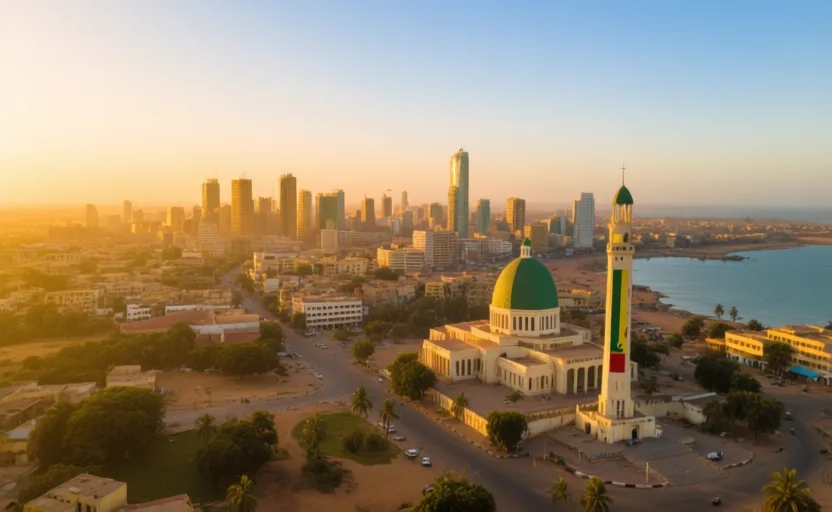 Dakar · AI city illustration · Artistic impression
City · Africa
Dakar
Saved in this browser — no account needed. Sign in later and it comes with you.
Where it is
Dakar occupies the tip of the Cap-Vert peninsula, the far western tip of the African mainland, so the Atlantic lies on three sides. The sea works as the city’s air conditioning: sea breezes keep it cooler than Sahelian towns such as Niamey or N’Djamena, which stay above 36 °C for much of the year. The climate is hot semi-arid with a short rainy season, July to October, and a long dry one. The land is low and flat apart from two small hills, Les Mamelles, and a few offshore islands, Gorée among them. That position made it a natural port, and it also leaves the city exposed to sea-level rise: a 2022 IPCC assessment names Dakar among 12 African cities that would be hit hardest.
The land and water around it
The Cap-Vert peninsulapeninsula
A hook of land on the Atlantic coast, jutting out as the continent’s most westerly mainland ground. The city and its metropolitan area now fill much of it.
Les Mamellesmountains
Two small hills in Ouakam that are the only high ground in the city. One carries a lighthouse from 1864, the other the African Renaissance Monument, the tallest statue in Africa.
The offshore islandsisland
Gorée, Yoff, Ngor and the Madeleine islands flank the city. Gorée in particular shaped its history, as the island where Europeans traded before the mainland site had a port.
Its history, in short
The peninsula was settled by the Lebu, a coastal subgroup of the Wolof, and the villages they founded, Ouakam, Ngor, Yoff and Hann, are still distinct Lebu neighbourhoods. Portuguese ships reached the bay in 1444, and fleets heading to and from India later used it to take on water and food. A town grew on the bay as a port of Cayor, while the offshore island of Gorée became a European trading post and, from the sixteenth century, a base for exporting enslaved people. In 1795 the Lebu broke from Cayor in a revolt led by a clerical family and set up a small independent theocratic state. France annexed it after founding a military post in 1857. Peanut exports drew trade from Gorée to the mainland, a railway to Saint-Louis opened in 1885, and in 1902 Dakar replaced Saint-Louis as capital of French West Africa. A second railway, to Bamako, tied it to the interior. After a plague epidemic in 1914 the authorities forced most Africans out of the European Plateau into a new quarter, Médina. At independence in 1960 Dakar became the capital of Senegal, and its president, Léopold Senghor, wanted it to be the “Athens of sub-Saharan Africa”.
Timeline
Dates are shown on a timeline rather than as changing shapes on the map. The globe draws modern boundaries only, and tinting a modern outline to stand for a historical one would state something we cannot source.
Post-classical world
1444
Portuguese reach the bay
Portuguese ships arrive at the Bay of Dakar. Peaceful contact is established in 1456 by Diogo Gomes, and the bay later serves as a repair and watering stop for fleets sailing to and from India.
Well attestedWikipedia
Early modern & oceanic
1795
The Lebu Republic
Marabouts in Cayor revolt against the Damel, and the Lebu join them under the Diop family. After defeat in battle they retreat to the peninsula, wall it with laterite blocks and declare an independent theocratic state, which the French later call the Lebou Republic. The Serigne of Ndakaaru remains the Lebu’s traditional authority today.
Well attestedWikipedia
Industrial & imperial
1857
French military post
France founds a military post at Ndakaaru, which it calls Dakar, and annexes the Lebu state, though its institutions continue to function nominally.
Well attestedWikipedia1885
Railway to Saint-Louis
The line is completed and the city becomes a base for conquering the Western Sudan. Dakar is made a separate commune from Gorée in 1887.
Well attestedWikipedia1902
Capital of French West Africa
Dakar replaces Saint-Louis as seat of the federation. A second railway, the Dakar–Niger line built from 1906 to 1923, links it to Bamako.
Well attestedWikipedia1914
Plague and the Médina
Following an outbreak of plague, the colonial authorities push most of the African population out of the old Plateau district into Médina, behind a sanitary cordon. The Lebu, as first occupants of the land, resist the expropriation with the support of Blaise Diagne.
Well attestedWikipedia
Contemporary
1960
Capital of independent Senegal
After serving as the capital of the Mali Federation from 1959 to 1960, Dakar becomes the capital of the Republic of Senegal.
Well attestedWikipedia1978–2007
The Dakar Rally
From 1978 until 2007 the Dakar Rally frequently ended in the city, which put its name on a global motorsport event.
Well attestedWikipedia
Places that carry meaning
Gorée IslandFrom the 16th century
A small island facing the city, now a World Heritage site. The House of Slaves and Gorée Memorial remember the Atlantic slave trade, and artists show their work outdoors.
The PlateauColonial period
The administrative and commercial heart of the old town, with the Presidential Palace of 1907, the Place de l’Indépendance and the cathedral. After 1914 it became a district increasingly reserved for Europeans, a model for other colonial capitals in French Africa.
Médina and the Grand Mosque1914 onward
Created as a township for Africans after the plague of 1914, Médina is now a traditional commercial district full of tailors’ workshops. The Grand Mosque at its centre was built in 1964.
The Lebu villagesFrom the 15th century
Ouakam, Ngor, Yoff and Hann, the original settlements of the peninsula, remain distinctly Lebu neighbourhoods inside the modern city.
Languages here
Places are usually multilingual. This lists what is actually spoken, not one language per border.
FrenchRomance family
The official language and the language of administration and the university.
Dakar was the centre of French rule in West Africa, and the city still has about 20,000 French nationals and a French air force base. Cheikh Anta Diop University, the University of Dakar, was established in 1957.
WolofNiger-Congo family
The everyday language of the city and of the wider country.
The Lebu who founded the villages are a Wolof subgroup, and about 80 per cent of Senegalese speak Wolof as a first or second language. The city also has Lebanese, Moroccan, Mauritanian, Cape Verdean and Guinean communities.
Learn the language here
- 1Understand which languages are spoken hereDakar is multilingual. Start with which languages are used, by whom, and for what — the phrase list only covers one of them.Written by Globe Quest
- 2Learn 14 phrasesCurated everyday phrases for Dakar, with audio and a written form.Written by Globe Quest
- 3Say them out loudSpeaking practice with pronunciation feedback, one phrase at a time.Globe Quest material, your own additions
- 4Come back to themSpaced review, so what you learned this week is still there next month.Written by Globe Quest
Check yourself
Who were the first settlers of the Dakar peninsula?
The Lebu, a coastal subgroup of the Wolof
The Lebu settled the peninsula by the fifteenth century and their villages, including Ouakam, Ngor, Yoff and Hann, still exist inside the modern city.
What did Dakar replace Saint-Louis as in 1902?
The capital of French West Africa
After the railway to Saint-Louis opened in 1885 and trade moved to the mainland port, Dakar became the federation’s capital. It served as capital of the Mali Federation only in 1959–1960.
Worth arguing about
- After 1914 the colonial authorities moved most Africans out of the Plateau for reasons of health and hygiene. How far do those lines still sort the city today?
- Senghor wanted Dakar to be the Athens of sub-Saharan Africa. What would a city that earns that name have to offer that a port and a capital do not?
What we have not established
These are open questions, listed rather than filled in. We would rather show a gap than a plausible guess.
How much rain does Dakar get in a year?
One account gives about 411 millimetres falling between July and October, another about 600 millimetres between June and October. The figures probably reflect different weather stations and averaging periods.
How many people live in Dakar?
The department proper had about 1.28 million residents, while the metropolitan area was put at 4.0 million in 2023. The total depends on where the boundary of the built-up area is drawn.
Sources
- Wikipedia · DakarWikipedia · encyclopedia · checked 2026-11-24
- Wikipedia · SenegalWikipedia · encyclopedia · checked 2026-11-24
Reviewed by Globe Quest editorial on 2026-11-24. Drafted with AI assistance and checked against the sources above before publication.