 Globe Quest
 Human Quest · LearningSign in
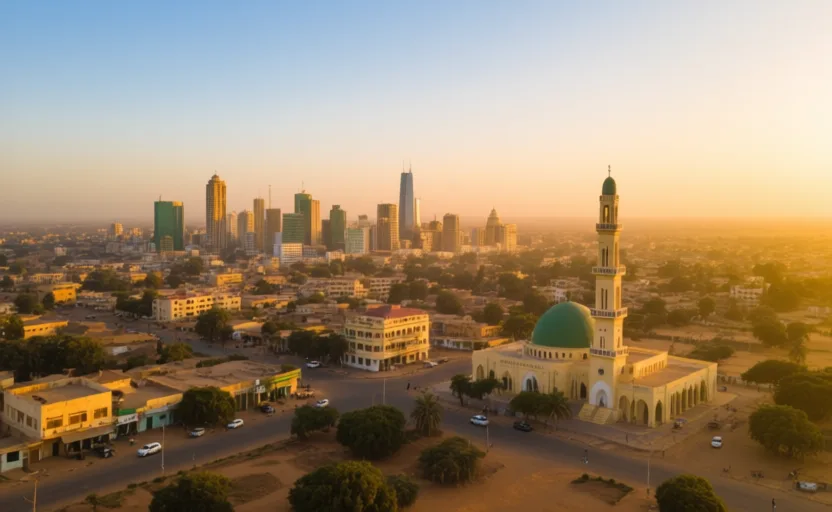 Thiès · AI city illustration · Artistic impression
City · Africa
Thiès
Saved in this browser — no account needed. Sign in later and it comes with you.
Where it is
Thiès is a railway junction 72 kilometres inland from Dakar, on the N2 road. It stands on a plateau that was once wooded country between two kingdoms, Cayor and Baol, and the land around it is farming country that grows rice, peanuts, manioc, millet and fruit. Roads and rail lines fan out from here to the capital, to Saint-Louis on the northern coast and to Bamako in Mali. Its strength as a town has always been its position at the meeting of these routes rather than any harbour or river.
The land and water around it
The Thiès plateauplateau
A wooded height that served as a borderland between the kingdoms of Cayor and Baol. Its strategic position is what led a Cayor village to be planted here in the seventeenth century and the French to garrison it in 1864.
The phosphate depositsplain
Phosphate is worked near the town at Palo Dial and Taïba. The mineral is a fertiliser and counts among Senegal’s biggest exports.
Its history, in short
Before the French, the Thiès plateau was a thinly settled frontier between Cayor and Baol, inhabited by the Serer-Noon. A village called Dianxene, belonging to Cayor, was founded on this strategic ground in the seventeenth century, though it held only 75 people in 1860. In 1864 the French set up a military post there, which shaped the town’s growth ever after, and a Spiritan mission followed in the late nineteenth century to help protect local people from slave raids coming from Mauritania. The decisive event was the Dakar to Saint-Louis railway in 1885, the first rail line in French West Africa, with a stop at Thiès. The colonial authorities created a commune in 1904. As a railway junction, the town became a centre of organised labour: a railway strike in 1938 was put down with violence, and general strikes came again in 1945–1946 and 1947–1948. In November 1956 the town elected as mayor Léopold Sédar Senghor, the future first president of independent Senegal. Since independence Thiès has added industry, a polytechnic and a university, and as the capital of Thiès Region it is increasingly an extension of the crowded Cap-Vert peninsula.
Timeline
Dates are shown on a timeline rather than as changing shapes on the map. The globe draws modern boundaries only, and tinting a modern outline to stand for a historical one would state something we cannot source.
Early modern & oceanic
17th century
Dianxene is founded
A village belonging to the kingdom of Cayor is planted on the plateau. By 1860 it has only 75 inhabitants.
Approximate dateWikipedia
Industrial & imperial
1864
French military post
France sets up a garrison on the plateau, which becomes a lasting influence on the town’s development.
Well attestedWikipedia1885
The first railway in French West Africa
The Dakar–Saint-Louis line opens with a stop in Thiès, which turns it into a junction with lines to Bamako as well.
Well attestedWikipedia1904
A commune
The colonial administration creates the commune of Thiès.
Well attestedWikipedia1938
Railway strike
Rail workers strike and France crushes it with force. General strikes come again in the mid-1940s and the late 1940s.
Well attestedWikipedia
Contemporary
November 1956
Senghor becomes mayor
Léopold Sédar Senghor, who will become independent Senegal’s first president, wins the post of mayor of Thiès.
Well attestedWikipedia1966
A weaving manufactory
A specialised factory is set up to weave large wall hangings from designs by leading Senegalese artists, a craft for which the town became best known.
Well attestedWikipedia
Places that carry meaning
The railway yardsFrom 1885
The rail yards and repair shops at the junction made Thiès a working-class town and the site of the labour actions of 1938 and the late 1940s.
Thiès-NonesPre-colonial onward
A neighbourhood in the south-west of the city that is still home to the Serer-Noon, the people of the plateau before colonisation.
The weaving manufactoryFrom 1966
A factory that produced woven works designed by Senegal’s top artists, among them the large work known as Birds of Paradise.
Languages here
Places are usually multilingual. This lists what is actually spoken, not one language per border.
Noon
The language of the Serer-Noon of the plateau.
One of the Cangin languages, spoken by the Serer-Noon, who still live in the Thiès-Nones neighbourhood of the south-west of the city.
WolofNiger-Congo family
The national lingua franca.
Around 80 per cent of Senegalese speak Wolof as a first or second language It is the lingua franca alongside French, so it is the common language between neighbours who do not share a mother tongue.
FrenchRomance family
The official language and the language of schooling.
French, ratified as official at independence in 1960, is spoken by people who have spent several years in the education system, which includes the town’s polytechnic school and university.
Learn the language here
- 1Understand which languages are spoken hereThiès is multilingual. Start with which languages are used, by whom, and for what — the phrase list only covers one of them.Written by Globe Quest
- 2Learn 14 phrasesCurated everyday phrases for Thiès, with audio and a written form.Written by Globe Quest
- 3Say them out loudSpeaking practice with pronunciation feedback, one phrase at a time.Globe Quest material, your own additions
- 4Come back to themSpaced review, so what you learned this week is still there next month.Written by Globe Quest
Check yourself
What made Thiès an important town?
A junction of railway lines to Dakar, Bamako and Saint-Louis
The Dakar–Saint-Louis line of 1885 stopped here, and later lines made it a junction, so industry, workshops and labour organising gathered at the crossing.
Who were the original inhabitants of the Thiès plateau?
The Serer-Noon
Before colonisation the plateau was a wooded frontier between Cayor and Baol inhabited by the Serer-Noon, who speak a Cangin language and still live in the south-west of the city.
Worth arguing about
- Thiès owes its growth to a rail junction rather than to a harbour or river. What happens to such a town when roads and highways replace the railway?
- The city is increasingly an extension of Dakar, with plans for a highway and commuter train. Does being absorbed into a capital’s orbit help a second city or erase it?
Sources
- Wikipedia · ThièsWikipedia · encyclopedia · checked 2026-11-24
- Wikipedia · SenegalWikipedia · encyclopedia · checked 2026-11-24
Reviewed by Globe Quest editorial on 2026-11-24. Drafted with AI assistance and checked against the sources above before publication.