 Globe Quest
 Human Quest · LearningSign in
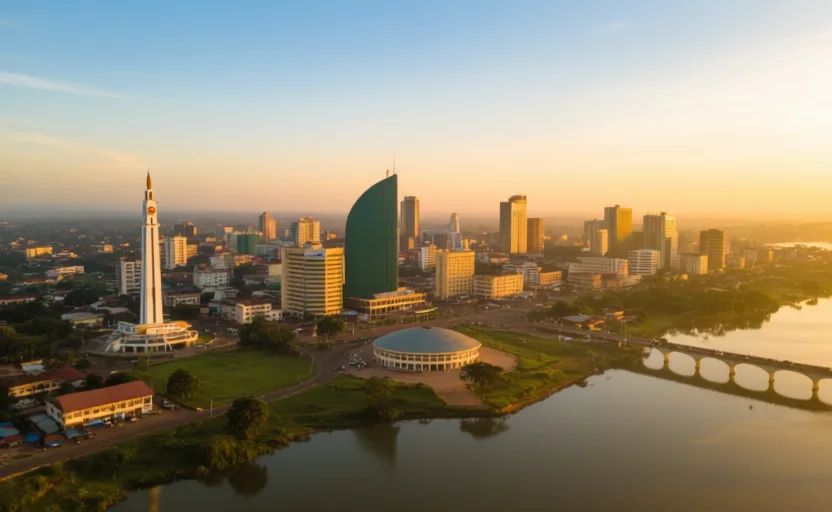 Brazzaville · AI city illustration · Artistic impression
City · Africa
Brazzaville
Saved in this browser — no account needed. Sign in later and it comes with you.
Where it is
Brazzaville occupies the north bank of the Congo River just below Pool Malebo, the broad lake-like widening where the river slows. The ground is flat, about 317 metres above sea level, with plains around it, and the Atlantic is some 506 kilometres away. Downriver the Congo drops through rapids that block ships from the sea, so this is where river traffic from the interior stops. Directly across the water stands Kinshasa. It is the only place where two national capitals face each other from opposite banks of a river, in sight of one another. The wet season runs from October to May and July and August are the driest months.
The land and water around it
The Congo River at Pool Maleboriver
The city sits just below the pool, with the large island of Mbamu inside it belonging to the Republic of the Congo. The pool is the last navigable stretch before the rapids, which is why both Brazzaville and Kinshasa grew here as river ports.
Livingston Fallsrapids
Below the city the Congo falls through a series of rapids known as Livingston Falls, which stop navigation from the Atlantic. They made the railway to the coast necessary and fixed Brazzaville as the point where goods changed from boat to train.
The surrounding plainsplain
The land around the city is large, open plain and the town itself is relatively flat. Its dry season runs from June, which is its winter, and temperatures vary little through the year.
Its history, in short
Two trading centres, Mfwa and Mpila, stood here under the Tio kingdom, the Eastern Teke, and the site included a Bateke settlement named Ncuna. In September 1880 the Italian-born explorer Pierre Savorgnan de Brazza signed a treaty with the Tio king Iloo I that put the land under French protection, and the settlement took Brazza's name. A small squad of troops held the site into 1882 to stop it falling to the Belgians across the river, and building began in earnest only when French and Belgian colonists started to compete over the two banks. Brazzaville became capital of the French Congo in 1904 and of French Equatorial Africa in 1910. The Congo–Ocean Railway of 1934 linked it to the coast at Pointe-Noire and carried the river's trade past the rapids, at a very high cost in African lives. In the Second World War it served as the capital of Free France, and a 1944 conference here tried to redraw France's relationship with its colonies. Since the late twentieth century it has been a stage for civil wars and clashes.
Timeline
Dates are shown on a timeline rather than as changing shapes on the map. The globe draws modern boundaries only, and tinting a modern outline to stand for a historical one would state something we cannot source.
Industrial & imperial
10 September 1880
Brazza's treaty with the Tio king
Pierre Savorgnan de Brazza officially founds the settlement. King Iloo I of the Tio signs a treaty of protection that subjects his lands to France, and a small squad under Sergeant Malamine Camara holds the site until May 1882.
Well attestedWikipedia1904
Capital of the French Congo
The city becomes capital of the French Congo, and in 1910 of French Equatorial Africa, a federation that included Gabon, the Central African Republic and Chad. The main municipal buildings, among them a courthouse, a bank headquarters and the Institut Pasteur, go up between 1910 and 1915.
Well attestedWikipedia1934
The Congo–Ocean Railway opens
The line connects Brazzaville to the Atlantic port of Pointe-Noire and bypasses the rapids. More than 17,000 Africans died building it, by one count, and people revolted against the French in 1928.
1940–1943
Capital of Free France
Brazzaville and the rest of French Equatorial Africa stay beyond the control of Vichy France, and the city serves as the capital of Free France.
1944
The Brazzaville Conference
Leaders of the resistance and delegates from the African colonies meet here. The resulting declaration is an attempt to redefine relations between France and its colonies.
Contemporary
1960
Independence
The Republic of the Congo becomes fully independent from France on 15 August 1960. Political tension in Pointe-Noire led the first president, Fulbert Youlou, to make Brazzaville the national capital.
1980
Made a commune of nine arrondissements
Brazzaville becomes a commune of its own, cut out of the Pool department, and is split into nine arrondissements after the French pattern.
Well attestedWikipedia2013
UNESCO City of Music
The city is designated a City of Music by UNESCO and joins its Creative Cities Network.
Well attestedWikipedia
Places that carry meaning
Poto-Poto, Bacongo and MakélékéléColonial period to the 1960s
Until the 1960s the city was split into a European centre and these African sections. The names are still in use for neighbourhoods, and the colonial division explains why the centre and the districts around it look so different.
Mbamu IslandPresent day
A large island inside Pool Malebo that belongs to the Republic of the Congo's territory. The city's department has taken in the island's district since 2011.
The house for Charles de Gaulle1940s
Charles de Gaulle led Free France from the city, and the architect Roger Erell built a house here for him.
Languages here
Places are usually multilingual. This lists what is actually spoken, not one language per border.
FrenchRomance family
The official language.
French is the language of the state, and Brazzaville's long role as a federal capital under French rule made it the language of government here.
Lingala and KitubaBantu family
Recognised national languages.
Both Kituba and Lingala are recognised as national languages. Across the river, Lingala is the most widely spoken indigenous language of the Democratic Republic of the Congo.
LaariBantu family
The main language of the Kongo subgroup in Brazzaville and the Pool region.
The Laari are the most significant subgroup of the Kongo, who make up about half the national population, and they live in Brazzaville and the Pool region. Teke and Mbochi communities also live in and around the city.
Learn the language here
- 1Understand which languages are spoken hereBrazzaville is multilingual. Start with which languages are used, by whom, and for what — the phrase list only covers one of them.Written by Globe Quest
- 2Learn 14 phrasesCurated everyday phrases for Brazzaville, with audio and a written form.Written by Globe Quest
- 3Say them out loudSpeaking practice with pronunciation feedback, one phrase at a time.Globe Quest material, your own additions
- 4Come back to themSpaced review, so what you learned this week is still there next month.Written by Globe Quest
Check yourself
What is unusual about Brazzaville's position?
It faces another national capital across a river
Brazzaville and Kinshasa are national capitals on opposite banks of the Congo, within sight of each other, which is not true of any other pair of capitals.
Why was a railway to Pointe-Noire needed?
Rapids downriver block navigation from the Atlantic
The Congo's Livingston Falls rapids prevent ships from reaching Brazzaville from the sea, so the 1934 Congo–Ocean Railway carried goods around them.
Worth arguing about
- Two capitals face each other across a river and have been rivals in trade, sport and power. What would a bridge between them change, and for whom?
- The railway that made Brazzaville an entrepôt cost many thousands of lives. How should a city remember the infrastructure it depends on?
What we have not established
These are open questions, listed rather than filled in. We would rather show a gap than a plausible guess.
How many people died building the Congo–Ocean Railway?
Accounts range from at least 14,000 to more than 17,000 and around 23,000, depending on what is counted and who counted it. We state the range rather than choose one.
How long did Brazzaville serve as the capital of Free France?
Accounts give 1940 to 1942 or 1940 to 1943. We use the wider span and mark it approximate.
Sources
- Wikipedia · BrazzavilleWikipedia · encyclopedia · checked 2026-11-24
- Wikipedia · Republic of the CongoWikipedia · encyclopedia · checked 2026-11-24
- Wikipedia · History of the Republic of the CongoWikipedia · encyclopedia · checked 2026-11-24
Reviewed by Globe Quest editorial on 2026-11-24. Drafted with AI assistance and checked against the sources above before publication.