 Globe Quest
 Human Quest · LearningSign in
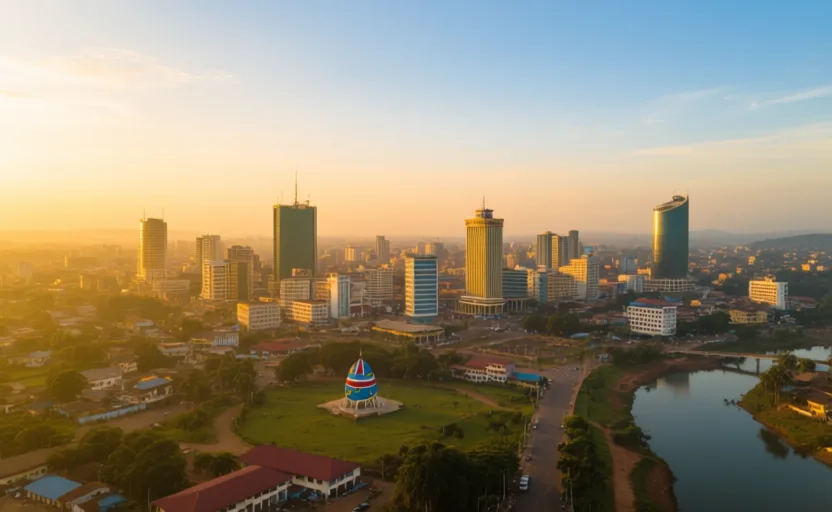 Kinshasa · AI city illustration · Artistic impression
City · Africa
Kinshasa
Also known as Léopoldville
Saved in this browser — no account needed. Sign in later and it comes with you.
Where it is
The Congo River widens here into a lake-like stretch called Pool Malebo, and Kinshasa spreads along its southern shore in a crescent across low, flat ground at roughly 300 metres. Much of the older, wealthier city sits on alluvial sand and clay close to the water, while newer districts climb onto eroding red-soil hills of 310 to 370 metres. Across the water, four kilometres away and joined by no bridge, lies Brazzaville, capital of the other Congo. The climate is tropical wet and dry, with a long rainy season from October to May and a short dry season from June to September. Downstream, a series of rapids blocks the river between the city and the coast.
The land and water around it
Pool Malebolake
A broad widening of the Congo with islands and islets, which gave traders from the upper river a place to meet people from the coast. It is the reason there is a city here at all.
Livingstone Fallsriver
A series of rapids more than 300 kilometres downstream, between the city and the Atlantic. For years goods between Léopoldville and the port of Matadi had to be carried by porters, which made the railway the colony's first great project.
The Kinshasa plainplain
A marshy alluvial plain at about 275 to 300 metres that is easy to build on but prone to drainage problems. The valleys around the Pool hold gallery forest, savanna and aquatic plants.
Its history, in short
Before colonisation two trading centres, Ntamo and Nshasa, stood on the shore, within the sphere of the Tio kingdom, and Teke and Humbu people had lived there for centuries. In 1881 Henry Morton Stanley set up a trading post for the Belgian king and named it Léopoldville. It became the first navigable port above the rapids of Livingstone Falls, and after a railway round them to Matadi was completed, it grew quickly as an administrative and military centre. Colonial planning kept African residents in separate cités indigènes and Europeans in a planned centre. Léopoldville became the capital of the Belgian Congo in 1926, and after the Second World War its population exploded as migrants arrived from across the country, bringing the Lingala-speaking, music-making city of today. In 1966 Mobutu renamed it after the village of Nshasa. Decades of decline in the late twentieth century did not stop its growth.
Timeline
Dates are shown on a timeline rather than as changing shapes on the map. The globe draws modern boundaries only, and tinting a modern outline to stand for a historical one would state something we cannot source.
Industrial & imperial
1 August 1881
Léopold II Station
Stanley founds a trading post on the shore of Ngaliema Bay for the International Association of the Congo, naming it Léopoldville after the Belgian king. It is one of several villages on the Pool, among them one called Kinshasa.
1898
The Matadi railway
A railway round the rapids joins the river port to the sea at Matadi, and the settlement grows fast. Accounts differ on dates: one gives the line as built from 1890 to 1911.
1926
Capital of the Belgian Congo
Léopoldville replaces the much smaller town of Boma as the colonial capital. By 1959 it has about 300,000 people, of whom 25,000 are Europeans.
Contemporary
1960
Independence
The city has around 400,000 residents and grows by more than 11 per cent a year in the years that follow, as people arrive from the whole country.
1966
Léopoldville becomes Kinshasa
Under Mobutu's campaign to Africanise names, the city takes the name of a village that once stood nearby.
1974
Rumble in the Jungle
Kinshasa hosts the boxing match in which Muhammad Ali beats George Foreman to regain the world heavyweight title.
Well attestedWikipedia1997
The fall of Mobutu
After rioting by unpaid soldiers in 1991 and a rebel advance, Mobutu's regime falls. Military prisons in the city see ill-treatment and deaths after the change of power.
Well attestedWikipedia2015
UNESCO City of Music
Kinshasa joins the Creative Cities Network as a City of Music, in recognition of the rumba tradition that grew up in its bars and studios.
Well attestedWikipedia
Places that carry meaning
The cités and the ville bassecolonial period
The old planned centre by the river and the indigenous quarters such as Léo I and Léo II were separated by a strip that later became the commercial district. Segregation shaped the street plan, and the divisions still show in the contrast between affluent districts and sprawling slums.
Boulevard du 30 Juincolonial period onward
The avenue near the railway, once called Boulevard Albert 1er. Colonial authorities pushed African quarters up against the European residential areas here in the 1920s.
N'djili and the National Museum20th century
The international airport, the largest in the country, and the main national museum serve a capital that is also the country's centre of finance and media.
Languages here
Places are usually multilingual. This lists what is actually spoken, not one language per border.
FrenchRomance family
The official language of government, schools and media.
Kinshasa is the largest officially French-speaking city in the world, though many residents struggle with it. In 2014, 67 per cent could read and write French.
LingalaBantu family
The lingua franca of the street.
Its spread began with recruits to the colonial army and with newcomers from many regions. It remains the common language of a city where music, film and football attract migrants.
Kikongo, Tshiluba and SwahiliBantu family
Three of the country's four national languages, heard alongside many vernaculars.
Together with Lingala they are the national languages. Several vernacular languages are spoken in the city as well, brought by migrants from every part of the country.
Learn the language here
- 1Understand which languages are spoken hereKinshasa is multilingual. Start with which languages are used, by whom, and for what — the phrase list only covers one of them.Written by Globe Quest
- 2Learn 14 phrasesCurated everyday phrases for Kinshasa, with audio and a written form.Written by Globe Quest
- 3Say them out loudSpeaking practice with pronunciation feedback, one phrase at a time.Globe Quest material, your own additions
- 4Come back to themSpaced review, so what you learned this week is still there next month.Written by Globe Quest
Check yourself
Why did Léopoldville grow quickly after 1898?
A railway round the rapids linked it with the sea at Matadi
The Pool is the first navigable stretch of the Congo above Livingstone Falls. Before the railway, goods had to be carried by porters to the coast. Afterwards the city became a transfer point for the whole upper river.
How did the city come to be called Kinshasa?
Mobutu renamed it in 1966 after a village that once stood near the site
Léopoldville was named after the Belgian king. In 1966 Mobutu's campaign to Africanise names gave it the name of a nearby village, whose own name has several proposed origins, including a trade in salt.
Worth arguing about
- Kinshasa and Brazzaville face each other across four kilometres of river without a bridge. What does it say about a region when its two capitals are this close and so little connected?
- The city grew from 400,000 at independence to more than ten million, mostly through migration. What makes people keep coming to a capital whose services have not kept up?
What we have not established
These are open questions, listed rather than filled in. We would rather show a gap than a plausible guess.
How big is Kinshasa, and when did it become the capital?
The metropolitan population is estimated at about 18.5 million in 2026, but a 2020 count was nearer 14.6 million, and the definition of the urban area is unsettled. Sources also disagree on dates: one says a royal decree of 1914 made it the capital of the Belgian Congo, another says 1926, and railway dates differ between 1898 and 1911.
Sources
- Wikipedia · KinshasaWikipedia · encyclopedia · checked 2026-11-24
- Wikipedia · History of KinshasaWikipedia · encyclopedia · checked 2026-11-24
- Wikipedia · Democratic Republic of the CongoWikipedia · encyclopedia · checked 2026-11-24
Reviewed by Globe Quest editorial on 2026-11-24. Drafted with AI assistance and checked against the sources above before publication.