 Globe Quest
 Human Quest · LearningSign in
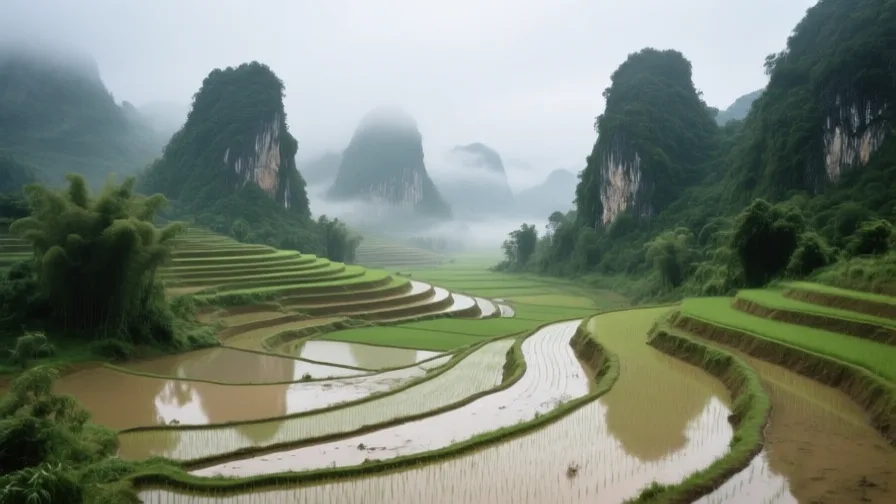 China · AI landscape illustration · Artistic impression
Country · East Asia
China
Saved in this browser — no account needed. Sign in later and it comes with you.
Where it is
China steps down from west to east. The Tibetan Plateau, over 4,000 metres, fills the south-west, and the Himalayas, Karakoram, Pamirs and Tian Shan wall the country off from South and Central Asia; Everest sits on the Nepal border at 8,848 metres. North-west of the plateau lie basins and deserts. The eastern half, with about 45 per cent of the area and 95 per cent of the people, is the monsoon zone: humid, farmed, and cut by the Yellow River and the Yangtze, both of which rise on the plateau. The coastline runs about 14,500 kilometres along the Bohai, Yellow, East China and South China seas. Rain comes with the summer monsoon, so flooding is among the most costly hazards.
The land and water around it
The Yellow River and the North China Plainriver
The river carries a heavy load of sand and mud onto the flat plain and is held in by embankments. The lower Yellow River basin was an early centre of farming, and severe flooding along it was part of the disasters of the 1340s that preceded the end of Mongol rule.
The Yangtze and the Sichuan Basinriver
The Yangtze, the longest river in the country, was where the earliest cultivated rice has been found. The Qin Mountains divide its delta from the northern plain and form the main physical boundary within China Proper. Upstream, the Sichuan Basin is ringed by mountains and has an average floor height around 500 metres, with some of the most densely farmed and populated land in the country.
The Tibetan Plateauplateau
About a quarter of the country but under one per cent of the people. It is the source of both great rivers, and the peaks along its western edge include eleven of the seventeen tallest mountains on Earth.
Its history, in short
Farming societies spread across the lower Yellow River basin by the sixth millennium BCE, and rice was grown by the Yangtze at least 8,000 years ago. Written history starts with the Shang, whose oracle bone inscriptions are the earliest known Chinese writing, and the Zhou who overthrew them around 1046 BCE. In 221 BCE the Qin state conquered its rivals and the first emperor founded a centralised empire; the Han then gave it a lasting Confucian administrative frame. Unity broke and returned: the Sui built the Grand Canal to link north and south, and the Tang ran a cosmopolitan state from Chang’an. Mongol conquest brought the Yuan in the thirteenth century, and the Ming restored Han rule. The empire gave way to the Republic of China in 1911 to 1912, civil war and Japanese invasion followed, and in 1949 the Communist Party proclaimed the People’s Republic while the Republic’s government retreated to Taiwan. Reform and opening from 1978 turned the economy toward a market model.
Timeline
Dates are shown on a timeline rather than as changing shapes on the map. The globe draws modern boundaries only, and tinting a modern outline to stand for a historical one would state something we cannot source.
First cities & states
c. 1046 BCE
The Zhou overthrow the Shang
A coalition under King Wu defeats the Shang at Muye. The Shang had left oracle bone inscriptions, the oldest known form of Chinese writing and the ancestor of modern characters.
Classical world
221 BCE
Qin unifies China
After conquering the other warring states, Qin Shi Huang takes the title of first emperor and organises the land into commanderies and counties. The dynasty lasts only fifteen years.
Well attestedWikipedia206 BCE–220 CE
The Han order
The Han rebuild centralised rule on Confucian scholarship and institutions that survive in some form into the twentieth century.
Well attestedWikipedia
Post-classical world
589
Sui reunification and the Grand Canal
The Sui reunite China after centuries of division and build the Grand Canal to join north and south. The Tang that succeed them centre a cosmopolitan state on Chang’an.
Well attestedWikipedia1271–1368
The Yuan dynasty
Kublai Khan, a grandson of Genghis Khan’s empire, establishes Mongol rule and subdues the Song in the 1270s. Han rule returns under the Ming in 1368.
Industrial & imperial
1911–1912
The Republic
The 1911 Revolution ends imperial rule, and a provisional Republic of China government forms at Nanjing in March 1912. Regional warlords then hold much real power.
Contemporary
1949
The People’s Republic
Mao Zedong proclaims the People’s Republic after Communist victories, and the Republic of China government relocates to Taiwan. Both governments still claim to be the legitimate government of China.
The government in Beijing treats Taiwan as a province of the People’s Republic; the government in Taipei, as the Republic of China, claims legitimacy as well.
1978
Reform and opening up
A programme of economic reform begins and shifts the country toward a socialist market economy. Urban living rises from 20 per cent of people in 1980 to over 68 per cent in 2025 by official figures.
Well attestedWikipedia
Places that carry meaning
BeijingCapital today
The seat of the national government and of the standard spoken language, which is largely based on the Beijing dialect.
Shanghai and the Yangtze and Pearl deltasModern
Shanghai is the biggest city by urban area. The Yangtze and Pearl deltas are where the country’s great urban agglomerations cluster.
The Grand CanalSui dynasty onward
Begun to link the north and the south, it was restored in a major effort under the Ming. It is one of the sixty World Heritage sites listed for the country, along with the Great Wall.
Languages here
Places are usually multilingual. This lists what is actually spoken, not one language per border.
Mandarin ChineseSino-Tibetan family
The official language, used as the national standard.
Standard Chinese is based largely on the Beijing dialect, and most Han Chinese speak some form of Mandarin.
Other Chinese languagesSino-Tibetan family
Regional varieties spoken at home by around 300 million people.
Chinese sources often call these local varieties or dialects, while linguists treat them as separate languages. They are one reason a single written tradition and a single spoken standard are not the same thing.
Minority languages
Spoken by the 55 officially recognised minorities, mostly in the west and border regions.
Han Chinese are over 91 per cent of the population. The Zhuang in the south-west are the largest minority; the Uyghurs, Hui, Mongols and Tibetans are other major groups, and the state recognises 56 ethnic groups in all.
Learn the language here
Check yourself
Which dynasty first dug the Grand Canal between the north and the south?
The Sui
The Sui reunited China in 589 and built the canal to tie the northern plains to the rice lands of the south. The dynasty collapsed within a generation, but the waterway outlasted it.
Where do most people in China live?
In the monsoon-watered eastern half
Eastern, monsoon China covers about 45 per cent of the area but holds about 95 per cent of the population, because rain and river plains make dense farming possible there.
Worth arguing about
- The Yellow River and the Yangtze built two different agricultural worlds, millet in the north and rice in the south. How much of China’s regional difference still follows that line?
- Local Chinese languages are called dialects in Chinese sources and languages by many linguists. What turns on that word?
What we have not established
These are open questions, listed rather than filled in. We would rather show a gap than a plausible guess.
How many people live in China?
The 2020 census counted about 1.41 billion, and later estimates give slightly different totals. The population has been falling since 2022 according to the statistics bureau, so any single number goes out of date within a year.
How urbanised is China?
Chinese government figures give an urbanisation rate above 68 per cent for 2025, while the United Nations calculates 83.7 per cent. The gap comes from how city boundaries and urban populations are defined, since Chinese cities often include small towns and rural land.
Sources
- Wikipedia · ChinaWikipedia · encyclopedia · checked 2026-11-24
- Wikipedia · History of ChinaWikipedia · encyclopedia · checked 2026-11-24
- Wikipedia · Geography of ChinaWikipedia · encyclopedia · checked 2026-11-24
Reviewed by Globe Quest editorial on 2026-11-24. Drafted with AI assistance and checked against the sources above before publication.