 Globe Quest
 Human Quest · LearningSign in
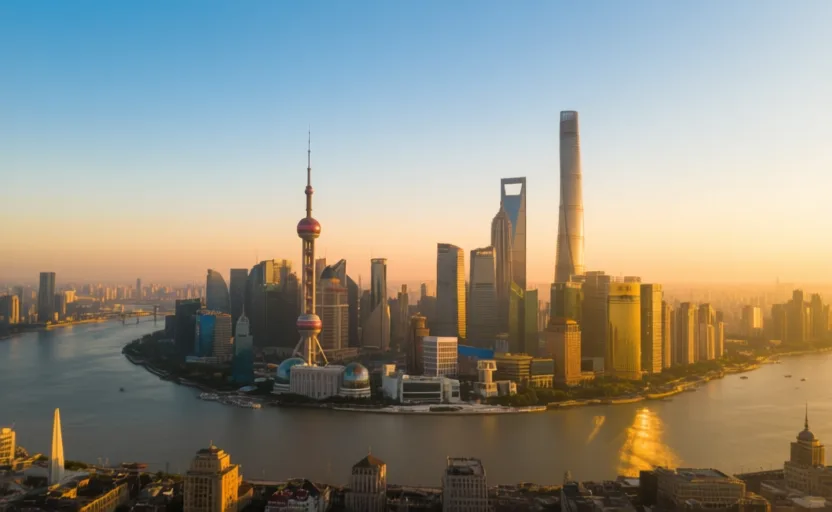 Shanghai · AI city illustration · Artistic impression
City · East Asia
Shanghai
Saved in this browser — no account needed. Sign in later and it comes with you.
Where it is
Everything in Shanghai stands on mud. The city is built on the southern lip of the Yangtze estuary, on an alluvial plain with an average height of only about 4 metres, and its tall towers need deep concrete piles to stop them sinking into the soft ground. Open water bounds it on three sides, the Yangtze mouth on the north, Hangzhou Bay on the south and the East China Sea on the east; the Huangpu River splits the centre into Puxi on the west bank and Pudong on the east. Much of the land is new, laid down by the river or reclaimed from tidal flats. Summers are hot and humid with typhoons, and winters are damp and cold, with night frosts when Siberian winds arrive.
The land and water around it
The Yangtze estuaryestuary
The city exists because the Yangtze drops its sediment here. The land is river deposit and later reclamation, and the municipality includes the estuary and its islands, among them Chongming Island, now the second-largest island of mainland China after twentieth-century growth.
The Huangpu Riverriver
A man-made tributary of the Yangtze, which local tradition credits to the Warring States noble Lord Chunshen. When sediment choked older waterways, the Huangpu became the main outlet for the region, and the city’s port grew along it.
The Lake Tai basinlake
Shanghai belongs to the drainage of Lake Tai, a country of canals, streams and lakes. Suzhou Creek, which joins the Huangpu at the old centre, linked the town to Lake Tai and the Grand Canal.
Its history, in short
For most of its life Shanghai was a modest place. A river confluence and a town of this name existed by the eleventh century, a market town status came in 1074, and a county was created in the early 1290s, but the silting of older ports on the Wusong River pushed trade down to the Huangpu. Cotton made the county rich in the Ming and Qing periods, and a city wall went up in 1553 against pirate raids. The turning point was the First Opium War. The Treaty of Nanjing opened Shanghai to foreign merchants, and British, American and French concessions followed from 1845, with the British and American areas merging into the International Settlement in 1863. The Chinese Communist Party was founded in the French Concession in 1921. The city became a Chinese municipality in 1927, suffered Japanese invasion in 1932 and 1937, and was taken by the People’s Liberation Army in 1949. After decades of reduced global role, reforms from 1990 and the development of Pudong brought finance back.
Timeline
Dates are shown on a timeline rather than as changing shapes on the map. The globe draws modern boundaries only, and tinting a modern outline to stand for a historical one would state something we cannot source.
Post-classical world
746
Qinglong Town
A trading port is set up in what is now Qingpu District, trading with provinces along the Yangtze and with Japan and Silla. Siltation later ended its role, and trade moved to the Huangpu.
Well attestedWikipedia1074
A market town
Shanghai is raised from village to market town. Shanghai County is created in the early 1290s under Songjiang Prefecture.
Early modern & oceanic
1553
A wall against pirates
A city wall is built around the county seat to fend off raiders from Japan. The City God Temple follows in 1602, an honour usually kept for prefectural capitals, which scholars read as a sign of the town’s economic weight.
Industrial & imperial
1842–1849
Treaty port and concessions
After the First Opium War, the Treaty of Nanjing opens Shanghai to British traders. The British concession is set up in 1845, the American in 1848 and the French in 1849, all beyond Chinese law.
1863
The International Settlement
The British and American areas merge into one settlement, whose waterfront becomes the Bund. No Chinese resident was allowed on its municipal council until 1928.
Well attestedWikipediaJuly 1921
The Communist Party is founded
The Chinese Communist Party holds its founding meeting in the French Concession.
Well attestedWikipedia7 July 1927
A Chinese municipality
Shanghai is separated from Jiangsu and made a municipality. By 1932 it is the fifth-largest city in the world, with 70,000 foreigners, and the commercial hub of the Asia-Pacific in the 1930s.
Well attestedWikipedia
Contemporary
1990
Pudong and the return of capital
Deng Xiaoping lets Shanghai begin economic reform, which brings back foreign capital and develops Pudong and its Lujiazui financial district.
Well attestedWikipedia
Places that carry meaning
The BundEarly 20th century
A row of buildings on the Huangpu’s west bank, running from neoclassical banks to the Art Deco Sassoon House. It was the face of the International Settlement and has been renovated several times since 1986.
Yu Garden and the Old CityMing dynasty onward
A Jiangnan-style garden at the core of the old walled city, whose walls were taken down in 1912 because they blocked growth. It sits near the City God Temple, a reminder of the pre-treaty town.
Shikumen lanesLate 19th and early 20th centuries
Grey-brick row houses of two or three storeys, entered through a heavy door set in a stone arch and arranged along straight alleys called longtang. They are the everyday housing of the old concessions, standing next to the Art Deco and Soviet-style buildings.
Lujiazui1990 onward
The financial district on the east bank of the Huangpu in Pudong, built on what had been farmland. It includes the Shanghai Tower, completed in 2015, the tallest building in China.
Languages here
Places are usually multilingual. This lists what is actually spoken, not one language per border.
ShanghaineseSino-Tibetan family
The city’s vernacular, a Northern Wu variety.
It is not mutually intelligible with Mandarin. In the late nineteenth century downtown Shanghainese replaced Suzhou speech as the prestige variety of the Yangtze delta, shaped by migrants from Jiangsu and Zhejiang.
Mandarin ChineseSino-Tibetan family
The national standard language, used across the city’s many regions of origin.
About 40 per cent of residents, roughly 9.8 million people, come from other parts of China, so Mandarin is the common language between them and with the state.
Japanese, English and Korean
Languages of the largest foreign communities.
Officially counted foreign residents number about 157,900, with Japanese citizens the largest group at about 28,900 and Americans and Koreans each near 21,000, though the real figure is probably higher.
Learn the language here
- 1Understand which languages are spoken hereShanghai is multilingual. Start with which languages are used, by whom, and for what — the phrase list only covers one of them.Written by Globe Quest
- 2Learn 11 phrasesCurated everyday phrases for Shanghai, with audio and a written form.Written by Globe Quest
- 3Say them out loudSpeaking practice with pronunciation feedback, one phrase at a time.Globe Quest material, your own additions
- 4Come back to themSpaced review, so what you learned this week is still there next month.Written by Globe Quest
Check yourself
Why do Shanghai’s skyscrapers need deep concrete piles?
The ground is soft estuary sediment and reclaimed land
The city sits on the Yangtze’s alluvial deposits at about 4 metres above sea level, so towers must be anchored well below the sandy soil to avoid sinking.
Which two concessions merged in 1863 to form the International Settlement?
The British and American
The British and American areas joined, while the French Concession stayed separate to the west of the old town. The settlement’s waterfront became the Bund.
Worth arguing about
- Shanghai grew rich as a treaty port under foreign legal control, and then as a Chinese municipality under reform. Which of those versions of the city do residents recognise as their own?
- Nearly 40 per cent of residents come from elsewhere in China, and the Shanghainese vernacular is not understood by Mandarin speakers. What happens to a city’s local language when most of its people arrive from outside?
What we have not established
These are open questions, listed rather than filled in. We would rather show a gap than a plausible guess.
How many people live in Shanghai?
The urban area is put at about 30 million for 2026, the municipality’s registered and resident total at about 24.9 million for 2023, and the wider metropolitan area at about 34 million by one estimate. The figure depends on whether the boundary is the built-up city, the municipality or the commuting region.
Sources
- Wikipedia · ShanghaiWikipedia · encyclopedia · checked 2026-11-24
- Wikipedia · History of ShanghaiWikipedia · encyclopedia · checked 2026-11-24
Reviewed by Globe Quest editorial on 2026-11-24. Drafted with AI assistance and checked against the sources above before publication.