 Globe Quest
 Human Quest · LearningSign in
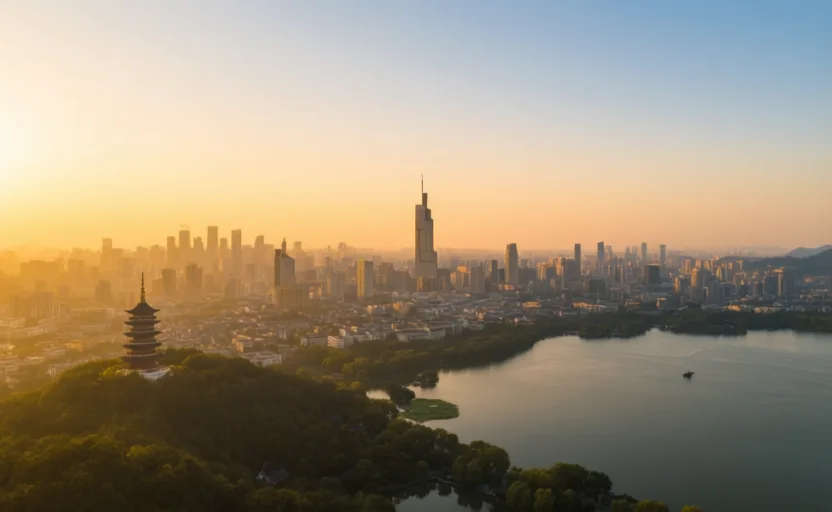 Hangzhou · AI city illustration · Artistic impression
City · East Asia
Hangzhou
Saved in this browser — no account needed. Sign in later and it comes with you.
Where it is
Hangzhou stands where three bodies of water meet. The Qiantang River flows past the south of the city into Hangzhou Bay, whose funnel shape drives a tidal bore up the river that can reach 12 metres. The Grand Canal ends here, and to the west the city centre wraps around the eastern and northern shores of West Lake, with hills on the other sides. Beyond the urban core, the municipality reaches west into mountains toward Anhui and east to the coastal plain. Summers are long, hot and humid, the plum rains arrive in June, and typhoons in late summer usually make landfall further south along the Zhejiang coast.
The land and water around it
West Lakelake
A lagoon cut off from Hangzhou Bay by a sandbar, a process dated to around the start of the common era. Hills ring it on three sides and the city on the fourth. Its two causeways and three islands came from repeated dredging between the ninth and twelfth centuries, so the lake is partly man-made.
The Qiantang River and its tideriver
The largest river in Zhejiang. In the eighth lunar month it throws up a tidal bore, the largest in the world according to local tradition. Seawalls were first built along the bay around 100 CE to keep it out, and a tide table of 1056 is the oldest known.
The southern end of the Grand Canalriver
The Jiangnan section was dredged around 610 to join Suzhou and Hangzhou. The whole canal runs over 2,000 kilometres, linking five major river basins, and was listed by UNESCO in 2014.
Its history, in short
Archaeology puts rice farmers at Hemudu, to the south-east, some 7,000 years ago, and the jade-carving Liangzhu culture around the site about 5,000 years ago. The Qin set up a county here in 222 BCE, but the city proper dates from the Sui, who made it the seat of Hang Prefecture in 589 and gave it a wall two years later. Its place at the southern end of the Grand Canal tied it to the empire’s grain supply. Wuyue, a regional kingdom, made it a capital in the tenth century and patronised Buddhist art. After the Jurchens took Kaifeng in 1127, the Song court fled south and settled in Hangzhou, which became the capital of the Southern Song, with Emperor Gaozong choosing it in 1129 and the court declaring it the capital in 1132. Mongol armies took the city in 1276 but spared it, and visitors’ accounts, among them one attributed to Marco Polo, called it among the finest cities in the world. The harbour silted up in the Ming era, and in the twentieth century it was occupied by Japan from 1937 to 1945 before reform in 1978 brought new growth.
Timeline
Dates are shown on a timeline rather than as changing shapes on the map. The globe draws modern boundaries only, and tinting a modern outline to stand for a historical one would state something we cannot source.
First cities & states
c. 3300–2300 BCE
Liangzhu culture
A highly stratified farming culture dominates the area from a capital in what is now Yuhang District. The city has since added the Liangzhu ruins to its UNESCO sites.
Classical world
222 BCE
Qiantang County
The Qin pacify the south-east and organise the region as part of Kuaiji Commandery. Qiantang is made a county.
Post-classical world
589–591
Hang Prefecture and its walls
The Sui make the city a prefectural seat, and a wall goes up two years later. The Jiangnan Canal, completed around 609, ties it to the Grand Canal.
822–824
Bai Juyi’s dyke
The poet Bai Juyi, governing the city, builds a taller dyke and sluice to restore the lake that farms depend on for irrigation, and plants willows along it.
907
Capital of Wuyue
As the Tang fall, Wuyue takes Hangzhou as capital under the name Xifu. Its rulers patronise Buddhist temples, and the Baochu, Liuhe and Leifeng pagodas are built over the century.
1089–1091
Su Dongpo’s causeway
The poet-governor Su Shi uses 200,000 workers to build a 2.8-kilometre causeway across West Lake from dredged mud.
Well attestedWikipedia1129–1132
Capital of the Southern Song
After the fall of Kaifeng the court retreats south, settling in Hangzhou in 1129 and naming it capital in 1132. Around 1180 it is said to have passed Constantinople and Fez as the most populous city in the world.
1276
The Mongol capture
Kublai Khan’s armies take the city, three years before the Song’s final collapse, and spare the Zhao royal family. Hangzhou remains a commercial and administrative centre for the south.
Well attestedWikipedia
Places that carry meaning
West Lake Cultural Landscape9th century onward
A landscape of causeways, islands, temples, pagodas and gardens, covering about 3,323 hectares. UNESCO treats it as a model of improving nature to create “pictures”, whose ten named scenes were fixed under the Southern Song and copied as far as the Summer Palace in Beijing and in Japan and Korea.
Lingyin Temple4th century onward
The oldest famous temple in Hangzhou, in the hills west of the lake. Its traditional founding date of 326 or 328 is attributed to the Indian missionary Huili, and the temple has been destroyed and rebuilt repeatedly.
The Phoenix Mosquec. 630
Counted among China’s Four Ancient Mosques. In 1848 Hangzhou was described as a stronghold of Islam in Zhejiang, with several mosques and Arabic inscriptions.
Yue Fei Temple1221
A temple on the north-west shore of West Lake honouring General Yue Fei, who died through political persecution under the Song.
Languages here
Places are usually multilingual. This lists what is actually spoken, not one language per border.
Mandarin ChineseSino-Tibetan family
The national standard, used in schools, government and across the city’s migrants.
Standard Chinese, based largely on the Beijing dialect, is the official language, and the city draws people from across the country. Around 300 million Chinese speak other Chinese languages at home, which Chinese sources often call local varieties.
Wu ChineseSino-Tibetan family
The Chinese language group of the lower Yangtze region around the city.
Wu is one of the seven major groups of Chinese, set apart from Mandarin as English is from German or Danish. Its best-known members are Shanghainese, Suzhounese and Wenzhounese, and Hangzhou lies in the same Yangtze Delta region.
ArabicSemitic family
The language of inscriptions in the city’s old mosques.
In 1848 Hangzhou was described as a stronghold of Islam in China, with several mosques carrying Arabic inscriptions.
Learn the language here
- 1Understand which languages are spoken hereHangzhou is multilingual. Start with which languages are used, by whom, and for what — the phrase list only covers one of them.Written by Globe Quest
- 2Learn 11 phrasesCurated everyday phrases for Hangzhou, with audio and a written form.Written by Globe Quest
- 3Say them out loudSpeaking practice with pronunciation feedback, one phrase at a time.Globe Quest material, your own additions
- 4Come back to themSpaced review, so what you learned this week is still there next month.Written by Globe Quest
- 5Practise with people: Arabic practice · DohaAn in-person practice circle. It is a prepared plan and needs a host before it runs.Run by members
Check yourself
Why did Hangzhou become an imperial capital in the twelfth century?
The Song court fled south after the Jurchens captured Kaifeng
After the fall of Kaifeng in 1127, the court moved several times before reaching Hangzhou in 1129. The city then grew into the Southern Song capital.
How did West Lake come to look as it does?
A sandbar cut off a lagoon, and later dredging shaped its causeways and islands
The lake began as a lagoon separated from the bay by a sandbar. Causeways and islands grew from dredging between the ninth and twelfth centuries, the work of poet-governors such as Bai Juyi and Su Dongpo.
Worth arguing about
- West Lake is part natural lagoon and part designed picture, kept up by officials who were also poets. What counts as a natural landscape when people have shaped it for a thousand years?
- Hangzhou was a famous capital, then a silting port, then a technology centre. What does it take for a city to remain important after its original reason is gone?
What we have not established
These are open questions, listed rather than filled in. We would rather show a gap than a plausible guess.
When was Hangzhou the capital of Wuyue?
The city’s main article gives 923 to 997 in one place and 907 to 978 in another, while the timeline starts in 907. The kingdom’s dating depends on whether the start is the regional ruler’s power or the formal title.
How many ancient capitals does China count, and is Hangzhou one?
The article describes Hangzhou as one of the Eight Ancient Capitals in its lead and as one of the Seven Ancient Capitals later on, so the standard list varies depending on which cities are included.
Sources
- Wikipedia · HangzhouWikipedia · encyclopedia · checked 2026-11-24
- Wikipedia · Timeline of HangzhouWikipedia · encyclopedia · checked 2026-11-24
- UNESCO · West Lake Cultural Landscape of HangzhouUNESCO World Heritage Centre · intergovernmental · checked 2026-11-24
- UNESCO · The Grand CanalUNESCO World Heritage Centre · intergovernmental · checked 2026-11-24
- Wikipedia · ChinaWikipedia · encyclopedia · checked 2026-11-24
- Wikipedia · Languages of ChinaWikipedia · encyclopedia · checked 2026-11-24
Reviewed by Globe Quest editorial on 2026-11-24. Drafted with AI assistance and checked against the sources above before publication.