 Globe Quest
 Human Quest · LearningSign in
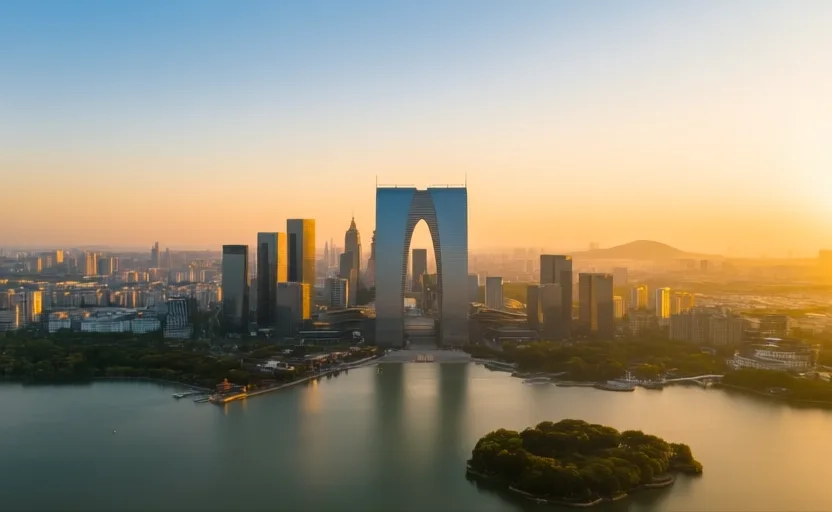 Suzhou · AI city illustration · Artistic impression
City · East Asia
Suzhou
Saved in this browser — no account needed. Sign in later and it comes with you.
Where it is
Water covers or crosses much of Suzhou: rivers, lakes and mudflats account for more than a third of the land. The city occupies a rich lowland of river-laid silt, the Lake Tai Plain, with the Yangtze to the north and Lake Tai, the third-largest freshwater lake in China, to the south-west. The ground is flat and low, mostly 3 to 4 metres above sea level and about 2 metres around Yangcheng Lake, with only scattered hills up to 342 metres in the west and on Lake Tai’s islands. Until the early twentieth century much of the old city was a set of islands tied together by canals. Summers are hot and humid, winters cool, cloudy and damp, with an annual mean of 17.2 °C.
The land and water around it
Lake Tailake
The third-largest freshwater lake in China, at 2,578 square kilometres, with most of its surface inside Suzhou’s boundaries. Its water flows north to the Yangtze and east through marshes toward the Huangpu River. Lake Tai’s islands carry some of the area’s few hills.
The Grand Canalriver
The canal enters the city from the west at Wangting and leaves south at Shengze, crossing the northern part of Suzhou. Together with the Yangtze, it made the city a regional centre of industry and foreign commerce.
The Yangtze delta plainplain
Plains make up more than half the city’s area, and the lowest ground sits only a few metres above sea level. This network of lakes and channels is the reason the city is called a Jiangnan water town.
Its history, in short
Suzhou is among the oldest towns in the Yangtze basin. Local Baiyue peoples lived in villages along the hills above the wetlands around Lake Tai when, according to tradition, a Zhou lord set up the state of Wu nearby. In 514 BCE King Helü moved his court to a new city, planned as nine squares in a symbolic three-by-three pattern, the palace in the middle, and that city grew into Suzhou; Wu fell to Yue in 473 BCE. The Sui first officially called it Suzhou in 589. The Grand Canal put it on the main trade route, and from the tenth century it was an economic centre and, until about 1850, the largest city in the world apart from capitals, when Shanghai overtook it. The Ming founder took it after a ten-month siege in 1367 and taxed it hard, yet it prospered again and its scholar-officials built the famous gardens. The Taiping rebels devastated it in 1860 and Japan invaded in 1937. Reform from 1978 turned it into a major industrial hub.
Timeline
Dates are shown on a timeline rather than as changing shapes on the map. The globe draws modern boundaries only, and tinting a modern outline to stand for a historical one would state something we cannot source.
Classical world
514 BCE
Helü City
King Helü of Wu moves his court to a new capital, helped in the planning by his minister Wu Zixu. In 496 BCE Helü is buried at Tiger Hill. The 2,500-year-old city wall survives in part, including the gate at Pan Gate.
Well attestedWikipedia473 BCE
Wu falls to Yue
The kingdom of Wu is defeated and annexed by Yue, which is itself taken by Chu in 306 BCE. Under the Qin the city is capital of Kuaiji Commandery from 222 BCE.
Well attestedWikipedia
Post-classical world
589
The name Suzhou
The Sui officially call the city Suzhou. “Su” is a contraction of Gusu, the older name taken from a nearby hill.
Well attestedWikipedia1035
The Confucian Temple
The poet and writer Fan Zhongyan founds a Confucian temple that later becomes a venue for the imperial examinations and eventually Suzhou High School.
Well attestedWikipedia1367
Taken by Zhu Yuanzhang
After a ten-month siege Zhu Yuanzhang takes the city from his rival Zhang Shicheng, tears down the old inner walls and imposes heavy taxes on the powerful families. The future Ming emperor’s punishment does not last, and Suzhou is prosperous again.
Well attestedWikipedia
Early modern & oceanic
1488
A visitor’s verdict
Choe Bu, a shipwrecked Korean official travelling home through eastern China, writes that Suzhou surpasses every other city.
Well attestedWikipedia
Industrial & imperial
1860–1863
Rebel occupation
The rebels capture the prefecture in 1860, and by the time Charles Gordon’s Ever-Victorious Army takes it back in November 1863 many buildings and gardens are close to ruin. The population is back at about 500,000 by 1880.
Well attestedWikipedia16 July 1906
The railway to Shanghai
Suzhou railway station opens, connecting the city with Shanghai. Silk looms, a cotton mill and a rice trade all operate around this time.
Well attestedWikipedia
Places that carry meaning
The classical gardens11th century to the 18th century
Private gardens, each a small model of nature made from water, stones, plants and buildings within the limits of a single house. Over 50 survive, and UNESCO treats nine of them, among them the Lion Grove Garden and the Net Master’s Garden, as the finest. More than 200 gardens existed between the sixteenth and eighteenth centuries.
Canglang PavilionEarly 11th century
The earliest of the nine key gardens, built on the site of an earlier garden that had been destroyed.
Tiger Hill496 BCE onward
The traditional burial place of King Helü. Under the Tang, Bai Juyi built the Shantang Canal to link the city with it.
Pan GateAncient Wu
A gate in a surviving stretch of the city wall, one of the remnants of the Wu kingdom’s city, said to be 2,500 years old.
Languages here
Places are usually multilingual. This lists what is actually spoken, not one language per border.
SuzhouneseSino-Tibetan family
The local dialect, a Wu variety.
Many residents still speak it, though Mandarin is the official language of broadcasting and teaching. It belongs to the Wu family. Local performance such as the storytelling art pingtan mixes singing with passages in the spoken dialect.
Mandarin ChineseSino-Tibetan family
The official language of broadcast and instruction.
The population is mostly Han Chinese, and Mandarin is the language of schools and media. Standard Chinese, based on the Beijing dialect, serves as the common language between speakers of China’s many Chinese languages.
KoreanKoreanic family
The language of a large expatriate community.
A Korean bank estimated 15,000 Koreans in the municipality in 2014, with 850 Korean companies. Korean children made up the largest group at the Suzhou Singapore International School.
Learn the language here
- 1Understand which languages are spoken hereSuzhou is multilingual. Start with which languages are used, by whom, and for what — the phrase list only covers one of them.Written by Globe Quest
- 2Learn 11 phrasesCurated everyday phrases for Suzhou, with audio and a written form.Written by Globe Quest
- 3Say them out loudSpeaking practice with pronunciation feedback, one phrase at a time.Globe Quest material, your own additions
- 4Come back to themSpaced review, so what you learned this week is still there next month.Written by Globe Quest
Check yourself
What are Suzhou’s classical gardens designed to be?
Small models of the natural world within the space of one house
Garden masters used water, stones, plants and buildings to imitate nature in the limited space of a single residence, drawing on landscape painting. UNESCO inscribed the gardens in 1997 and extended the listing in 2000.
Which city overtook Suzhou as the largest non-capital city around 1850?
Shanghai
Shanghai, just downstream on the delta, took over as trade shifted to its treaty port. Suzhou had held the position since the tenth century.
Worth arguing about
- Suzhou’s gardens were built by scholar-officials as private worlds inside walls. Who are they for now that anyone can walk through them?
- Suzhou was the largest non-capital city in the world for centuries and then lost that role to a port a few dozen miles away. What makes some cities the winner when trade changes direction?
What we have not established
These are open questions, listed rather than filled in. We would rather show a gap than a plausible guess.
How many people live in Suzhou?
The only recent figure is about 5 million registered residents for 2023, a count that leaves out migrants and the rest of the prefecture, so the actual resident population is higher but not given on a consistent basis.
Sources
- Wikipedia · SuzhouWikipedia · encyclopedia · checked 2026-11-24
- UNESCO · Classical Gardens of SuzhouUNESCO World Heritage Centre · intergovernmental · checked 2026-11-24
- Wikipedia · Languages of ChinaWikipedia · encyclopedia · checked 2026-11-24
Reviewed by Globe Quest editorial on 2026-11-24. Drafted with AI assistance and checked against the sources above before publication.