 Globe Quest
 Human Quest · LearningSign in
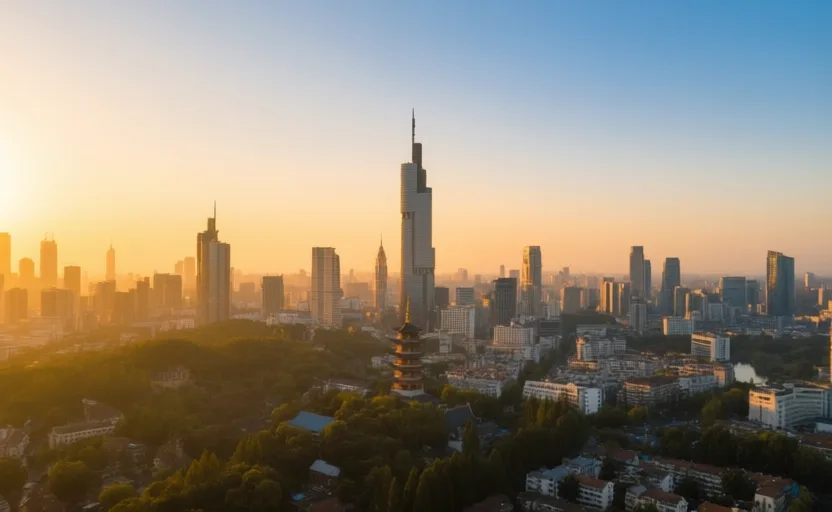 Nanjing · AI city illustration · Artistic impression
City · East Asia
Nanjing
Saved in this browser — no account needed. Sign in later and it comes with you.
Where it is
Nanjing is a river capital in the lower Yangtze valley, more than 300 kilometres from the river’s mouth. The Yangtze swings past the west side of the city and then along the north, while the Ningzheng Ridge curves around the other three sides, so the site is protected by water on one side and hills on the rest. The Qinhuai River, the “mother river” of the city, runs south to north through the old centre and joins the Yangtze; Xuanwu Lake and Mochou Lake lie inside the urban area, and water makes up about 11 per cent of the city. Summers are very hot and muggy, which is why Nanjing is counted among the Yangtze’s “Three Furnaces” with Chongqing and Wuhan.
The land and water around it
The Yangtze Riverriver
The river runs diagonally across the municipality for about 93 kilometres, from south-west to north-east, and Nanjing is one of the world’s largest inland ports. For centuries crossing it was a barrier: the first Nanjing Yangtze River Bridge, opened in 1968, was for a time the only bridge over the lower Yangtze in eastern China.
The Qinhuai Riverriver
The river that the city calls its mother, running south to north across the urban centre before it meets the Yangtze. Its southern stretch became the city’s entertainment district in the mid-Ming dynasty, drawing literati, and the Confucius Temple district still stands beside it.
The Ningzheng Ridgemountains
A line of hills that surrounds the city on its north, east and south sides, with the Yangtze closing the west and north.
Its history, in short
Nanjing’s name means Southern Capital, but it was a capital long before it was called that. Sun Quan moved his headquarters to the site in 211, fortified Shitou Hill and made it the seat of Eastern Wu in 229. Under the name Jiankang it was then the capital of the Eastern Jin and of each of the Southern dynasties between 317 and 589, until the Sui tore down its walls and palaces and returned the land to farming. For three centuries it was a minor provincial place. Zhu Yuanzhang took it in 1356 and in 1368 proclaimed the Ming dynasty here, building a capital of four nested enclosures; when the imperial court shifted north, Nanjing became a commercial and literary metropolis. The Taiping made it their Heavenly Capital from 1853 to 1864. Sun Yat-sen was sworn in as provisional president here on 1 January 1912, and the Republic made it capital again from 1927. The city suffered the Nanjing Massacre in 1937 to 1938 during the Japanese occupation.
Timeline
Dates are shown on a timeline rather than as changing shapes on the map. The globe draws modern boundaries only, and tinting a modern outline to stand for a historical one would state something we cannot source.
Classical world
211–229
Jianye, capital of Eastern Wu
Sun Quan moves his headquarters to the site in 211, fortifies Shitou Hill to build the Stone City and renames the place Jianye. He declares himself emperor and establishes his capital here in 229.
Well attestedWikipedia317–589
Jiankang and the Southern dynasties
The Eastern Jin, then in turn the Liu Song, Southern Qi, Liang and Chen, hold court here, with brief interruptions. Buddhism flourishes, and the “480 temples” of the Southern dynasties become a centre of Chinese Buddhism.
Well attestedWikipedia
Post-classical world
589
The Sui level the city
Emperor Wen of Sui takes the city, demolishes its walls, palaces and homes, deports the Chen ruler and officials, and gives the land back to farmers. For the next three centuries the settlement is demoted.
Well attestedWikipedia1368
Capital of the Ming
Zhu Yuanzhang ascends the throne here as the Hongwu Emperor and names the city Southern Capital. By the end of the fourteenth century the plan consists of four enclosures set inside one another, from an innermost palace city out to an outer ring.
Well attestedWikipedia
Industrial & imperial
1853–1864
The Taiping Heavenly Capital
Taiping forces capture the city in March 1853 and rename it Tianjing, Heavenly Capital. The Manchu garrison suffers heavy casualties, and the regime runs a large Bible-printing enterprise and separates residents by sex into occupational units.
Well attestedWikipedia1 January 1912
Sun Yat-sen’s inauguration
Delegates from provinces that had declared independence elect Sun Yat-sen provisional president on 29 December 1911, and he is sworn in on 1 January 1912, marking the founding of the Republic of China.
Well attestedWikipedia1937–1938
The Nanjing Massacre
During the Second Sino-Japanese War the city suffers devastating atrocities, the most notable being the Nanjing Massacre. The Japanese-installed regime of Wang Jingwei then uses it as a seat from 1940 to 1945.
Well attestedWikipedia
Contemporary
April 1949
The government leaves
Communist forces cross the Yangtze and capture Nanjing. The Nationalist government retreats through Guangzhou, Chongqing and Chengdu before moving to Taipei in December. The city becomes the capital of Jiangsu in 1952.
Well attestedWikipedia
Places that carry meaning
The Ming city wall and Zhonghua Gate14th century
Parts of the city’s Ming-era walls survive, with Zhonghua Gate among the gates inside the walled city.
Ming Xiaoling MausoleumMing dynasty
A mausoleum complex outside the walled city, near Purple Mountain, and one of the city’s chief heritage sites together with the Presidential Palace and the Sun Yat-sen Mausoleum.
The Nanjing Yangtze River Bridge1960s
Designed and built by Chinese engineers after foreign surveys failed and Soviet expertise was first relied on and then rejected, so that it became a symbol of modern China when it opened in 1968.
Fuzimiao and the Qinhuai riversideMing dynasty onward
The Confucius Temple district beside the Qinhuai, traditionally the centre of the city’s nightlife.
Languages here
Places are usually multilingual. This lists what is actually spoken, not one language per border.
Nanjingese and Huai ChineseSino-Tibetan family
The local speech, a variety of Huai Chinese.
Huai varieties spread into Nanjing under the Southern Song, replacing earlier Wu-speaking populations, and so share many features with Wu. In the Ming and Qing a court language widely believed to derive from Nanjingese was used until the court switched to the Beijing speech in the mid-nineteenth century. Northern Wu and Xuanzhou Wu are still spoken in the southern counties.
Mandarin ChineseSino-Tibetan family
The national standard.
The city is 98.56 per cent Han by the official count, and Mandarin is the common language in schools and government.
Hui and other minority communities
The largest of the city’s officially recognised minorities.
Of 77,394 minority residents counted in 1999, 64,832 were Hui, followed by Manchu and Zhuang.
Learn the language here
- 1Understand which languages are spoken hereNanjing is multilingual. Start with which languages are used, by whom, and for what — the phrase list only covers one of them.Written by Globe Quest
- 2Learn 11 phrasesCurated everyday phrases for Nanjing, with audio and a written form.Written by Globe Quest
- 3Say them out loudSpeaking practice with pronunciation feedback, one phrase at a time.Globe Quest material, your own additions
- 4Come back to themSpaced review, so what you learned this week is still there next month.Written by Globe Quest
Check yourself
When was the name Nanjing, “Southern Capital”, first given to the city?
1368, at the founding of the Ming
The Hongwu Emperor named his capital Southern Capital in 1368. The city had served as a capital under other names, such as Jianye and Jiankang, for more than a thousand years before.
What did the Sui do to Jiankang in 589?
They flattened its walls, palaces and homes and farmed the land
After conquering the Chen, Emperor Wen of Sui demolished the city and deported its rulers to his own capital. The settlement stayed minor for about three centuries.
Worth arguing about
- Nanjing has been a capital many times and a minor town in between. What makes a site keep returning to power after a dynasty destroys it?
- A city that was both a Taiping capital and a Republican one, and the site of the 1937 massacre, carries several rival memories. How should its public places hold them?
What we have not established
These are open questions, listed rather than filled in. We would rather show a gap than a plausible guess.
How many people live in Nanjing?
The city article gives 9,423,400 for 2021, a 2010 census figure of 8.005 million, and an OECD estimate of 11.7 million for the wider metropolitan area. The total changes with the boundary and the count date.
Sources
- Wikipedia · NanjingWikipedia · encyclopedia · checked 2026-11-24
Reviewed by Globe Quest editorial on 2026-11-24. Drafted with AI assistance and checked against the sources above before publication.