 Globe Quest
 Human Quest · LearningSign in
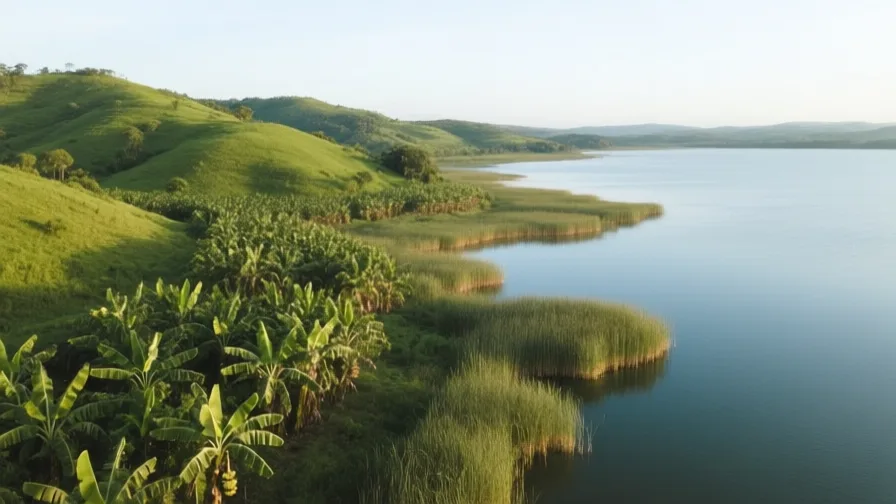 Uganda · AI landscape illustration · Artistic impression
Country · Africa
Uganda
Saved in this browser — no account needed. Sign in later and it comes with you.
Where it is
Uganda has a long lake shore and no sea coast. It sits astride the equator on an upland plateau averaging about 900 m, ringed by mountains: the snow-capped Rwenzori on the Congolese border, volcanic Mount Elgon on the Kenyan one. The whole south leans on Lake Victoria, and the larger cities cluster beside it. Almost the entire country drains to the Nile, which leaves Victoria, crosses Lake Kyoga and its marshes, then drops into Lake Albert and runs north into South Sudan. Rain comes twice a year in the south, from March to May and September to November, and once in the north, where the northeast is semi-arid.
The land and water around it
Lake Victorialake
The southern part of the country is shaped by one of the biggest lakes in the world, shared with Kenya and Tanzania and dotted with islands. The capital Kampala and Entebbe, among the most important cities, stand on its northern shore.
The Victoria Nile and the northern lakesriver
The Victoria Nile carries water from Lake Victoria into Lake Kyoga, a shallow lake surrounded by extensive marsh, and then into Lake Albert on the Congolese border before it flows north out of the country. Lakes Edward and George lie along the western border.
Rwenzori and Elgonmountains
The Rwenzori range in the west holds Mount Stanley, 5,109 m, which is the summit of both Uganda and its western neighbour the Democratic Republic of the Congo, and snow lies on its peaks. In the east, on the border with Kenya, the volcanic Mount Elgon reaches 4,321 m at Wagagai, which lies in Uganda.
Its history, in short
People have lived in what is now Uganda for at least 50,000 years. Farmers and herders speaking Central Sudanic and other languages held much of it until roughly three millennia ago. Then Bantu-speaking newcomers settled the south and Nilotic-speaking ones the northeast, and by 1500 most had been absorbed into Bantu-speaking cultures. Oral tradition and archaeology describe the Kitara empire, whose heirs included Bunyoro, Tooro, Ankole and Busoga, and the Buganda kingdom, which grew beside it and lends the country its name. Arab traders came from the coast in the 1830s and British explorers and missionaries followed. Britain declared a protectorate in 1894 and extended it over other kingdoms by treaty; unlike Kenya, Uganda kept a measure of self-government. Independence came on 9 October 1962, but the place of Buganda in a unitary state split the new government, and in 1966 and 1967 Milton Obote abolished the kingdoms. Idi Amin seized power in 1971, expelled Uganda’s Asian minority and ruled with mass killing until Tanzanian forces and exiles drove him out in 1979. After a guerrilla war Yoweri Museveni took power in 1986, and he still holds it.
Timeline
Dates are shown on a timeline rather than as changing shapes on the map. The globe draws modern boundaries only, and tinting a modern outline to stand for a historical one would state something we cannot source.
Early human world
at least 50,000 years ago
Early human presence
Acheulean stone tools from the former shores of Lake Victoria, exposed along the Kagera valley, show people living in the area for at least 50,000 years, and perhaps as long as 100,000.
Approximate dateWikipedia
First cities & states
c. 3,000 years ago
Bantu and Nilotic speakers arrive
Bantu speakers move into the south and Nilotic speakers into the northeast, among farmers and herders who spoke Central Sudanic and Kuliak languages. By about 1500 CE most of these groups had been absorbed into Bantu-speaking cultures.
Approximate dateWikipedia
Post-classical world
10th century
The Kitara empire
Oral tradition and archaeology place a large Kitara empire between lakes Albert and Kyoga in the north and Victoria and Tanganyika in the south. It grows out of the Urewe culture and is claimed as the forerunner of Tooro, Ankole and Busoga.
Early modern & oceanic
c. 15th century
Luo migration and new kingdoms
Luo-speaking migrants arrive and Kitara collapses. Biito dynasties emerge, ruling Bunyoro, and Buganda rises alongside it.
Industrial & imperial
1894
British protectorate
The Uganda Protectorate is established after the Imperial British East Africa Company, bankrupted by religious wars, hands over its administration. Further treaties, with Toro (1900), Ankole (1901) and finally Bunyoro (1933), stretch it to roughly the present borders.
Well attestedWikipedia
Contemporary
9 October 1962
Independence
Uganda becomes independent with Milton Obote as prime minister and the Kabaka of Buganda, Edward Muteesa II, as ceremonial president. The place of Buganda within a unitary state dominates the first years.
Well attestedWikipedia1971–1979
Idi Amin’s rule
Amin deposes Obote in a coup on 25 January 1971. His government kills many Ugandans and in 1972 expels the Asian minority, mostly of Indian origin, cutting a community of around 80,000 to as few as 7,000. He is overthrown in the Uganda–Tanzania War.
Well attestedWikipediaJanuary 1986
Museveni takes power
A six-year guerrilla war ends when Yoweri Museveni’s National Resistance Movement prevails. A non-party “Movement” system restricted party activity until a referendum in July 2005 ended the ban on multi-party politics.
Well attestedWikipedia
Places that carry meaning
Rwenzori Mountains National Parkpresent
A World Heritage property in the range on the Congolese border, where snow lies on the peaks.
Bwindi Impenetrable National Parkpresent
A World Heritage forest park in the southwest that shelters a population of mountain gorillas, one of ten national parks among 60 protected areas.
Entebbe20th century
A town on Lake Victoria near Kampala and the site of the international airport. In June 1976 a hijacked Air France flight was forced to land there, and an Israeli commando raid freed the hostages after ten days.
Murchison Falls National Parkpresent
One of the ten national parks, home to hippos.
Languages here
Places are usually multilingual. This lists what is actually spoken, not one language per border.
EnglishGermanic family
Official language and the language of administration and schooling.
Until a constitutional amendment in 2005 it was the sole official language. A local variety is sometimes nicknamed Uglish.
LugandaBantu family
The language of Buganda, widely spoken in the south and the capital.
The country is named after the Buganda kingdom, which covers a large part of the south including Kampala, and its language Luganda is widely spoken there.
SwahiliBantu family
The second official national language since 2005.
Swahili is an important lingua franca in the north and is widely used in the police and the army, but speakers of Bantu languages in the south and southwest do not favour it. Its status has shifted with the politics of whoever holds power; Idi Amin, from the north-west, declared it the national language.
Nilotic and Central Sudanic languages
Spoken across the north and northeast.
Nilotic speakers arrived in the northeast about three thousand years ago. Groups such as the Acholi, Langi, Alur and Iteso are among the large ethnic communities, and the languages spoken at home reflect that variety.
Learn the language here
Check yourself
Which kingdom gave Uganda its name?
Buganda
Uganda is named after Buganda, the large southern kingdom that includes Kampala and whose language, Luganda, is widely spoken. Britain’s dealings with Buganda shaped the protectorate and the first years after independence.
Where does the Victoria Nile go after leaving Lake Victoria?
Through Lake Kyoga, then Lake Albert, then north into South Sudan
Almost all of Uganda lies in the Nile basin. The river runs through Lake Kyoga and its marshes into Lake Albert, then flows north out of the country.
Worth arguing about
- Uganda’s protectorate left kingdoms such as Buganda with real privileges, and the central government abolished them in 1967. Should a unitary state find room for kings?
- Uganda has the youngest population in the world, with a median age of 15, and hosted more than 1.4 million refugees in 2021. What does a country like that need to plan for first?
What we have not established
These are open questions, listed rather than filled in. We would rather show a gap than a plausible guess.
How many people died under Idi Amin?
Estimates of deaths during his eight years in power range from 80,000 to 500,000. The records are incomplete and the figures were produced by different methods, so no single number can be stated.
Sources
- Wikipedia · UgandaWikipedia · encyclopedia · checked 2026-11-24
- Wikipedia · History of UgandaWikipedia · encyclopedia · checked 2026-11-24
- Wikipedia · Geography of UgandaWikipedia · encyclopedia · checked 2026-11-24
Reviewed by Globe Quest editorial on 2026-11-24. Drafted with AI assistance and checked against the sources above before publication.