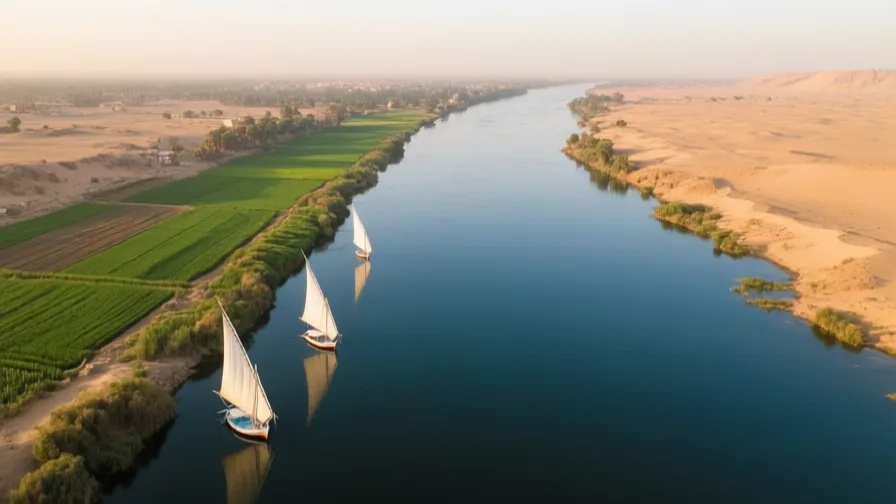
 The Nile · AI landscape illustration · Artistic impression
Natural feature · Africa
The Nile
Also known as Iteru, an-Nīl, Ḥapi
One of the world's longest rivers, flowing north through Sudan and Egypt to a Mediterranean delta.
Saved in this browser — no account needed. Sign in later and it comes with you.
Where it is
The Nile flows north across north-east Africa to a delta on the Mediterranean, gathering from two main branches: the White Nile, rising in the East African lakes region, and the Blue Nile, rising in the Ethiopian highlands. The Blue Nile contributes the majority of the water and most of the sediment, and it does so seasonally, which is why the historic flood arrived when it did. Almost all of Egypt's population lives on the floodplain and delta.
The land and water around it
The Nile Deltadelta
A fan of distributaries and farmland north of Cairo, built from sediment over millennia. Reduced sediment delivery and rising sea level now put parts of its coastline into retreat.
The Ethiopian highlandsplateau
The Blue Nile's source region, whose summer rains produced the historic flood pulse. Where the water originates matters politically as much as hydrologically.
Its history, in short
The relationship between the river and the states along it has been continuous and explicit for five thousand years: the flood determined the harvest, the harvest determined tax, and measuring the flood was a state function. The modern chapter is about control rather than measurement — dams that store water between years instead of relying on each year's flood, with benefits and costs that fall in different places and different decades. The river crosses many countries and its allocation is now a live international dispute.
Timeline
Dates are shown on a timeline rather than as changing shapes on the map. The globe draws modern boundaries only, and tinting a modern outline to stand for a historical one would state something we cannot source.
First cities & states
c. 3100 BCE
A unified state along the valley
Egyptian tradition and later king lists describe the unification of Upper and Lower Egypt. The date is conventional and reconstructed, not recorded at the time.
Approximate dateUNESCO World Heritage Centrec. 2600–2500 BCE
The pyramid fields
Monumental tomb construction at Giza and Dahshur, at the junction of the valley and the delta near Memphis.
Approximate dateUNESCO World Heritage Centre
Industrial & imperial
1902
The first Aswan Dam
A dam is completed at Aswan, later heightened twice. It begins the shift from managing an annual flood to storing water across seasons.
Well attestedUNESCO World Heritage Centre
Contemporary
1963–1967
Nubian resettlement
Lake Nasser floods Nubian land in both Egypt and Sudan. About 50,000 Egyptian Nubians are moved to Kom Ombo, some 40 kilometres north of Aswan, in 1963–64; about 50,000 Sudanese Nubians are moved from the Wadi Halfa region to the New Halfa scheme, roughly 800 kilometres away, between 1964 and 1967.
1970
The Aswan High Dam is completed
The High Dam creates Lake Nasser and ends the annual flood in Egypt. Monuments including Abu Simbel are cut apart and moved above the new water line in an international campaign; the villages were not moved, they were replaced.
Well attestedUNESCO World Heritage Centre2011 onward
The Grand Ethiopian Renaissance Dam
Ethiopia builds a large dam on the Blue Nile. Egypt, Sudan and Ethiopia have negotiated over filling and operating rules without reaching a comprehensive agreement. Accounts of the dispute differ substantially depending on which government is describing it.
DisputedNASA Earth ObservatoryEgyptian, Sudanese and Ethiopian official positions on filling schedules, downstream guarantees and prior legal agreements differ materially. This entry records that the dispute exists and is unresolved.
Places that carry meaning
Abu Simbel13th century BCE; relocated 1960s
Rock-cut temples in Nubia, cut into blocks and reassembled on higher ground during the High Dam project. The relocation is itself now part of what the site means.
Thebes and the Valley of the Kingsc. 2000–1000 BCE
A concentration of temple and tomb building on both banks in the southern valley, associated with a period when political power sat upstream rather than at the delta.
Languages here
Places are usually multilingual. This lists what is actually spoken, not one language per border.
ArabicSemitic family
The dominant language along the Egyptian and Sudanese Nile today.
Egyptian Arabic is the everyday spoken variety in Egypt and is widely understood across the Arabic-speaking world through Egyptian media.
Nubian languagesNilo-Saharan family
Spoken along the river in southern Egypt and northern Sudan.
A group of related languages whose speaking communities were directly affected by the High Dam's reservoir, which flooded Nubian villages and prompted resettlement.
CopticEgyptian family
Liturgical language of the Coptic Orthodox Church.
The last stage of the Egyptian language, written in a Greek-derived alphabet. No longer a community's first language, but in continuous liturgical use.
Learn the language here
- 1Understand which languages are spoken hereThe Nile is multilingual. Start with which languages are used, by whom, and for what — the phrase list only covers one of them.Written by Globe Quest
- 2Practise with people: Arabic practice · DohaAn in-person practice circle. It is a prepared plan and needs a host before it runs.Run by members
Check yourself
Which branch supplies most of the Nile's water and sediment?
The Blue Nile
The Blue Nile, rising in the Ethiopian highlands, supplies the majority of the flow and most of the sediment, and does so seasonally.
Why does damming the river affect the delta's coastline?
The reservoir traps sediment that used to rebuild the delta
Deltas are maintained by sediment supply. Trap the sediment and erosion continues unopposed.
Worth arguing about
- The Blue Nile's water falls in Ethiopia and is used in Egypt. What principle should govern a river that crosses borders?
- Abu Simbel was saved and Nubian villages were not. What does that choice say about how heritage is valued?
What we have not established
These are open questions, listed rather than filled in. We would rather show a gap than a plausible guess.
Why do published totals for Aswan displacement differ?
The per-country figures are sourced above and are close to 50,000 each. Totals of 100,000–120,000 also circulate, as does a figure of 48,000 for Egypt. The likeliest explanation — that the ethnic Nubian population was larger than the population physically resident in Nubia at the time, because of long-established labour migration to Cairo and Alexandria — is consistent with the sources but is not itself stated by any institutional source we found. We record it as an unverified explanation rather than presenting it as one.
What is the current status of GERD filling and operating negotiations?
This changes; a dated statement would be stale within months. The dossier records that no comprehensive agreement has been reached rather than describing a negotiating round.
Sources
- UNESCO · Historic CairoUNESCO World Heritage Centre · intergovernmental · checked 2026-09-07
- UNESCO · Memphis and its Necropolis – the Pyramid Fields from Giza to DahshurUNESCO World Heritage Centre · intergovernmental · checked 2026-09-07
- UNESCO · Ancient Thebes with its NecropolisUNESCO World Heritage Centre · intergovernmental · checked 2026-09-07
- UNESCO · Nubian Monuments from Abu Simbel to PhilaeUNESCO World Heritage Centre · intergovernmental · checked 2026-09-07
- NASA Earth Observatory · The Nile Delta's Disappearing FarmlandNASA Earth Observatory · government · checked 2026-09-07
- NASA Earth Observatory · A Grand New Dam on the NileNASA Earth Observatory · government · checked 2026-09-07
- Hussein M. Fahim · Community-Health Aspects of Nubian Resettlement in EgyptKroeber Anthropological Society Papers, via UC Berkeley Library · journal · checked 2026-09-07
- Marianna Wallin · Resettled for Development: The Case of New Halfa Agricultural Scheme, SudanNordiska Afrikainstitutet (The Nordic Africa Institute) · journal · checked 2026-09-07
Reviewed by Globe Quest editorial on 2026-09-07.
Related places
Themes: Rivers & cities, Water & environment, How cities work, Religion & pilgrimage