 Globe Quest
 Human Quest · LearningSign in
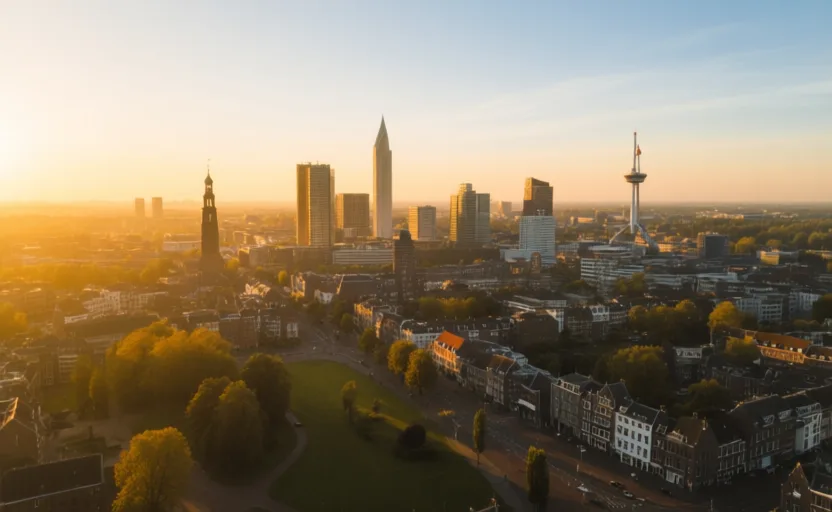 Eindhoven · AI city illustration · Artistic impression
City · Europe
Eindhoven
Saved in this browser — no account needed. Sign in later and it comes with you.
Where it is
Away from the coast and the big rivers, Eindhoven lies in the Campine region of North Brabant, on sandy ground where several small streams meet. The villages and town that make up the city were first built on sandy rises between the Dommel, the Gender and the Tongelreep, and from the nineteenth century people also built in the stream basins, which brought flooding into the centre. After the Second World War the Gender, which ran through the middle of the city, was dammed and filled in and the Dommel was straightened; now parts of that work are being reversed. The climate is oceanic but slightly warmer in summer and colder in winter than on the coast, with frost common but no lasting snow.
The land and water around it
The Dommel and the Genderriver
The two streams meet at the old town. The Gender once flowed through the centre, and was dammed and filled after the war partly to stop flooding; the Dommel was regulated, though parts of its course have since been restored. Plans exist to bring the Gender back through the centre.
The sandy rises of the Campineplain
The settlements stood on dry sandy elevations between three streams, so the old town was only a few hundred houses. Heath and woodland around them were turned into farmland in the nineteenth century, and later into housing estates.
Its history, in short
Written history starts in 1232, when Duke Hendrik I of Brabant gave a charter to a small town with about 170 houses behind a rampart, where two streams met on the trade route from Holland to Liège. The Middle Ages and the Dutch Revolt were rough on it: troops from Guelders plundered and burned it in 1486, a fire destroyed three quarters of its houses in 1554, and Spanish troops took it and pulled down its walls in 1583. Only in 1629 did it pass to the Netherlands, and it stayed minor until industry arrived. In 1815 it had 2,310 people. A canal came in 1843 and railways between 1866 and 1870, and the tobacco and textile trades were joined by Philips, founded here in 1891 to make light bulbs, and later by the truck maker DAF. Population leapt from 47,946 in 1920 to 103,030 in 1935, and five neighbouring municipalities were merged in 1920. Bombing in 1942 and 1944 and postwar rebuilding left little of the old fabric.
Timeline
Dates are shown on a timeline rather than as changing shapes on the map. The globe draws modern boundaries only, and tinting a modern outline to stand for a historical one would state something we cannot source.
Post-classical world
1232
City rights
Duke Hendrik I of Brabant grants city rights, with a weekly market that nearby farmers must use. The town has about 170 houses.
Well attestedWikipedia
Early modern & oceanic
1486
Plundered and burned
Troops from Guelders plunder the town. Rebuilding is complete in 1502, with sturdier defences and a new castle.
Well attestedWikipedia1554
The great fire
A fire destroys 75 per cent of the houses. They are rebuilt by 1560 with the help of William I of Orange.
Well attestedWikipedia1629
Joins the Netherlands
After changing hands between Dutch and Spanish forces during the revolt, and losing its walls in 1583, Eindhoven becomes part of the Netherlands.
Well attestedWikipedia
Industrial & imperial
1891
Philips begins
Philips is founded in Eindhoven as a light-bulb manufacturer. It becomes a major multinational and drives the city’s growth.
Well attestedWikipedia1920
Greater Eindhoven
Five neighbouring municipalities, Woensel, Tongelre, Stratum, Gestel en Blaarthem and Strijp, are incorporated, because the city was still confined to its medieval moat limits while the population exploded.
Well attestedWikipedia1942 and 1944
Air raids
An RAF raid on the Philips factory on 6 December 1942 kills 148 civilians, and a German raid on 19 September 1944 during Operation Market Garden destroys large parts of the city and kills 227.
Well attestedWikipedia
Places that carry meaning
Strijp-S20th century, converted in the 21st
The old Philips factory complex, now a cultural and residential district where LED lighting is tested in public art, keeping a link with the company’s past.
Philips Gloeilampenfabriekje anno 18911891
The company’s first light-bulb factory, now a museum documenting the early lamp industry. It sits beside the DAF Museum, which covers the other founding industry of the city.
High Tech Campus21st century
A research campus that is a co-location centre of the European Institute of Innovation and Technology, part of the Brainport effort to build a knowledge economy around the technical university.
Languages here
Places are usually multilingual. This lists what is actually spoken, not one language per border.
DutchGermanic family
The standard language, spoken everywhere.
The city has no uniform dialect of its own. Brabantian forms once heard in the old villages of Gestel, Woensel and Stratum have nearly died out.
East Brabantian dialectsGermanic family
The regional speech around the city.
The spoken language mixes Kempenlands, which extends into Belgium, and North Meierijs, spoken south of ’s-Hertogenbosch. Both are East Brabantian and close to colloquial Dutch.
Learn the language here
- 1Understand which languages are spoken hereEindhoven is multilingual. Start with which languages are used, by whom, and for what — the phrase list only covers one of them.Written by Globe Quest
- 2Learn 12 phrasesCurated everyday phrases for Eindhoven, with audio and a written form.Written by Globe Quest
- 3Say them out loudSpeaking practice with pronunciation feedback, one phrase at a time.Globe Quest material, your own additions
- 4Come back to themSpaced review, so what you learned this week is still there next month.Written by Globe Quest
Check yourself
What did Philips first make in Eindhoven in 1891?
Light bulbs
Philips was founded as a light-bulb manufacturer and grew into a multinational that shaped the city. Trucks were the product of DAF, a separate firm.
Why were five municipalities merged into Greater Eindhoven in 1920?
Because the city was still confined to its medieval limits while industry brought rapid growth and housing needs
Industrial growth and the housing it required had spilled into the neighbouring municipalities, which already bore the brunt of the needs, and administration had to catch up.
Worth arguing about
- A city that began as a company town for light bulbs now brands itself as a technology region. How does a place keep an identity when its main employer is gone or changes beyond recognition?
- Postwar Eindhoven paid little attention to historic buildings and demolished a neo-Gothic city hall for a road that was never built. What counts as heritage in a city that was rebuilt fast?
What we have not established
These are open questions, listed rather than filled in. We would rather show a gap than a plausible guess.
How many people live in Eindhoven?
The municipality had 249,054 people on 1 January 2025 by one count, while another 2025 figure cited for the city is 372,720. The numbers appear to describe different areas, so no single total is relied on here.
Sources
- Wikipedia · EindhovenWikipedia · encyclopedia · checked 2026-11-24
Reviewed by Globe Quest editorial on 2026-11-24. Drafted with AI assistance and checked against the sources above before publication.