 Globe Quest
 Human Quest · LearningSign in
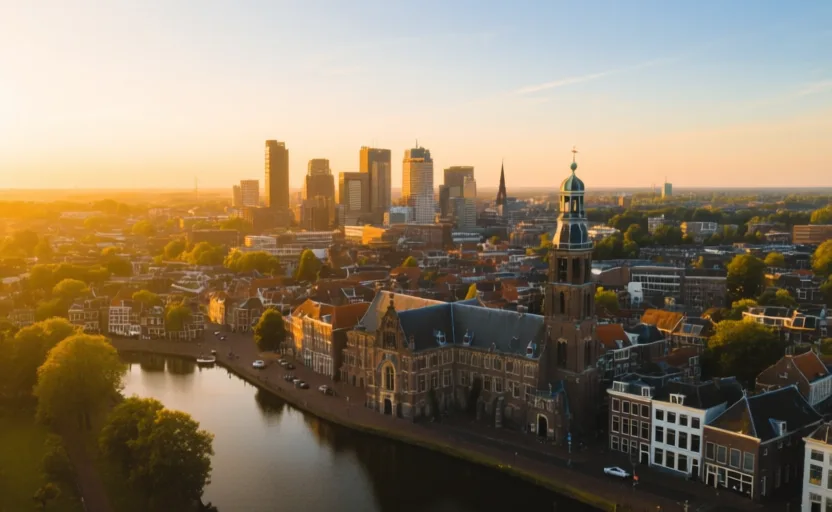 Nijmegen · AI city illustration · Artistic impression
City · Europe
Nijmegen
Saved in this browser — no account needed. Sign in later and it comes with you.
Where it is
Hills are scarce in the Dutch delta, so the ones above the Waal at Nijmegen mattered. They give a long view over the Waal and Rhine valley, which is why the Romans put a camp here, and the old centre still climbs the Valkhof hill on the south bank. The river is the city’s defining line: the municipality reaches north across it into newer districts, and the Waal carried the trade that made the town rich. The German border is only a few kilometres away. The climate is oceanic but warm, and the stretch between Roermond, Nijmegen and Eindhoven usually records the country’s highest summer temperatures.
The land and water around it
The Waalriver
The main branch of the Rhine in the delta. Trade along it made the medieval town prosperous, and the Dutch government is now altering the river’s course to give it more room and so reduce flood risk near the city.
The Nijmegen hillsmountains
Low hills on the south bank that give a view over the Waal and Rhine valley. Their strategic value is what drew the Romans, and the Valkhof hill holds the city’s oldest buildings. Groesbeek, nearby, has some of the northernmost wineries in the world.
Its history, in short
The Romans built a camp on the hills in the first century BCE. In 69 CE the Batavi rose against Rome and destroyed the village that had formed beside it, after which the Romans built a bigger camp for the Tenth Legion and, in 98, gave the settlement Roman city rights. Trajan renamed it Ulpia Noviomagus Batavorum in 104, the origin of the modern name. Charlemagne kept a palace here in 777, and the emperor Henry VI was born in the town in 1165. His son Frederick II granted city rights in 1230, and in 1247 the city was pledged to the count of Guelders as security for a loan that was never repaid, so it has belonged to Gelderland ever since. It joined the Hanseatic League and, after the Spanish were driven out in 1591, remained a border town under repeated sieges. The Treaty of Nijmegen of 1678 failed to bring lasting peace. In 1944 an American bombing by mistake and then the fighting of Operation Market Garden destroyed much of what the centuries had left.
Timeline
Dates are shown on a timeline rather than as changing shapes on the map. The globe draws modern boundaries only, and tinting a modern outline to stand for a historical one would state something we cannot source.
Classical world
98 CE
Roman city rights
It is the earlier of just two places in today’s Kingdom of the Netherlands to be given Roman city rights. In 104 Trajan renames it Ulpia Noviomagus Batavorum.
Well attestedWikipedia
Post-classical world
777
Charlemagne’s palace
Charlemagne maintains a palace in Nijmegen, possibly on at least three more occasions after that.
Well attestedWikipedia1230
City rights from Frederick II
Frederick II grants the city its charter, and in 1247 it is pledged to the count of Guelders for a loan that is never repaid.
Well attestedWikipedia1364
Hanseatic League
The city joins the Hanseatic League. Famous medieval painters, among them the Limbourg brothers, are born and trained here.
Well attestedWikipedia
Early modern & oceanic
1678
The Treaty of Nijmegen
The city hosts negotiations among the European powers meant to end continual warfare, and the treaty fails to provide a lasting peace.
Well attestedWikipedia
Industrial & imperial
1874
The fortifications come down
Too many people were crammed inside the walls, but they could not be dismantled while the city was vital to the country’s defence. The Franco-Prussian War showed the old fortifications were obsolete, and the policy changed.
Well attestedWikipedia22 February 1944
The bombing
American aircraft bomb the centre, killing over 750 people. A 2005 study by the Dutch war research institute NIOD found it was a mistake, born of confused communications and disorder in the airspace. In September the city sees heavy fighting in Operation Market Garden over its bridges.
Well attestedWikipedia
Places that carry meaning
Valkhofc. 1050
The hill with the Valkhof chapel, the oldest intact building in the Netherlands, and a remnant of a castle that Frederick Barbarossa built and that was largely demolished in 1798. The Valkhof Museum there displays the city’s Roman past.
Stevenskerk13th century
A church about 750 years old that had to be reconstructed after the Second World War.
RembrandtstraatRoman
The foundations of the Roman amphitheatre are traced in the paving of this street, one of the few visible reminders of the Roman town.
Languages here
Places are usually multilingual. This lists what is actually spoken, not one language per border.
DutchGermanic family
The everyday language of the city and its university.
The city is known locally in its own dialect as Nimwéêge. Since 1923 the city has had a Catholic university, now Radboud University, which is, with the hospitals, one of its main employers.
Latin place-namesItalic family
A trace of Roman rule rather than a living language here.
The modern name descends from Noviomagus, the Roman name for the town. Roman inscriptions and finds are held in the Valkhof Museum.
Learn the language here
- 1Understand which languages are spoken hereNijmegen is multilingual. Start with which languages are used, by whom, and for what — the phrase list only covers one of them.Written by Globe Quest
- 2Learn 12 phrasesCurated everyday phrases for Nijmegen, with audio and a written form.Written by Globe Quest
- 3Say them out loudSpeaking practice with pronunciation feedback, one phrase at a time.Globe Quest material, your own additions
- 4Come back to themSpaced review, so what you learned this week is still there next month.Written by Globe Quest
Check yourself
What is the oldest intact building in the Netherlands, according to the history of Nijmegen?
The Valkhof chapel
The Valkhof chapel dates from about 1050 and stands on the same hill where the Romans, then Charlemagne and later Barbarossa built.
Why did the Romans choose the Nijmegen hills for a camp?
They had a good view over the Waal and Rhine valley
The hills gave a good view over the river valley, a great strategic value on the empire’s northern frontier. The Batavi, by contrast, rebelled against Rome in 69.
Worth arguing about
- The city has been bombed by mistake, shelled for months and then partly demolished by its own planners. How should a place with so little left of its past tell that past?
- A border city with a left-leaning council once earned the nickname “Havana on the Waal”. Does a university town’s politics follow from its geography or from its students?
What we have not established
These are open questions, listed rather than filled in. We would rather show a gap than a plausible guess.
When exactly was Nijmegen founded?
The city celebrated 2,000 years of existence in 2005, but written evidence only names a Roman camp in the first century BCE, and the town’s earliest buildings are not securely dated.
Sources
- Wikipedia · NijmegenWikipedia · encyclopedia · checked 2026-11-24
Reviewed by Globe Quest editorial on 2026-11-24. Drafted with AI assistance and checked against the sources above before publication.