 Globe Quest
 Human Quest · LearningSign in
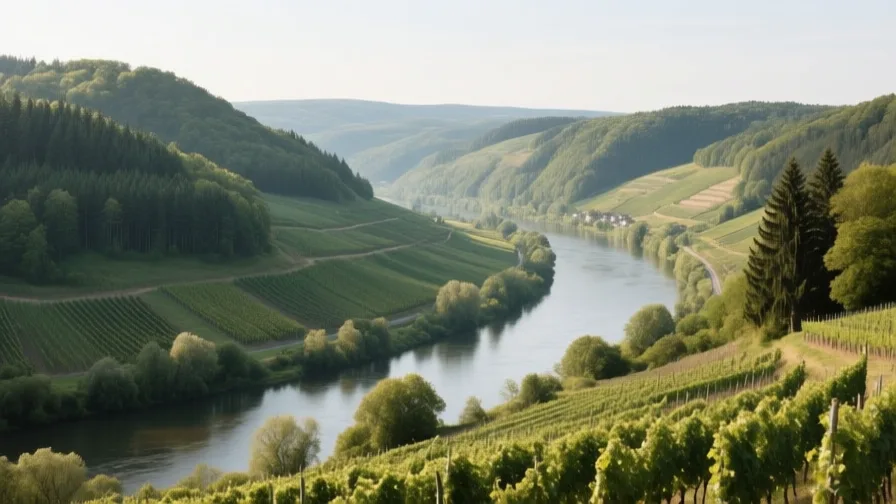 Germany · AI landscape illustration · Artistic impression
Country · Europe
Germany
Saved in this browser — no account needed. Sign in later and it comes with you.
Where it is
Germany is built in three tiers that tilt toward the sea. In the south the Alps rise to the Zugspitze, roughly 2,960 metres. Across the middle runs a belt of forested uplands, some of them shaped by ancient volcanoes, cut through by the Rhine valley. The north is the flat North European Plain, running out to the North Sea and the Baltic, and its lowest point lies about 3.5 metres below sea level. Three big rivers organise the country: the Rhine, the Elbe and the Danube. Nine countries touch it, more than any other in Europe apart from Russia, and its climate is maritime toward the north-west and turns more continental toward the east and south-east.
The land and water around it
The Rhine, Elbe and Danuberiver
The Rhine runs 865 km through Germany, with the Neckar, Main and Moselle feeding into it. The Elbe covers 727 km and the Danube 687 km. The Rhine and the Elbe both drain into the North Sea. For Rome, the Rhine and Danube together became the line where conquest stopped.
The North European Plainplain
The northern third of the country is flat land crossed by rivers flowing north. Marsh and wetland lie near the Dutch border and along the Frisian coast, and the sandy north-east holds many lakes left by the last ice age. Germany’s tidal flats along that coast cover an estimated 2,783 km².
The central uplands and the Alpsmountains
Between plain and Alps lies a patternless run of hills and low mountains: the Eifel, Hunsrück, Taunus, Vogelsberg, Rhön and Thuringian Forest, reaching east to the Ore Mountains on the Czech border. The Alps close the south, and Lake Constance, the largest lake, is shared with neighbouring states.
Its history, in short
Rome never held the land east of the Rhine. A coalition under Arminius destroyed three legions in 9 AD, and by about 100 the frontier settled along the Rhine, the Danube and the Limes Germanicus. The idea of a German kingdom grew out of the eastern half of Charlemagne’s divided empire, and in 962 Otto I was crowned as the first ruler of the Holy Roman Empire. For the next eight centuries power sat with dukes, princes and bishops rather than a capital. Port towns formed the Hanseatic League on the Baltic and North Sea coasts, and from 1517 Luther’s Reformation split the lands into Protestant north and east and Catholic south. The Thirty Years’ War devastated the empire, and it dissolved in 1806 amid the Napoleonic Wars. A united German Empire came only in 1871, under Prussia. After defeat in two world wars and the Nazi dictatorship, the country was divided in 1949 into a western and an eastern state, and they were joined again on 3 October 1990.
Timeline
Dates are shown on a timeline rather than as changing shapes on the map. The globe draws modern boundaries only, and tinting a modern outline to stand for a historical one would state something we cannot source.
Classical world
9 AD
Teutoburg Forest
Tribes led by Arminius defeat three Roman legions. Rome gives up the idea of conquering the land beyond the Rhine, and the frontier settles along the Rhine and Danube.
Post-classical world
800
Charlemagne’s empire
The Carolingian Empire is founded and divided in 843. Its eastern part, East Francia, stretches from the Rhine to the Elbe and from the North Sea to the Alps.
Well attestedWikipedia962
Otto I becomes emperor
The Kingdom of Germany forms the core of the Holy Roman Empire, which lasts until 1806.
Early modern & oceanic
From 1517
The Reformation
Martin Luther’s challenge to the Catholic Church divides the German lands. The north and east turn Protestant while other states stay Catholic.
Well attestedWikipedia1618–1648
Thirty Years’ War
The war brings great destruction to the empire. The Peace of Westphalia gives the member states, among them Austria, Prussia, Bavaria and Saxony, their autonomy.
Well attestedWikipedia
Industrial & imperial
1871
Unification under Prussia
The modern nation-state emerges as the German Empire, a federation of 25 states, after a loose confederation of 39 had existed since 1815.
Contemporary
1949
Two states
The western occupation zones become the Federal Republic on 23 May, with Bonn as a provisional capital. The Soviet zone becomes the German Democratic Republic on 7 October, with East Berlin as its capital.
3 October 1990
Reunification
The eastern states join the Federal Republic. Full sovereignty follows on 15 March 1991, and the Berlin/Bonn Act of 1994 moves the capital back to Berlin.
Well attestedWikipedia
Places that carry meaning
The Swabian Jura cavesAbout 40,000 years ago
Caves in the limestone of the Swabian Jura gave up the Lion-man figurine, the Venus of Hohle Fels and flutes some 42,000 years old, the oldest known musical instruments and some of the oldest figurative art.
HeuneburgLate Bronze and Iron Age
A Celtic centre described as the oldest city north of the Alps, with trade routes reaching the Mediterranean. Germanic peoples spreading south from about 700 BC later replaced the Celtic-speaking populations of the region.
Bonn1949 to the present
Chosen as West Germany’s provisional capital to signal that division was temporary. After Berlin took back the capital role it kept the status of federal city and several ministries.
Büsingen am HochrheinPresent
A German village entirely surrounded by Switzerland, cut off from the rest of the country by a strip of Swiss land 680 metres wide at its narrowest. It is one example of how a long, complicated border produces odd shapes: there are also five German exclaves along the old Vennbahn railway line inside Belgium.
Languages here
Places are usually multilingual. This lists what is actually spoken, not one language per border.
GermanGermanic family
The official and dominant language.
Around 100 million people speak it as a first language in the European Union, more than any other language. The word Deutsch began as a label for the speech of ordinary people, set against Latin and the Romance languages. About three in four German citizens say they can use at least one foreign language.
Recognised minority languages
Protected under a European charter for regional and minority languages.
Seven native minority languages have official recognition: Danish, Sorbian, Romani, Low German, Low Rhenish, North Frisian and Saterland Frisian.
Immigrant languages
Spoken by large communities that arrived in the last century.
The most used are Turkish, Arabic, Kurdish, Polish, Italian, Greek and Spanish, along with Serbo-Croatian, Bulgarian, other Balkan languages and Russian. Around a quarter of the population either lacks a German passport or descends directly from immigrants.
Learn the language here
Check yourself
Who was the first ruler of the Holy Roman Empire, in 962?
Otto I
Otto I was crowned in 962, after the Frankish empire had split in 843 and its eastern half grew into the Kingdom of Germany. Charlemagne had founded the earlier empire in 800.
Where did Rome finally fix its northern frontier in the region?
On the Rhine and Danube
After Arminius’s coalition defeated three legions in 9 AD, Rome abandoned plans to conquer Germania. By about 100 the border ran along the Rhine, the Danube and the Limes Germanicus.
Worth arguing about
- For eight centuries power sat with princes, bishops and free cities rather than one capital. How does that still show in where Germany’s big institutions, banks and media sit?
- Bonn was chosen as a provisional capital to show that division was meant to be temporary, and then held the role for decades. What makes a temporary arrangement last?
What we have not established
These are open questions, listed rather than filled in. We would rather show a gap than a plausible guess.
How many people live in Germany?
Estimates of just over 83 million and a 2023 census count of 84.7 million both appear in the record. They refer to different years and counting methods, so no single total is given here.
Sources
- Wikipedia · GermanyWikipedia · encyclopedia · checked 2026-11-24
- Wikipedia · History of GermanyWikipedia · encyclopedia · checked 2026-11-24
- Wikipedia · Geography of GermanyWikipedia · encyclopedia · checked 2026-11-24
Reviewed by Globe Quest editorial on 2026-11-24. Drafted with AI assistance and checked against the sources above before publication.