 Globe Quest
 Human Quest · LearningSign in
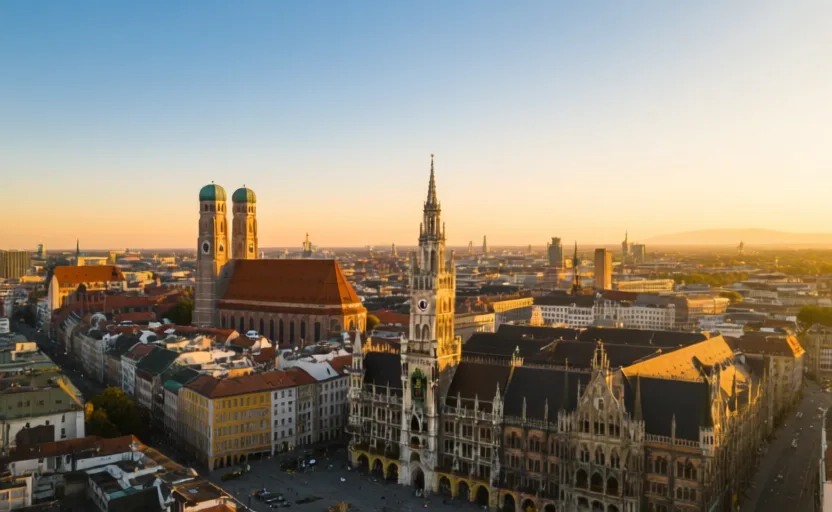 Munich · AI city illustration · Artistic impression
City · Europe
Munich
Also known as München
Saved in this browser — no account needed. Sign in later and it comes with you.
Where it is
Munich stands on a raised gravel plain in the Alpine foreland, about 520 metres above sea level and some 50 km north of the mountains. The Isar and the Würm cross it. To the south the ground is covered in glacial moraine hills, while gravel outwash spreads between them, and where that gravel thins, groundwater rises and makes marsh in the north. With no large water body nearby, temperatures swing widely through the year. The nearness of the Alps brings extra rain and snow, and the föhn, a warm downslope wind, can lift winter temperatures sharply within hours.
The land and water around it
The Isarriver
A prehistoric trade route and the reason for the town: whoever held the bridge controlled the salt that crossed it. The first medieval bridge sat near today’s Museuminsel and Ludwigsbrücke.
The Alpine foreland plainplain
The city occupies the raised plains of Upper Bavaria. Outwash gravel left by melting glaciers lies across the plain, and where it grows thin, groundwater comes up and produces marshy ground in the north.
The Alps and the föhnclimate
The mountains are not visible in the city’s street plan but shape its weather. They add to rainfall and flood risk, and the föhn wind that drops off them brings sudden warm spells even in winter.
Its history, in short
The Isar was a trade route long before there was a city, and in the Bronze Age the site was one of the largest raft ports in Europe. The name comes from a small monastic settlement of the 10th century, “to the monks”. The town itself dates from a quarrel over salt. About 1158 Duke Henry the Lion burned the bridges at nearby Föhring, which belonged to the Bishop of Freising, and built a toll bridge and customs house upstream so that the salt trade would pass through his own market. Barbarossa’s arbitration in Augsburg on 14 June 1158 settled the dispute in the duke’s favour, and that date counts as the foundation. The Wittelsbach family made it their residence in 1255 and ruled until 1918. When Bavaria was reunited in 1506, Munich became its capital; it led the Counter-Reformation and stayed Catholic. A kingdom followed in 1806, and with it a building programme under Ludwig I. Population grew from 24,000 in 1700 to 500,000 in 1901. After the war the old street plan was kept in the rebuilding.
Timeline
Dates are shown on a timeline rather than as changing shapes on the map. The globe draws modern boundaries only, and tinting a modern outline to stand for a historical one would state something we cannot source.
Post-classical world
14 June 1158
Henry the Lion’s bridge
At Augsburg, the quarrel over the Isar toll bridge is settled in the duke’s favour and the text names the place “Munichen”. The date is taken as the city’s foundation, though 11th-century pottery found near Marienplatz shows the settlement is older.
1255
Wittelsbach residence
The House of Wittelsbach makes Munich its seat, beginning more than six centuries of rule.
Well attestedWikipedia
Early modern & oceanic
1506
Capital of reunited Bavaria
After the War of the Succession of Landshut, the duchy is reunited with Munich at its head. In the following century it becomes a stronghold of the Counter-Reformation and is called the “German Rome”.
Well attestedWikipedia
Industrial & imperial
1806
Kingdom of Bavaria
Allied with Napoleonic France, Bavaria becomes a kingdom with Munich as capital, and the archdiocese of Munich and Freising is set up there. The university moves from Landshut twenty years later.
Well attestedWikipediaOctober 1810
A wedding festival
A beer festival on meadows outside the city celebrates the marriage of the crown prince to Princess Therese. The fields became the Theresienwiese, and the celebration grew into the annual Oktoberfest.
Well attestedWikipedia1918–1919
End of the monarchy
Ludwig III flees the city in November 1918, and the revolution ends Wittelsbach rule. The murder of the first republican premier in February 1919 leads to the short-lived Bavarian Soviet Republic.
Well attestedWikipedia
Contemporary
1957
One million
The population passes a million. Postwar Munich was rebuilt to its prewar street grid, and its weight in the West German economy earned it the nickname “secret capital”.
Well attestedWikipedia1972
Olympic Games
Munich hosts the Summer Olympics. Having won the bid in 1966, the mayor accelerated the building of the U-Bahn and the S-Bahn commuter railway.
Well attestedWikipedia
Places that carry meaning
Marienplatz and the old townFrom the 12th century
The old centre is built around Marienplatz, with the Old and New Town Halls. St Peter’s is the oldest church in the inner city, and three gates of the medieval fortification, the Isartor, Sendlinger Tor and Karlstor, survive.
The Residenz Antiquarium1568
Duke Albrecht V built it for the Wittelsbach family’s collection of antiquities from Greece and Rome. Albrecht also drew Italian musicians to court, and Orlando di Lasso led the orchestra.
Ludwigstraße and Königsplatz19th century
Under Ludwig I, architects Leo von Klenze and Friedrich von Gärtner gave Munich neoclassical avenues and squares, and the city earned the nickname “Isar-Athen”.
Theresienwiese1810 to the present
An open field on the edge of the old city that has hosted the Oktoberfest since the wedding celebration of 1810.
Languages here
Places are usually multilingual. This lists what is actually spoken, not one language per border.
GermanGermanic family
The official language of administration, school and business.
Munich is Germany’s most densely populated city, with about 4,800 people per square kilometre, and in 2023 foreign nationals were 30.1 percent of residents. German citizens with a migration background added another 19.4 percent.
BavarianGermanic family
The regional dialect group of the south-east.
Only Vienna is bigger among the cities of the Bavarian-speaking area. The 1810 festival’s parades in regional dress showed the range of the kingdom the city governed.
Languages of the largest foreign communities
Spoken by residents from Turkey, Croatia, Italy, Greece and the Balkans.
The biggest groups of foreign nationals in 2023 were Turks (38,947) and Croats (37,541), followed by Italians, Austrians, Greeks, Bosnians and Ukrainians. Some Croats call Munich their “second capital”.
Learn the language here
- 1Understand which languages are spoken hereMunich is multilingual. Start with which languages are used, by whom, and for what — the phrase list only covers one of them.Written by Globe Quest
- 2Learn 12 phrasesCurated everyday phrases for Munich, with audio and a written form.Written by Globe Quest
- 3Say them out loudSpeaking practice with pronunciation feedback, one phrase at a time.Globe Quest material, your own additions
- 4Come back to themSpaced review, so what you learned this week is still there next month.Written by Globe Quest
Check yourself
Why did Henry the Lion build a toll bridge at Munich around 1158?
To control the salt trade across the Isar
The duke destroyed the bridges at Föhring and built a new toll crossing and customs house upstream so that the salt trade would pay him, not the Bishop of Freising.
What event in 1810 led to the Oktoberfest?
The marriage of the crown prince to Therese of Saxe-Hildburghausen
A beer festival held on meadows outside the city celebrated the royal wedding. The fields became the Theresienwiese and the event repeated every year.
Worth arguing about
- Munich began as a toll point designed to divert a trade route. When is it fair for a ruler to reshape the geography of commerce to suit himself?
- The city was rebuilt on its prewar street plan after 1945, with few exceptions. What does a city gain, and lose, by restoring the old layout?
What we have not established
These are open questions, listed rather than filled in. We would rather show a gap than a plausible guess.
How many people live in Munich?
Statistics from the state, built on the 2022 census, put the population at about 1.5 million at the end of 2025, while the city’s own register lists about 1.61 million people with a primary residence there. The two count residents differently, so both are valid and they do not match.
Sources
- Wikipedia · MunichWikipedia · encyclopedia · checked 2026-11-24
- Wikipedia · History of MunichWikipedia · encyclopedia · checked 2026-11-24
Reviewed by Globe Quest editorial on 2026-11-24. Drafted with AI assistance and checked against the sources above before publication.