 Globe Quest
 Human Quest · LearningSign in
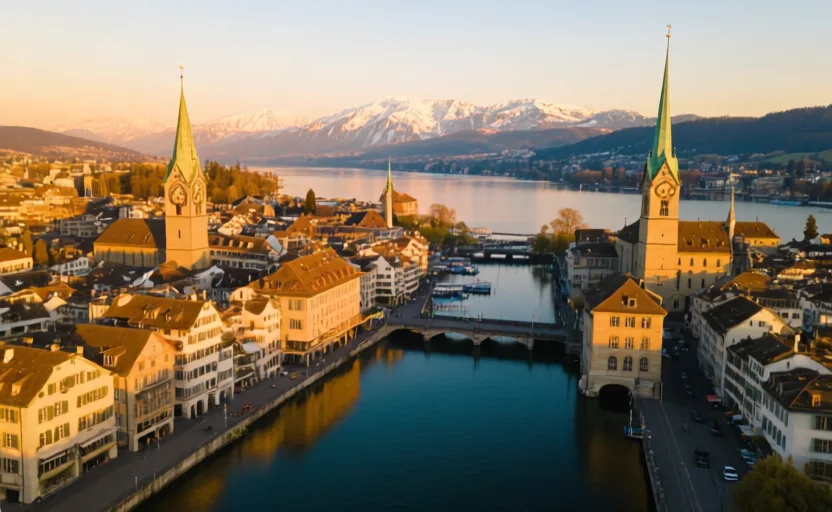 Zurich · AI city illustration · Artistic impression
City · Europe
Zurich
Saved in this browser — no account needed. Sign in later and it comes with you.
Where it is
Lake Zurich narrows to a northern tip here, and the Limmat drains out of it at 408 metres above sea level, about 30 kilometres north of the Alps. Wooded hills close in on the west and east, so the old town fills a corridor on both banks of the river, with the Lindenhof, a small moraine hill, as its natural centre. The Sihl joins the Limmat beside the Platzspitz. The flat valley floor is narrow, which is why dense districts follow the water while newer housing climbs the slopes of the Zürichberg and the Uetliberg. The climate is temperate and oceanic, with westerly rain and the cold north-easterly Bise.
The land and water around it
Lake Zurichlake
A long lake whose outflow, the Limmat, gave the Romans their toll point and gave the medieval town its two banks. Neolithic and Bronze Age pile dwellings were found submerged along its shore in the nineteenth century, on what had once been marshy ground between the river mouth and the water.
The Limmat and the Sihlriver
The Limmat runs along the right side of its valley floor rather than the middle, partly straightened by engineers. The Sihl joins it at the Platzspitz, next to the Swiss National Museum. The old town stretches across both banks of the Limmat.
Lindenhofhill
A small hill left by the glaciers on the west bank, about 700 metres downstream of the lake. It carried a Celtic settlement, then the Roman castellum, then a Carolingian castle, and the city has treated it as its historic centre ever since.
Its history, in short
Zurich began as a place to collect tax. Where the Limmat leaves the lake, Rome built a post on the Lindenhof to levy duty on goods moving along the river, close to the border between two provinces. After Roman rule faded, power passed to the Church. Louis the German founded the Fraumünster abbey in 853 and endowed it with the lands of Zurich, and in 1045 its abbess received rights to hold markets, collect tolls and mint coins, which made her the effective ruler of the town. A guild revolt in the 14th century broke that order and led to the 1351 oath that made Zurich the fifth member of the Swiss Confederacy. From 1519 Huldrych Zwingli preached at the Grossmünster and made the city a centre of the Reformation; the Zurich Bible was printed in 1531. In 1648 Zurich dropped its status as an imperial city and called itself a republic. Industry drew people in from the countryside after the 1830s, and these newcomers lacked civic rights until reforms in 1860 and 1875. In 1893 eleven outlying districts were merged into the city. Rail, a stock exchange and a main street followed, and Zurich became the largest city in Switzerland.
Timeline
Dates are shown on a timeline rather than as changing shapes on the map. The globe draws modern boundaries only, and tinting a modern outline to stand for a historical one would state something we cannot source.
Classical world
15 BC
The Romans fortify the Lindenhof
During the conquest of the Alpine region, the Romans build a castellum on the hill. A tax-collecting settlement called Turicum grows up below it, on the Limmat route that marked part of a provincial border.
Well attestedWikipedia
Post-classical world
853
Fraumünster abbey founded
Louis the German founds a Benedictine convent for his daughter Hildegard and gives it the lands of Zurich. Under the abbess, who gains market, toll and coinage rights in 1045, the abbey effectively governs the town.
1 May 1351
Zurich joins the Confederacy
Citizens swear allegiance before representatives of Lucerne, Schwyz, Uri and Unterwalden, and Zurich becomes the fifth member of the loose alliance. It was expelled in 1440 after a war over Toggenburg and readmitted in 1450.
Early modern & oceanic
1519
Zwingli begins the Swiss Reformation
As chief preacher at the Grossmünster, Zwingli starts preaching systematically through the Gospel of Matthew instead of following the set readings. The last abbess of the Fraumünster, Katharina von Zimmern, supports a peaceful change, and the Zurich Bible appears in 1531.
1648
A republic, with a second ring of walls
Alarmed by the Thirty Years' War, the council had built a second belt of fortifications in the 1620s and 1640s, paid for by subject territories whose revolts were crushed. In 1648 Zurich proclaims itself a republic rather than a free imperial city.
Industrial & imperial
1847
The first railway on Swiss soil
The Spanisch-Brötli-Bahn links Zurich with Baden, which puts the Hauptbahnhof at the start of the Swiss rail network. The present station building dates from 1871, Bahnhofstrasse from 1867 and the stock exchange from 1877.
Well attestedWikipedia1893
Eleven districts merged into the city
Industrial growth had pushed population into suburbs and villages around the old town. The city absorbs eleven of them, giving it a boundary close to its present core.
Well attestedWikipedia
Places that carry meaning
LindenhofRoman to Carolingian
The hill where the customs post stood, and where a tombstone naming the Turicum station was found. A Carolingian castle replaced the ruined Roman one by 835.
Fraumünster853 onward
The convent church of the abbey whose abbess ruled the town. Its last abbess, Katharina von Zimmern, backed the Reformation.
GrossmünsterReformation, from 1519
The church where Zwingli preached. The Reformation that started here changed state and civic life in Zurich and spread to several other cantons, while others stayed Catholic and drifted towards the Wars of Kappel.
Zürich Hauptbahnhof1847; present building 1871
The origin of the Swiss rail network and today the busiest main station in the country, beside the airport that is also the busiest.
Languages here
Places are usually multilingual. This lists what is actually spoken, not one language per border.
Standard GermanGermanic family
The written and official language of government, schools, courts and the press.
The Swiss variety of Standard German is what people read and write. Many residents speak it as one half of the Swiss German and Standard German pair, which 69.3 per cent named as their home language in the 2010 census.
Zurich GermanGermanic family
The everyday spoken dialect, called Züritüütsch.
One of the Swiss German dialects descended from medieval Alemannic, and mutually intelligible with its neighbours. Constant arrivals from other cantons mean that speakers of many Swiss German dialects live and commute here, and home use of both German varieties is slowly falling.
EnglishGermanic family
The fastest-growing second language, used heavily at work.
Use of English at home rose by about 60 per cent in ten years to 14 per cent of the population in 2024, and about 40 per cent of residents use it at work.
Italian, Spanish, Portuguese and FrenchRomance family
Spoken by large communities of foreign residents.
Germany, Italy, Spain, Portugal and France are the five biggest countries of citizenship among foreign residents, who make up 34.2 per cent of the population. Italian and French are also two of Switzerland's national languages.
Learn the language here
- 1Understand which languages are spoken hereZurich is multilingual. Start with which languages are used, by whom, and for what — the phrase list only covers one of them.Written by Globe Quest
- 2Learn 12 phrasesCurated everyday phrases for Zurich, with audio and a written form.Written by Globe Quest
- 3Say them out loudSpeaking practice with pronunciation feedback, one phrase at a time.Globe Quest material, your own additions
- 4Come back to themSpaced review, so what you learned this week is still there next month.Written by Globe Quest
Check yourself
What was the Roman settlement of Turicum for?
A customs post taxing goods on the Limmat route
A 2nd-century tombstone found on the Lindenhof names the Turicum station, a post for collecting a 2.5 per cent tax on goods passing between provinces.
Where did Zurich stand among the members of the Swiss Confederacy when it joined?
The fifth
On 1 May 1351 Zurich swore allegiance before representatives of Lucerne, Schwyz, Uri and Unterwalden, becoming the fifth member of a loose alliance of nearly independent states.
Worth arguing about
- Zurich's written language and its spoken language differ more than in most countries. What does that do to who counts as local?
- An abbey, then guilds, then a republic, then a financial centre: which of these changes of rulers left the deepest mark on the street plan?
What we have not established
These are open questions, listed rather than filled in. We would rather show a gap than a plausible guess.
How many people live in Zurich?
The municipality had 440,935 residents at the end of 2025, the urban area 1.45 million in 2020 and the wider metropolitan area 2.1 million. Which figure is right depends on where the boundary of the city is drawn, so there is no single answer.
Sources
- Wikipedia · ZurichWikipedia · encyclopedia · checked 2026-11-24
- Wikipedia · History of ZurichWikipedia · encyclopedia · checked 2026-11-24
Reviewed by Globe Quest editorial on 2026-11-24. Drafted with AI assistance and checked against the sources above before publication.