 Globe Quest
 Human Quest · LearningSign in
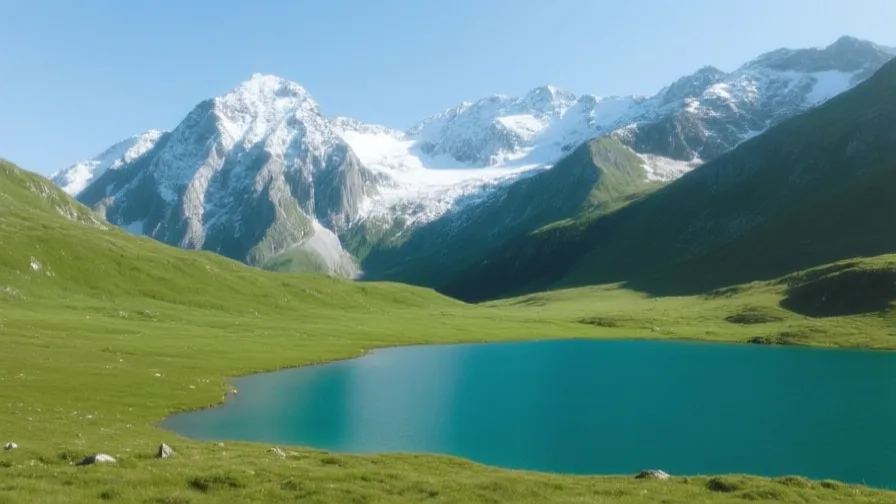 Switzerland · AI landscape illustration · Artistic impression
Country · Europe
Switzerland
Saved in this browser — no account needed. Sign in later and it comes with you.
Where it is
Switzerland is a landlocked country of 41,291 square kilometres, no more than about 350 kilometres across, wedged between Germany, France, Italy, Austria and Liechtenstein. The Alps cover roughly 60 per cent of it, the Jura rises in the north-west, and between them lies the Swiss Plateau, a band of rolling hills and plains that holds most of the people and the biggest cities. Its mountains feed several great rivers, the Rhine and the Rhône among them. Lowland climate is temperate and sits between oceanic and continental, while altitude produces everything from near-Mediterranean air in Ticino to permanent ice.
The land and water around it
The Swiss Alpsmountains
The Alps take up about 60 per cent of the country and hold glaciers covering 1,063 square kilometres. The highest summit wholly in Switzerland is the Dufourspitze of Monte Rosa at 4,634 metres. Alpine passes, above all the St Gotthard, made the central valleys valuable and shaped the early confederacy.
The Swiss Plateauplateau
A strip of rolling hills and plains along the northern foot of the Alps, drained mainly by the Aare. Most of the population lives on it, in cities such as Zurich, Geneva, Basel, Bern and Lausanne, at a density of about 400 people per square kilometre, and the urban built-up area has grown quickly since the 1930s.
The Rhône and Rhine valleysvalley
The Rhône flows west and the Rhine east, each in a deep trench on its own side of the high northern ridge of the Bernese and Glarus Alps. Their headwaters lie close together near the St Gotthard, from where the Reuss runs north and the Ticino south. The Rhine also marks a large part of the German frontier.
Its history, in short
Romans called the people of the plateau Helvetii, and Caesar defeated their attempted migration in 58 BCE. The state grew from a defensive alliance of the rural valley communities of Uri, Schwyz and Unterwalden around 1291, strategically placed on the trade route through the St Gotthard Pass. Other cantons joined, with Zurich, Bern and Lucerne among them, and the confederacy became powerful by the late 15th century. Its independence from the Holy Roman Empire was recognised in 1648. France invaded in 1798 and imposed a centralised Helvetic Republic; Napoleon restored a looser confederation in 1803, and the Congress of Vienna in 1814–15 recognised permanent neutrality and set the present borders. The Protestant–Catholic Sonderbund war of 1847 was brief and left fewer than a hundred dead, but it persuaded the Swiss that they needed a stronger union, and the constitution of 1848, partly modelled on the United States, created the federal state. Switzerland was not invaded in either world war, and joined the United Nations only in 2002.
Timeline
Dates are shown on a timeline rather than as changing shapes on the map. The globe draws modern boundaries only, and tinting a modern outline to stand for a historical one would state something we cannot source.
Classical world
58 BCE
The Helvetii defeated
The Helvetii, a Celtic people of the plateau under pressure from Germanic tribes, try to move into Gaul and are beaten by Julius Caesar’s army at Bibracte, in eastern France, and sent home. The region is then Romanised.
Post-classical world
1291
The Federal Charter
The rural communities of Uri, Schwyz and Unterwalden agree an alliance. It is treated as Switzerland’s founding document, though similar pacts probably existed decades earlier.
Approximate dateWikipedia
Early modern & oceanic
1648
Independence recognised
The Peace of Westphalia formally recognises Swiss independence from the Holy Roman Empire. The confederation is one of the few republics of its age to survive the Napoleonic Wars.
Well attestedWikipedia1798
The Helvetic Republic
Revolutionary France invades and imposes a centralised state that largely abolishes the cantons. It is deeply unpopular, and in 1803 Napoleon’s Act of Mediation restores much cantonal autonomy.
Industrial & imperial
1814–1815
Neutrality and the modern borders
The Congress of Vienna re-establishes Swiss independence, and the powers agree to recognise permanent Swiss neutrality. Valais, Neuchâtel and Geneva join, completing today’s territory.
Well attestedWikipedia1847–1848
Civil war and a federal constitution
Catholic cantons that formed a separate alliance are defeated in less than a month. A new constitution follows in 1848 that sets up the current federal system with individual rights, separation of powers and a two-chamber parliament.
1920
Joins the League of Nations
Switzerland joins the League, based in Geneva, after being exempted from military obligations. Geneva has since become the base of many international bodies.
Contemporary
2002
Joins the United Nations
Having kept its distance for decades, Switzerland becomes a member, though it had joined the Council of Europe in 1964.
Well attestedWikipedia
Places that carry meaning
BernFounded 1191
The federal city and seat of government, founded by the Zähringen dukes in 1191 and one of the three city-states that joined the confederacy by 1353.
GenevaJoined 1815
Seat of the League of Nations after 1920 and today of many international organisations. It became a Swiss canton only after the Congress of Vienna.
The St Gotthard Pass13th century onward
A direct route through the mountains that made Uri and Schwyz worth defending. The empire granted them imperial freedom in 1231 and 1240 to control it, and the Habsburgs later sought to revoke that.
Languages here
Places are usually multilingual. This lists what is actually spoken, not one language per border.
GermanGermanic family
The largest national language, spoken in the north and east.
About 62 per cent of the population speak German natively. After Alemannic settlement it became the language of the eastern and northern regions, and early Swiss literature was written in it.
FrenchRomance family
National language of the west, about 22.7 per cent.
The west was originally Burgundian territory, and French became fashionable in Bern in the 18th century.
ItalianRomance family
National language of the south, about 8.2 per cent.
Spoken natively in the south, notably in Ticino, which lies entirely south of the Alps.
RomanshRomance family
A small national language, spoken by about 0.5 per cent in the canton of Graubünden.
Surviving in the upper valleys of the Rhine and Inn, Romansh is a national language, but federal laws do not have to be issued in it. It is an official language only when authorities deal with Romansh speakers.
Learn the language here
Check yourself
Why is Switzerland called a “nation of volition” (Willensnation)?
Its identity rests on shared history and values, not on a single language or religion
Swiss nationhood rests on a shared past, federalism, direct democracy and Alpine symbolism, and cuts across four languages and two main Christian confessions.
Why did the St Gotthard route matter for the early confederacy?
It gave direct passage through the mountains, so its valleys became valuable to the empire
To keep control of the pass, the empire gave Uri and Schwyz direct imperial freedom in 1231 and 1240, and Rudolph of Habsburg later cancelled that status.
Worth arguing about
- Switzerland is bound by choice rather than language or religion. Can a nation of volition survive a changing population and ageing demographics?
- Armed neutrality has been policy for centuries, and the country joined the UN only in 2002. What does neutrality protect, and what does it leave out?
What we have not established
These are open questions, listed rather than filled in. We would rather show a gap than a plausible guess.
What share of Swiss residents speak each national language?
One account gives German 62 per cent, French 22.7 per cent and Italian 8.2 per cent, while another gives 63.7, 20.4 and 6.5 per cent. The figures differ by survey year and method, so only approximate shares are given.
Sources
- Wikipedia · SwitzerlandWikipedia · encyclopedia · checked 2026-11-24
- Wikipedia · History of SwitzerlandWikipedia · encyclopedia · checked 2026-11-24
- Wikipedia · Geography of SwitzerlandWikipedia · encyclopedia · checked 2026-11-24
Reviewed by Globe Quest editorial on 2026-11-24. Drafted with AI assistance and checked against the sources above before publication.