 Globe Quest
 Human Quest · LearningSign in
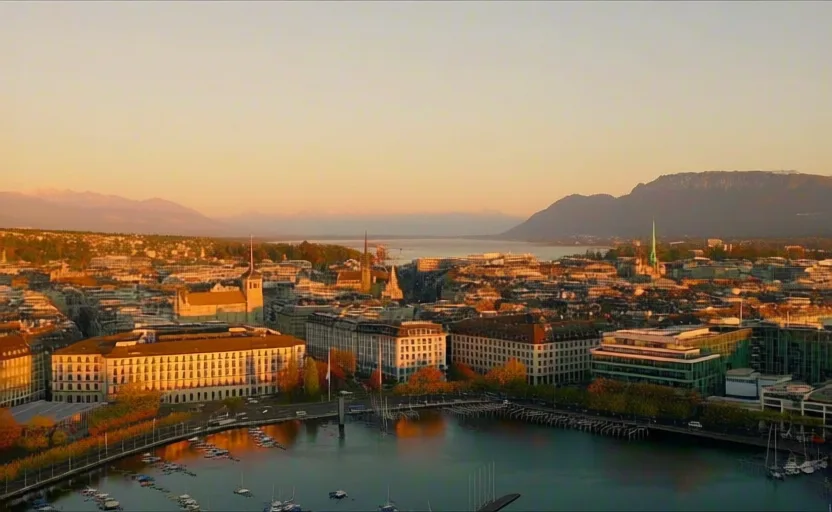 Geneva · AI city illustration · Artistic impression
City · Europe
Geneva
Saved in this browser — no account needed. Sign in later and it comes with you.
Where it is
The Rhône leaves Lake Geneva at its south-western end, and the city grew on that outflow. Three ridges of the Jura enclose the basin: the main range to the north-west, the Vuache to the south and the Salève to the south-east, with Mont Blanc visible on clear days. The canton is almost an enclave. Of its 107.5 kilometres of border, 103 are shared with France and only 4.5 touch the rest of Switzerland, and the city centre lies just 1.9 kilometres from the French frontier. The Arve joins the Rhône west of the centre. Winters are cool and the Bise, a north-easterly wind, can glaze the lakefront with ice.
The land and water around it
Lake Geneva and the Rhônelake
The part of the lake belonging to the canton is called the petit lac, the small lake, and covers about 38 square kilometres. The city sits where the river leaves it. In 563 a landslide near the Rhône's entry into the lake is thought to have launched a wave eight metres high that reached Geneva within 70 minutes.
Jura ridges and the Salèvemountains
The Salève, at 1,379 metres, closes the southern view from the centre but lies across the French border. Verbier and Crans-Montana, two well-known Alpine ski areas, can be reached in under three hours by car, and Mont Blanc stands above Chamonix.
The Pierres du Nitonrock
Two large boulders left in the lake after the last ice age. The larger one, at 373.6 metres, became the datum that General Guillaume Henri Dufour used for every survey made in Switzerland.
Its history, in short
Geneva was a border town before it was anything else. The Allobroges fortified it against the Helvetii, Rome took it in 121 BC, and in 58 BC Caesar broke the Rhône bridge and raised an earthwork to hold the Helvetii back. It gained a bishop in the 5th century and was governed by a count answering to the Holy Roman Emperor, then pulled between its bishop and the House of Savoy. In the early 16th century the city threw off Savoy and allied with the Swiss, and in 1541 John Calvin became its spiritual leader, which gave it the name of a Protestant Rome. The population roughly doubled between 1550 and 1560, from about 12,000 to over 25,000. Through the 17th and 18th centuries a narrow oligarchy kept power, which provoked riots and the failed revolution of 1782. France annexed the city in 1798, and it joined the Swiss Confederation on 19 May 1815. In 1907 church and state were separated. After 1919 it became a seat of international organisations, a role that grew after the Second World War.
Timeline
Dates are shown on a timeline rather than as changing shapes on the map. The globe draws modern boundaries only, and tinting a modern outline to stand for a historical one would state something we cannot source.
Classical world
121 BC
Rome takes a frontier town
The earliest record of Geneva shows a border settlement of the Allobroges, fortified to face the Helvetii. The Roman Republic takes it, and in 58 BC Caesar destroys the Rhône bridge and builds a long earthwork to block the Helvetii.
Well attestedWikipedia
Post-classical world
563
The Tauredunum wave
Chroniclers describe a tsunami sweeping along the lake and killing many people in Geneva. Modern simulations point to a large landslide near the Rhône delta as the cause.
Approximate dateWikipedia
Early modern & oceanic
1541
Calvin leads the Reformed city
John Calvin had come to Geneva in 1536 at William Farel's urging, after the Catholic bishop went into exile in 1532. From 1541 he is the city's spiritual leader, and it becomes known as the Protestant Rome.
Well attestedWikipedia11 December 1602
L'Escalade
Savoyard troops try to take the city by night, climbing the walls on black ladders. They are discovered and driven off.
Well attestedWikipedia1798
Annexed by France
After the 1782 revolution was put down with the help of French, Bernese and Savoyard forces, the Directory annexes Geneva. Independence returns with the defeat of Napoleon's armies.
Industrial & imperial
19 May 1815
Joins the Swiss Confederation
The Congress of Vienna enlarges the territory with Savoyard and French parishes and guarantees the city's neutrality. Geneva becomes a Swiss canton.
1919
Seat of the League of Nations
The city's international role is set after the First World War. After the Second World War the European headquarters of the United Nations and dozens of other organisations settle here.
Places that carry meaning
The old cityCeltic, Roman and medieval layers
The whole old city is on the Swiss inventory of heritage sites. Archaeological finds show a Celtic, Roman and medieval village sequence beneath it.
Cathédrale St-PierreOld city, nationally listed
The cathedral of the old city, one of 82 buildings and sites in Geneva listed as nationally significant.
Parc des Bastions and the Reformers' Wall16th century to present
A listed city park that holds the Mur des Réformateurs, a memorial to the Reformation, tying the green space to the city's Protestant identity.
Palais des Nations20th century
The former League of Nations complex, now United Nations premises, listed together with the library and archives of both organisations.
Languages here
Places are usually multilingual. This lists what is actually spoken, not one language per border.
FrenchRomance family
The official language of the city and canton.
In the 2000 census about 72.3 per cent of city residents gave French as their first language. The metropolitan area runs into the French departments of Ain and Haute-Savoie, so the same language is spoken on both sides of the border.
EnglishGermanic family
The working language of many international bodies and banks.
Common in daily life because of the many English-speaking residents who work for international institutions and in finance. About 48 per cent of the city's residents were foreign nationals in 2013.
Learn the language here
- 1Understand which languages are spoken hereGeneva is multilingual. Start with which languages are used, by whom, and for what — the phrase list only covers one of them.Written by Globe Quest
- 2Learn 11 phrasesCurated everyday phrases for Geneva, with audio and a written form.Written by Globe Quest
- 3Say them out loudSpeaking practice with pronunciation feedback, one phrase at a time.Globe Quest material, your own additions
- 4Come back to themSpaced review, so what you learned this week is still there next month.Written by Globe Quest
Check yourself
Which reformer became Geneva's spiritual leader in 1541?
John Calvin
Calvin arrived in 1536 and led the city from 1541, making it a Protestant stronghold nicknamed the Protestant Rome.
Why is the canton of Geneva almost an enclave?
103 of its 107.5 kilometres of border are with France
Only 4.5 kilometres of the canton's border touch the rest of Switzerland, which is why the urban area and the metropolitan region spill over into France.
Worth arguing about
- A city of about 200,000 hosts the largest concentration of international bodies in the world. What does hosting them ask of a small place?
- Geneva's metropolitan area is split between two countries. Which problems does a border solve there, and which does it create?
What we have not established
These are open questions, listed rather than filled in. We would rather show a gap than a plausible guess.
How many people live in the Geneva area?
The municipality had 203,856 residents in 2021 within 16 square kilometres, while the cross-border Grand Genève region had 1,046,168, of whom 41.7 per cent live in France. The answer depends entirely on whether the border is counted.
Sources
- Wikipedia · GenevaWikipedia · encyclopedia · checked 2026-11-24
- Wikipedia · History of GenevaWikipedia · encyclopedia · checked 2026-11-24
Reviewed by Globe Quest editorial on 2026-11-24. Drafted with AI assistance and checked against the sources above before publication.