 Globe Quest
 Human Quest · LearningSign in
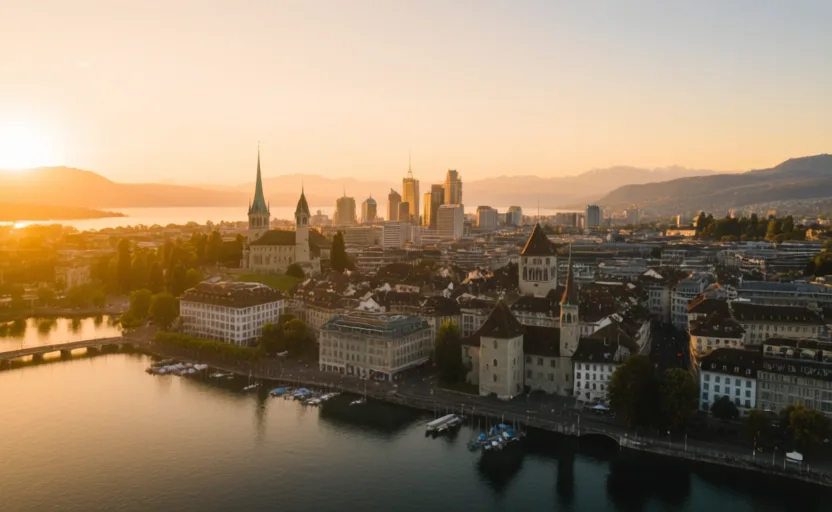 Lausanne · AI city illustration · Artistic impression
City · Europe
Lausanne
Saved in this browser — no account needed. Sign in later and it comes with you.
Where it is
Lausanne is built on a south-facing slope of the Swiss Plateau that falls about 500 metres from its northern edge down to the lakeshore at Ouchy. Across Lake Geneva lies the French town of Évian, and the Alps close the view to the south. A buried river, the Flon, runs through the middle in a gorge now crossed by bridges and covered by streets, so neighbouring districts can sit tens of metres above or below each other. The city sits on the boundary of two wine regions, Lavaux on one side and La Côte on the other. Precipitation averages about 1,153 millimetres a year, with May the wettest month.
The land and water around it
Lake Geneva (Le Léman)lake
The city's southern edge. Ouchy sits on the shore at the bottom of the slope, and the whole municipality tilts towards the water. Lausanne is 51.7 kilometres north-east of Geneva, the nearest large city.
The Flon gorgevalley
A former river that has been covered since the 19th century, leaving a deep gorge in the centre, below the old town. Bridges link the neighbourhoods on either side, and the name Flon is still used for a metro station in the depression.
Lavaux and La Côteslopes
Two wine-growing regions on either side of the city, one to the east and one to the west, facing the lake.
Its history, in short
Lausanne began down by the water. The Romans built a camp called Lousanna beside a Celtic settlement near Vidy and Ouchy, with a fort on the hill above. As order broke down in the later 4th century, residents moved up to that hill, which was easier to defend, and the town grew there. It belonged to the Kingdom of Upper Burgundy from 888 to 1032, and then was ruled by its bishop and the County of Savoy. The 12th and 13th centuries were its first great age, and the cathedral was consecrated in 1275 before Pope Gregory X and King Rudolf I of Germany. From the Reformation in the 16th century it was mostly Protestant. The 20th century brought a different role. The Treaty of Lausanne of 1923, which established the modern Turkish Republic, was signed here, and from the 1950s to the 1970s many Italians, Spaniards and Portuguese settled, mostly in the industrial suburb of Renens. International sport followed: the International Olympic Committee recognised Lausanne as the Olympic Capital in 1994.
Timeline
Dates are shown on a timeline rather than as changing shapes on the map. The globe draws modern boundaries only, and tinting a modern outline to stand for a historical one would state something we cannot source.
Classical world
Mid to late 4th century
The town moves uphill
Insecurity as the Western Roman Empire declines drives the residents of the lakeside camp to the hill, which is easier to defend. The medieval town grows around that site.
Approximate dateWikipedia
Post-classical world
888–1032
Part of Upper Burgundy
A small town in the kingdom of Upper Burgundy. In the 11th century it becomes a political, economic and religious centre, and the bishops exercise secular rule.
Well attestedWikipedia1275
The cathedral is consecrated
The consecration of Notre-Dame, the cathedral, takes place in front of Pope Gregory X and Rudolf I, king of Germany.
Well attestedWikipedia
Industrial & imperial
1923
Treaty of Lausanne
The city hosts the treaty that established the modern Turkish Republic, an early sign of its role as a neutral meeting ground.
Well attestedWikipedia
Contemporary
1950s–1970s
Labour migration from southern Europe
A large number of Italians, Spaniards and Portuguese arrive. Most settle in Renens, an industrial suburb, and over time they help shift the city's religious balance toward Catholicism.
Approximate dateWikipedia1994
The Olympic Capital
The International Olympic Committee recognises Lausanne as the Olympic Capital. It also houses the sport tribunal known as the Court of Arbitration for Sport and about 55 international federations.
Well attestedWikipediaJune 2022
Plateforme 10 opens
An art district opens with three museums, including the cantonal fine arts museum, the photography museum Photo Elysée and the design museum mudac.
Well attestedWikipedia
Places that carry meaning
Cathedral of Notre-Dame12th–13th century
The cathedral consecrated in 1275, restored later by Viollet-le-Duc. It is one of 46 buildings and sites of national significance in Lausanne.
Ouchy and VidyRoman to modern
The lakeside villages that held the Roman camp. Today they are part of the city's southern shore.
Plateforme 102022
A cluster of three museums built in the 21st century, a sign of the city's present identity as a centre of art and design as well as sport.
Languages here
Places are usually multilingual. This lists what is actually spoken, not one language per border.
FrenchRomance family
The local language and the daily language of the canton of Vaud.
In the 2000 census 78.8 per cent of residents gave French as their main language. The city is the largest in French-speaking Switzerland after Geneva.
German, Italian and Portuguese
The languages of the largest minority groups.
German was the second most common language in 2000 at 4.3 per cent, with Italian at 4.0 per cent. About 42 per cent of residents held foreign citizenship in 2013, after waves of migration from Italy, Spain and Portugal.
Learn the language here
- 1Understand which languages are spoken hereLausanne is multilingual. Start with which languages are used, by whom, and for what — the phrase list only covers one of them.Written by Globe Quest
- 2Learn 11 phrasesCurated everyday phrases for Lausanne, with audio and a written form.Written by Globe Quest
- 3Say them out loudSpeaking practice with pronunciation feedback, one phrase at a time.Globe Quest material, your own additions
- 4Come back to themSpaced review, so what you learned this week is still there next month.Written by Globe Quest
Check yourself
Why did Lausanne's residents move from the lakeshore to the hill in the later 4th century?
The hill was easier to defend as insecurity grew
As the Western Roman Empire declined, insecurity pushed people off the open lakeside to a hilly site, and the medieval city developed around it.
What did the International Olympic Committee do for Lausanne in 1994?
Recognised it as the Olympic Capital
Lausanne already hosted the committee, and by 1994 it had formally become the Olympic Capital, with dozens of sports federations nearby.
Worth arguing about
- A city of 150,000 with a metro and a federal court. What makes a place like this punch above its size?
- Lausanne moved from being mostly Protestant to Catholic plurality within a few decades. How does migration change what a city's old churches mean?
What we have not established
These are open questions, listed rather than filled in. We would rather show a gap than a plausible guess.
How many people live in Lausanne?
The municipality has about 150,000 residents, the agglomeration about 420,000, and the Lausanne–Geneva arc over 1.3 million. The counts rest on different boundaries and different years.
Sources
- Wikipedia · LausanneWikipedia · encyclopedia · checked 2026-11-24
Reviewed by Globe Quest editorial on 2026-11-24. Drafted with AI assistance and checked against the sources above before publication.