 Globe Quest
 Human Quest · LearningSign in
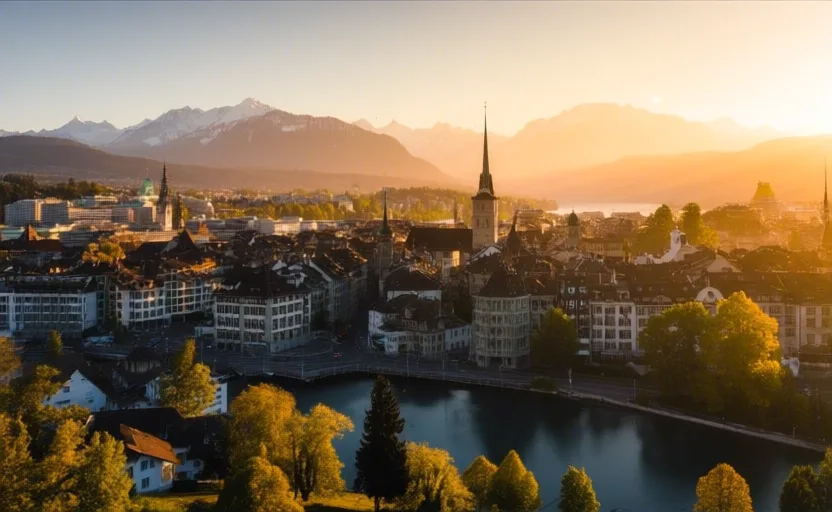 Bern · AI city illustration · Artistic impression
City · Europe
Bern
Saved in this browser — no account needed. Sign in later and it comes with you.
Where it is
A tight loop of the River Aare encircles a hilly peninsula on the Swiss Plateau, about 20 kilometres north of the Bernese Alps, and the medieval town was built on that neck of land. The glaciers of the last ice age shaped the surrounding countryside, and the nearest summits are the Gurten at 864 metres and the Bantiger at 947. The ground is uneven: up to 60 metres separate districts down by the river, such as Matte and Marzili, from higher ones like Kirchenfeld and Länggasse. By the 19th century the city had outgrown its bend and spread across the Aare by bridge. Winters bring more than 100 days of air frost, and the climate sits on the line between oceanic and humid continental.
The land and water around it
The Aare loopriver
The river curves round the old town on three sides, making a defensible peninsula. The settlement spread westward along it from the Nydegg castle, with towers marking successive gates, and bridges eventually let the city cross the water.
The Gurten and the Bantigerhills
The two nearest hills, at 864 and 947 metres, rise above a landscape of low glacial relief about 20 kilometres north of the Bernese Alps.
The Engehalbinselpeninsula
A second river peninsula north of the city, where a Celtic oppidum was fortified from the 2nd century BC, probably one of the twelve Helvetian strongholds Caesar mentions. A Gallo-Roman village followed and was abandoned between AD 165 and 211.
Its history, in short
Bern is a planned city. Before the 12th century the site seems to have been empty, though a Celtic oppidum and a Gallo-Roman village stood on the Engehalbinsel to the north. According to a chronicle of 1309, Berthold V, Duke of Zähringen, founded the town in 1191 on the Aare peninsula, where a castle at Nydegg guarded the river on the border between German-speaking Alemannians and French-speaking Burgundians. When Berthold died without an heir, the town became a free imperial city. It joined the Swiss Confederacy in 1353 and then expanded by conquest, taking Aargau in 1415 and Vaud in 1536 to become the largest city-state north of the Alps. A fire in 1405 turned a wooden town into one of half-timbered and then sandstone houses. French troops occupied it in 1798. When the Swiss federal state was created, Bern was chosen as the federal city on 28 November 1848, partly to avoid concentrating power in Zurich and partly because Catholic Lucerne had sided with the Sonderbund. It is the seat of government, not a constitutionally named capital.
Timeline
Dates are shown on a timeline rather than as changing shapes on the map. The globe draws modern boundaries only, and tinting a modern outline to stand for a historical one would state something we cannot source.
Classical world
2nd century BC
Celtic oppidum on the Engehalbinsel
A fortified Celtic settlement stands on the peninsula north of the later city. It is thought to be one of the twelve oppida of the Helvetii.
Post-classical world
1191
Berthold V founds Bern
A 14th-century chronicle gives 1191 as the year the Zähringen duke founded the city. Historians debate whether a settlement already stood near the castle and how far the first town extended.
1218
The Golden Charter
Tradition dates to 1218 the Golden Charter that makes Bern a free imperial city. Most scholars now think the document was a Bernese forgery of the mid-13th century, although King Rudolph I confirmed the traditional rights in 1274.
DisputedWikipediaTraditional Bernese chronicles hold to 1218 and Emperor Frederick II; most modern scholars see a mid-13th-century forgery.
1353
Joins the Swiss Confederacy
Bern becomes the eighth canton of the formative period. In the following two centuries it conquers territory across the plateau.
Well attestedWikipedia1405
The great fire
A blaze destroys the original wooden houses. The city is rebuilt in half-timbered and then sandstone buildings, which give the old town its look.
Well attestedWikipedia
Early modern & oceanic
1536
Vaud acquired
Bern conquers Vaud, after taking Aargau in 1415, and by the 18th century controls most of what is now the cantons of Bern and Vaud.
Well attestedWikipedia
Industrial & imperial
28 November 1848
Federal city
Deputies of the new Federal Assembly choose Bern as seat of government over Zurich and Lucerne. Its central location and support from French-speaking cantons helped.
Well attestedWikipedia
Contemporary
1983
World Heritage inscription
The old town is inscribed for its medieval urban plan, kept intact while the city modernised around it.
Places that carry meaning
The Old City of Berne12th century onward
Founded to a deliberate plan on a hill surrounded by the Aare, with wide market streets, narrow deep plots and arcades. Most of the buildings seen today date from the 18th century and are built of sandy limestone, with the public buildings placed at the edges.
Zytglogge and the western towers1191 to the 17th century
The Zytglogge was the city's western gate and limit from 1191 to 1256, after which the Käfigturm took over that role, followed by the Christoffelturm until 1622. Each tower records a step in the city's growth across the peninsula.
The bear pitsSince the 1440s
The bear is the city's heraldic animal, on its seal from at least the 1220s, and live bears have been kept at the Bärengraben since the 1440s. The name Bern may have a Celtic origin meaning cleft rather than a bear, though local legend has Berthold vowing to name the city for whatever animal he met first while hunting.
Languages here
Places are usually multilingual. This lists what is actually spoken, not one language per border.
GermanGermanic family
The main language, in its Swiss German form.
In the 2000 census 81.2 per cent of residents spoke German as their first language. Romansh speakers numbered 171.
Italian and FrenchRomance family
The next most common first languages.
Italian was the first language of 3.9 per cent and French of 3.6 per cent. About a third of residents are foreign nationals, and in the 18th century French was fashionable in Bern.
Learn the language here
- 1Understand which languages are spoken hereBern is multilingual. Start with which languages are used, by whom, and for what — the phrase list only covers one of them.Written by Globe Quest
- 2Learn 12 phrasesCurated everyday phrases for Bern, with audio and a written form.Written by Globe Quest
- 3Say them out loudSpeaking practice with pronunciation feedback, one phrase at a time.Globe Quest material, your own additions
- 4Come back to themSpaced review, so what you learned this week is still there next month.Written by Globe Quest
Check yourself
What is Bern's constitutional status?
It is the seat of government, called the federal city
The constitution does not define Bern as capital. It is the federal city, chosen in 1848 as seat of government, with Zurich and Lucerne passed over.
What made the Bern site easy to defend?
A hilly peninsula enclosed by the Aare
The old town stands on a hill in a loop of the river, with a castle at the narrow eastern end, so the settlement spread westward along the neck.
Worth arguing about
- Switzerland chose a mid-sized city as its seat of government so that power would not concentrate in its economic hub. Is that a good design for a federation?
- Bern's founding date rests on a chronicle written more than a century later, and its charter may be a forgery. How much does a city's founding story matter?
What we have not established
These are open questions, listed rather than filled in. We would rather show a gap than a plausible guess.
How did Bern get its name?
Folk tradition says the founder named the city after a bear, an older theory points to Verona, which was called Bern in Middle High German, and a zinc tablet found in the 1980s now suggests a pre-existing Celtic place name. None of these has been settled.
Sources
- Wikipedia · BernWikipedia · encyclopedia · checked 2026-11-24
- Wikipedia · History of BernWikipedia · encyclopedia · checked 2026-11-24
- UNESCO · Old City of BerneUNESCO World Heritage Centre · intergovernmental · checked 2026-11-24
- Wikipedia · SwitzerlandWikipedia · encyclopedia · checked 2026-11-24
Reviewed by Globe Quest editorial on 2026-11-24. Drafted with AI assistance and checked against the sources above before publication.