 Globe Quest
 Human Quest · LearningSign in
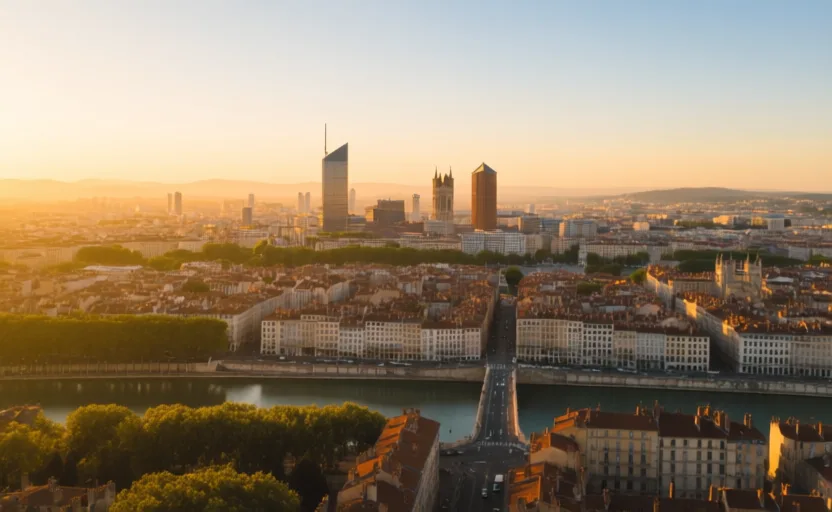 Lyon · AI city illustration · Artistic impression
City · Europe
Lyon
Saved in this browser — no account needed. Sign in later and it comes with you.
Where it is
Two rivers meet at Lyon and the city is built around the meeting. The Saône comes from the north and the Rhône from the Alps, and just south of the old centre they converge, enclosing a long peninsula, the Presqu’île. Two hills bound it: Fourvière to the west, which locals call the hill that prays, and the Croix-Rousse to the north, the hill that works. Across the Rhône to the east a broad flat plain holds most of the modern population. The climate is humid subtropical, with about 820 millimetres of rain a year, with the winter months the driest. The city lies 391 kilometres south-east of Paris, 278 north of Marseille and 113 south-west of Geneva.
The land and water around it
The confluence of the Rhône and Saôneriver
The two rivers meet south of the old centre, creating the Presqu’île, a peninsula that holds Place Bellecour, the third-largest public square in France. The site gave Lugdunum its commercial and strategic advantage.
Fourvière and the Croix-Roussemountains
The western hill carries the Roman city and the basilica; the northern slopes were the silk district. Narrow covered passages called traboules cut through buildings on both hills and join streets on different levels.
The eastern plainplain
East of the Rhône, a large flat area holds most of the modern city, the business district of La Part-Dieu and the main railway station, as well as the large Parc de la Tête d’Or.
Its history, in short
Rome founded a colony here in 43 BCE on the Fourvière hill, and recognised what the river junction offered: a communications hub where two navigable rivers met. Lugdunum became the starting point of the main roads of Gaul, the capital of the province of Gallia Lugdunensis and, in the words of the later title, the capital of the Gauls. It reached a population of nearly 70,000, and perhaps a quarter of its residents had Greek names. Early Christians were martyred here under several emperors, and the archbishop of Lyon still bears the title of Primate of the Gauls. After a stretch under Burgundian, Frankish and imperial rule, Lyon joined the Kingdom of France only in 1312. Italian merchants’ fairs made it the financial counting house of France in the late 15th century, and silk, then printing, drove its Renaissance wealth. Its silk workers, the canuts, rose in 1831 and 1834 for better pay. In 1793 the city, which had backed the Girondins against the Convention, was besieged for more than two months and punished. In 1895 the Lumière brothers invented the cinematograph here, and in the Second World War the city’s hidden passages helped the Resistance.
Timeline
Dates are shown on a timeline rather than as changing shapes on the map. The globe draws modern boundaries only, and tinting a modern outline to stand for a historical one would state something we cannot source.
Classical world
43 BCE
Lugdunum founded
The Senate orders a settlement for Roman refugees at the junction of the rivers. The date and founder are debated by historians, but the colony soon becomes the capital of its province.
Ancient accounts, notably Dio Cassius, give 43 BCE; some modern historians doubt the exact date of the founding.
19 CE
Amphitheatre of the Three Gauls
The amphitheatre is inaugurated and later enlarged around 130 CE. The theatre on Fourvière, opened between 16 and 14 BCE, is later enlarged under Hadrian to about 10,700 seats.
Well attestedWikipedia461–534
Burgundian kingdom
Lugdunum is the centre of the Kingdom of the Burgundians until the Franks conquer it in 534.
Well attestedWikipedia
Post-classical world
1312
Part of the Kingdom of France
After belonging to Middle Francia, the Kingdom of Arles and the Holy Roman Empire, Lyon is finally incorporated into France.
Well attestedWikipedia
Early modern & oceanic
late 15th century
The fairs
Fairs introduced by Italian merchants make Lyon the economic counting house of France, and silk strengthens its ties with Italy.
Approximate dateWikipedia1793
Siege and reprisals
The city rises against the National Convention and is besieged for over two months. After its surrender many buildings are destroyed and more than 2,000 people are executed.
Well attestedWikipedia
Places that carry meaning
FourvièreRoman to present
The summit was the forum and the heart of the Roman city. The slopes below it carry the ancient theatre, and the hill is crowned by the basilica of Notre-Dame de Fourvière.
Vieux LyonRenaissance
The Renaissance district, whose houses include examples of the shift from Gothic to French Renaissance style, and whose passages link streets through the buildings.
Croix-Rousse slopes19th century
The canuts lived and worked here in tenements built in the first half of the 19th century, such as the House of 365 Windows. UNESCO values it as evidence of the labouring classes’ history.
Languages here
Places are usually multilingual. This lists what is actually spoken, not one language per border.
FrenchRomance family
The everyday and official language.
French replaced the old local dialect as Lyon grew in importance. About 14 per cent of the population was born outside France in 2011.
Franco-ProvençalRomance family
The historic regional language of Lyon, now surviving mainly in words.
Residents of the region spoke dialects of Franco-Provençal from the Middle Ages, and Lyon’s own name for itself is Liyon. A few words of it still colour local French, such as gone for a little boy and fenotte for a little girl.
Learn the language here
- 1Understand which languages are spoken hereLyon is multilingual. Start with which languages are used, by whom, and for what — the phrase list only covers one of them.Written by Globe Quest
- 2Learn 11 phrasesCurated everyday phrases for Lyon, with audio and a written form.Written by Globe Quest
- 3Say them out loudSpeaking practice with pronunciation feedback, one phrase at a time.Globe Quest material, your own additions
- 4Come back to themSpaced review, so what you learned this week is still there next month.Written by Globe Quest
Check yourself
Which hill is known as the hill that works?
The Croix-Rousse
The Croix-Rousse, north of the Presqu’île, was home to small silk workshops, while Fourvière, the hill that prays, holds the basilica and convents.
Why was Lugdunum a natural capital of Roman Gaul?
It sat at the junction of two navigable rivers, a hub for roads and communication
The Romans recognised the confluence of the Rhône and Saône as a natural communications hub, and the main roads of the area started from the city.
Worth arguing about
- Lyon was Roman capital of Gaul and then a financial centre, yet it is often described as the quiet second city. What makes a city second?
- The traboules helped the Resistance hide in the Second World War, after serving silk workers for centuries. What else can a city’s hidden infrastructure do?
What we have not established
These are open questions, listed rather than filled in. We would rather show a gap than a plausible guess.
How many people live in Lyon?
The commune has about 519,000 residents, the Metropolis of Lyon about 1.44 million and the wider metropolitan area about 2.34 million in 2023. Which figure applies depends on the boundary used.
Sources
- Wikipedia · LyonWikipedia · encyclopedia · checked 2026-11-24
- Wikipedia · History of LyonWikipedia · encyclopedia · checked 2026-11-24
- UNESCO · Historic Site of LyonUNESCO World Heritage Centre · intergovernmental · checked 2026-11-24
Reviewed by Globe Quest editorial on 2026-11-24. Drafted with AI assistance and checked against the sources above before publication.